

Blast Away the Grime with the Best Way to Power Wash Your Driveway
Blast Away the Grime with the Best Way to Power Wash Your Driveway
Your Driveway Is Losing You Money Every Day It Stays Dirty
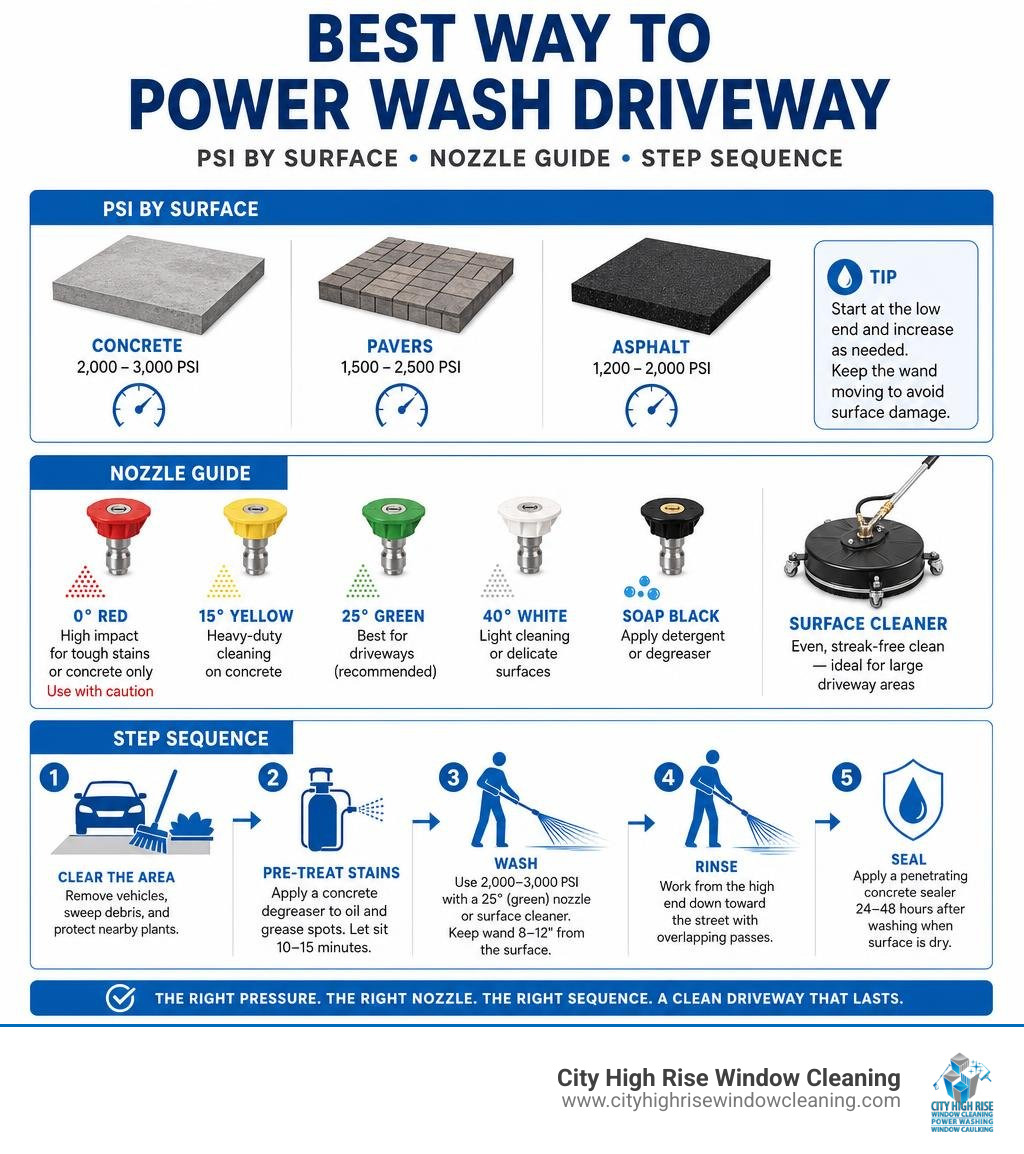
The best way to power wash a driveway is faster and simpler than most homeowners expect — here’s the quick version:
- Clear the area — remove vehicles, sweep loose debris, protect nearby plants
- Pre-treat stains — apply a concrete degreaser to oil and grease spots; let it sit 10–15 minutes
- Wash — use 2,000–3,000 PSI with a 25-degree (green) nozzle or a surface cleaner attachment, holding the wand 8–12 inches from the surface
- Rinse — work from the high end of the driveway down toward the street with overlapping passes
- Seal — apply a penetrating concrete sealer 24–48 hours after washing when the surface is completely dry
Your driveway takes a beating every day. Cars roll over it. Rain soaks in. Oil drips. Algae quietly takes hold in shaded corners. Over time, that grime doesn’t just look bad — it weakens the surface, creates slippery hazards, and chips away at your property’s curb appeal and value.
The good news? A proper power wash can make a concrete driveway look close to freshly poured — often in under two hours. But the difference between a clean result and permanent etching comes down to using the right pressure, the right nozzle, and the right sequence. Get it wrong, and you can strip the protective cream layer off concrete that costs thousands to resurface.
This guide walks you through everything: gear selection, step-by-step technique, stain removal, and when it makes more sense to call in the professionals.
I’m Brett Hochman, CEO of City High Rise Window Cleaning, with over 48 years of hands-on exterior building maintenance experience across New York City, Long Island, New Jersey, and Westchester — including high-pressure and high-rise hot water power washing on some of the region’s most demanding surfaces. When clients ask me about the best way to power wash a driveway, the answer always starts the same way: match your equipment to your surface, and never skip the prep.
Best way to power wash driveway vocabulary:
Choosing Your Gear: PSI, GPM, and the Best Way to Power Wash Driveway Surfaces
To get professional-grade results without destroying your property, you must understand the relationship between water pressure (PSI) and water volume (GPM).
- PSI (Pounds per Square Inch) measures the stripping force of the water. This is what breaks the bond between the dirt and your driveway.
- GPM (Gallons per Minute) measures the volume of water flowing through the machine. GPM is what actually sweeps the dirt away. The higher the GPM, the faster you will finish the job.
When you multiply PSI by GPM, you get Cleaning Units (CU). For example, a pressure washer delivering 3,000 PSI at 4 GPM produces 12,000 CU. This is a highly reliable metric for evaluating true cleaning power. If you want to dive deeper into selecting commercial-grade machinery, read my breakdown in Choosing Your Beast: A Guide to Commercial Power Washing Gear.
The best way to power wash a driveway safely is to match the pressure setting directly to your specific driveway material:
- Poured Concrete: 2,500 to 3,000 PSI is the sweet spot. While commercial concrete can sometimes handle up to 3,500 PSI, going higher increases the risk of surface etching.
- Asphalt: 1,000 to 1,500 PSI. Asphalt is a softer, petroleum-based material. High pressure will strip the binders and cause the aggregate to unravel.
- Pavers or Brick: 1,500 to 2,000 PSI. Excessive pressure will wash out the polymeric sand in the joints and can shift the pavers.
- Stamped Concrete: 2,000 to 3,000 PSI at a wider angle to protect the stamped texture and surface sealants.
Electric vs. Gas Pressure Washers
For residential driveway washing, you will typically choose between an electric or gas-powered machine. Here is how they stack up:
| Feature | Electric Pressure Washers | Gas Pressure Washers |
|---|---|---|
| Typical PSI Range | 1,500 – 2,300 PSI | 2,500 – 4,000+ PSI |
| Typical GPM Range | 1.2 – 1.8 GPM | 2.5 – 4.0 GPM |
| Best Suited For | Light cleaning, small patios, driveways under 600 sq. ft. | Heavy grease, deep stains, large multi-car driveways |
| Water Efficiency | High (uses ~1.5 GPM) | Moderate (uses 2.5 – 4.0 GPM) |
| Service Life | 5 – 10 years (pump seals and motor brushes wear out) | 10 – 15+ years (requires engine maintenance) |
| Portability | Lightweight, quiet, needs an extension cord | Heavy, loud, requires gasoline and oil |
(Note: While electric models are highly convenient, a 600-square-foot driveway cleaned efficiently with a gas unit requires roughly 75–150 gallons of water total. Because pressure washers restrict water flow to 2–5 gallons per minute versus the 8–10 gallons per minute of an unrestricted garden hose, you actually reduce water use by roughly 50–75% for the same cleaning coverage!)
Nozzles and Surface Cleaners: The Best Way to Power Wash Driveway Concrete Evenly
Using the wrong nozzle is the easiest way to ruin your driveway. Pressure washer nozzles are color-coded to indicate their spray angle:
- Red (0-Degree): A concentrated, pencil-point jet. Never use this on a driveway. It acts like a laser and will instantly slice permanent gouges into your concrete.
- Yellow (15-Degree): A narrow, high-stripping spray. Excellent for spot-cleaning concrete rust or heavy mud, but too narrow for washing an entire driveway.
- Green (25-Degree): The absolute workhorse for driveways. It offers the perfect balance of stripping power and width.
- White (40-Degree): A wide, gentle spray. Ideal for rinsing away detergent or washing delicate materials like asphalt and pavers.
- Black (65-Degree): Low-pressure soap nozzle. Used exclusively to siphon and apply detergents.
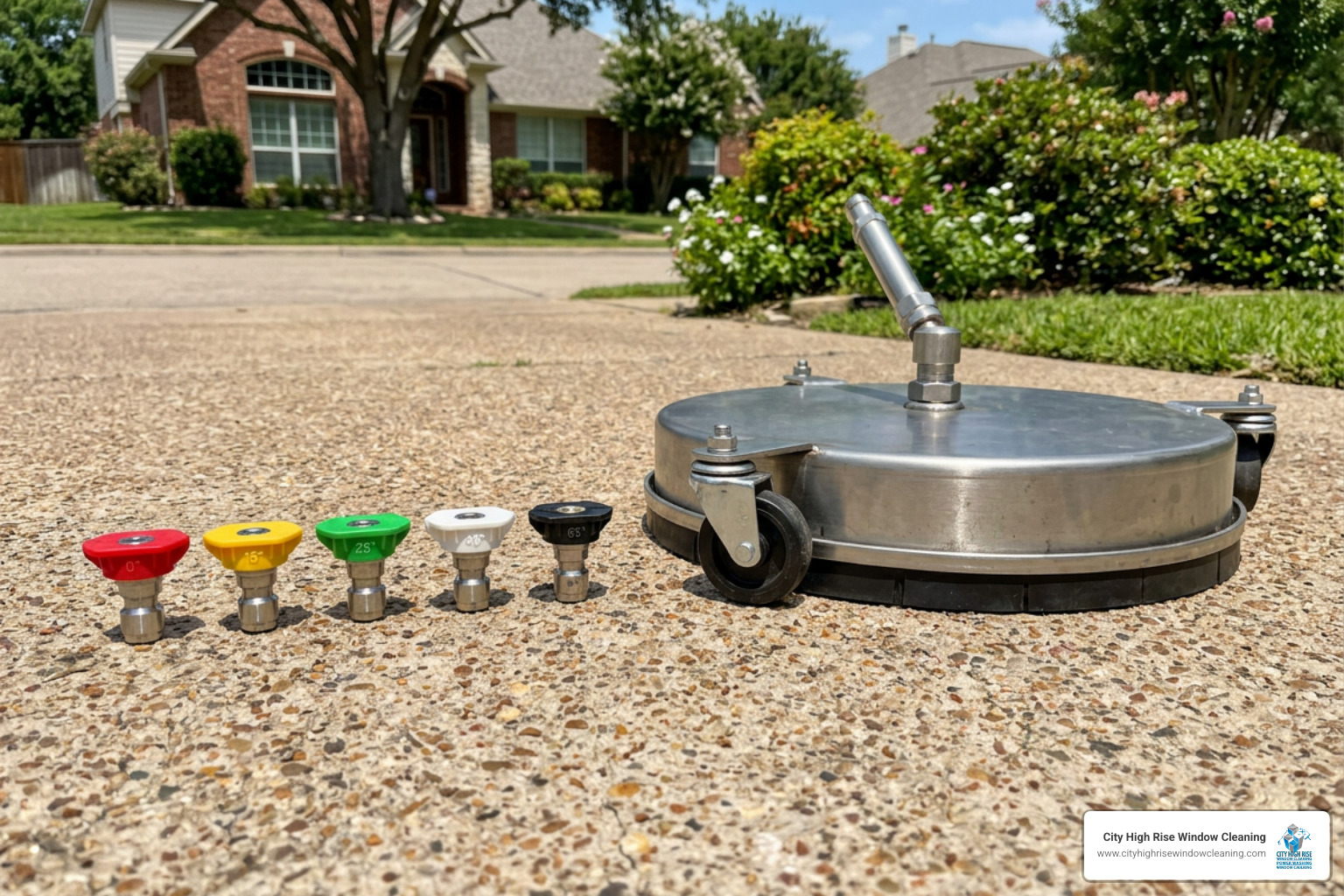
If you are still using a standard spray wand for the entire job, you are working too hard. The best way to power wash a driveway evenly is to use a surface cleaner attachment.
A surface cleaner features two or three counter-rotating nozzles housed inside a circular dome. It glides flat along the concrete, maintaining a perfectly consistent distance from the surface.
According to industry data, a surface cleaner attachment reduces cleaning time by 40–60% on flat concrete surfaces compared to a single wand nozzle. More importantly, it completely eliminates “zebra stripes” — those uneven, wavy lines left behind by hand-held wands. For a deeper look at proper equipment assembly, check out How to Use a Pressure Washer to Clean Your Driveway — Linea .
Step-by-Step Guide to Driveway Pressure Washing
Now that you have your gear, let’s look at the exact sequence for a spotless finish. For a detailed overview of the basic process, you can also reference Pressure Washing a Driveway: Step-by-Step Guide or Driveway Pressure Washing: A Complete DIY Guide .

Step 1: Preparation
Clear all vehicles, toys, and planters from the area. Use a stiff-bristle push broom to sweep away loose dirt, leaves, and twigs. If you skip this, the high pressure will blast this debris into your lawn, siding, or garage door.
Cover nearby delicate plants and garden beds with plastic sheeting, or thoroughly pre-wet them with a garden hose so they do not absorb any cleaning chemical overspray.
Step 2: Pre-Treatment
Apply your specialized cleaners to target stains (see the detailed stain removal steps below). Once spot-treating is complete, apply a general concrete cleaner or diluted house wash over the entire surface using your black low-pressure soap nozzle.
Step 3: Washing
Attach your surface cleaner or a green 25-degree nozzle. Start at the highest point of the driveway (usually near the garage) and work your way down to the street.
Step 4: Rinsing
Switch to your white 40-degree nozzle or a clean rinse setting. Sweep the loosened grime down the slope of your driveway. Make sure to rinse the entire surface thoroughly before the dirty water dries, which can leave unsightly water spots.
Step 5: Sealing
Wait 24 to 48 hours for the concrete to dry completely. Apply a high-quality penetrating sealer to protect your clean surface from future stains.
Pre-Treating Stains: The Best Way to Power Wash Driveway Oil and Grease
Pressure washing with cold water alone will not remove deep, petroleum-based oil stains. Because concrete is highly porous, oil sinks deep into the material.
To draw it out, apply a concentrated, alkaline concrete degreaser directly to the dry stain. Use a stiff scrub brush to work it into the pores, then allow a dwell time of 10 to 15 minutes. Do not let the degreaser dry on the concrete; mist it lightly with water if it begins to evaporate.
For organic growth, like the dark green or black algae common in shaded, humid parts of Long Island, Westchester, and New Jersey, pre-treat the area with a 1% to 3% sodium hypochlorite (diluted bleach) solution. Let it sit for 10 minutes to kill the spores at the root before washing. You can find more targeted solutions for organic growth in our guide on Algae Removal Power Washing.
Washing and Rinsing Techniques
If you are using a standard wand instead of a surface cleaner, master the “sweeping” motion. Hold the nozzle 8 to 12 inches from the concrete. Keep your wrist steady and work in overlapping, side-to-side sweeping passes of about 3 to 4 feet in width. Overlap each pass by roughly 2 inches to ensure uniform cleaning.
Never stop moving the wand while the trigger is engaged; lingering in one spot for even a second can etch a permanent line into the concrete.
Additionally, pay attention to runoff management. Under EPA National Pollutant Discharge Elimination System (NPDES) rules, you cannot legally wash heavy oils, degreasers, or toxic chemicals directly into storm drains. If you are using strong chemicals, use absorbent barriers or direct your rinse water onto your lawn, where the soil can naturally filter the runoff. For more information on proper residential washing practices, read How to Pressure Wash Your Driveway – The Home Depot .
Common Mistakes That Can Destroy Your Concrete
While power washing is incredibly satisfying, it is easy to make mistakes that cause permanent damage. Here are the four most common blunders I see across the tri-state area:
- Etching the Surface: When you hold a high-pressure nozzle too close to concrete, you slice through the top layer. This leaves permanent, bright white scars that collect dirt even faster in the future.
- Removing the Cream Layer: Fresh concrete (under 1–2 years old) has a smooth, protective “cream” layer on top. High pressure will strip this away, exposing the rough aggregate underneath and structurally weakening the slab.
- Using a Zero-Degree (Red) Nozzle: This nozzle should never touch residential concrete. It is designed for industrial steel or iron cleaning. On concrete, it acts like a chisel.
- Destroying Asphalt: Asphalt is held together by oily binders. Blasting it with high pressure or hot water will strip those binders, leaving you with loose gravel and a crumbling driveway.
DIY vs. Professional Power Washing: When to Call the Experts
Many homeowners look at a dirty driveway and think, “I can easily rent a machine and do this myself over the weekend.” While that is true for minor dirt, it is important to weigh the real costs and limitations of DIY.
Renting a professional-grade gas pressure washer typically costs $50 to $100 per day, plus the cost of fuel, safety gear, and specialized detergents. If you use a standard consumer electric washer, the job can easily take 4 to 6 hours due to the low GPM flow.
Furthermore, cold-water DIY machines cannot melt away deep oil or grease. For that, you need a commercial hot-water pressure washer that heats water above 180°F to saponify the grease.
If you want to save your weekend and protect your property, hiring a professional concrete cleaning service is highly beneficial. For local resources, take a look at our Local Concrete Cleaning: Your Guide to Nearby Power Washing Pros.
- Commercial-Grade Hot Water: Professional truck-mounted systems heat water up to 200°F, melting oil and grease stains that cold water can’t budge.
- Time Savings: A professional team can prep, wash, rinse, and treat a standard two-car driveway in under an hour.
- No Damage Risks: Experienced technicians know exactly how to adjust pressure, nozzles, and chemical mixtures for different materials, protecting your concrete and landscaping.
- Environmental Compliance: Professionals use professional recovery systems to capture and responsibly dispose of chemical runoff in compliance with local regulations.
Frequently Asked Questions About Driveway Cleaning
How often should a concrete driveway be pressure washed?
For most homes in New York, New Jersey, and Westchester, washing your driveway once per year is ideal. I highly recommend scheduling this in the spring to wash away the harsh road salt, sand, and winter grime, or in the early fall before temperatures drop and freeze-thaw cycles begin.
Can pressure washing damage a concrete driveway?
Yes. If you use excessive pressure (above 3,000 PSI), hold the wand closer than 8 inches, or use a 0-degree nozzle, you will etch the concrete and strip its protective surface layer. Always test your pressure in an inconspicuous corner first.
Is sealing a driveway necessary after power washing?
While not strictly required, sealing is highly recommended. Power washing opens up the pores of the concrete. Applying a penetrating silane/siloxane sealer 24–48 hours after washing creates a moisture and oil-resistant barrier that prevents future staining and extends the lifespan of your concrete by 3 to 5 years.
Conclusion
The best way to power wash a driveway is a systematic process that combines the correct pressure, smart pre-treatments, and even washing techniques. While a DIY approach is entirely possible with the right equipment and plenty of patience, the risks of surface etching, plant damage, and underwhelming results are real.
At City High Rise Window Cleaning, we bring over 30 years of exterior restoration experience to homes and businesses across New York City, Long Island, New Jersey, and Westchester. We back all of our work with a 100% customer satisfaction guarantee and a strict commitment to safety and environmental compliance. Whether you have a stained concrete driveway, delicate pavers, or require specialized commercial building maintenance, we have the hot-water systems and expertise to get the job done right.


