

Choosing Your Beast: A Guide to Commercial Power Washing Gear
Choosing Your Beast: A Guide to Commercial Power Washing Gear
Why Commercial Power Washing Is the Smartest Maintenance Investment for Your Building
Commercial power washing is the use of high-pressure, often heated water systems to clean large-scale surfaces — building facades, parking lots, storefronts, and more — using equipment far more powerful than anything found at a hardware store.
If you’re looking for a quick answer, here’s what you need to know:
| What You Need | Best Solution |
|---|---|
| Remove grease, oil, or gum | Hot water commercial power washer (200°F+) |
| Clean large concrete surfaces | Gas-powered unit, 4,000+ PSI, 5–8 GPM |
| Wash delicate facades (stucco, EIFS) | Soft-wash system, under 100 PSI |
| Indoor or enclosed spaces | Electric commercial pressure washer |
| High-rise or multi-story buildings | Trailer-mounted hot water system + certified crew |
For property owners and managers in New York, New Jersey, Long Island, and Westchester, a dirty building exterior isn’t just an eyesore — it’s a liability. Algae, mold, grime, and carbon buildup eat away at facade materials over time, and the longer you wait, the more expensive the fix. One real-world example drives this home: an office complex lost three potential tenants in a single month because of an algae-covered exterior. The cost of regular cleaning is always less than the cost of replacement or lost revenue.
I’m Brett Hochman, CEO of City High Rise Window Cleaning, and with nearly five decades of hands-on experience in commercial power washing and exterior building maintenance across the NYC metro area, I’ve seen what the right equipment — and the right team — can do for a building’s longevity and curb appeal. In this guide, I’ll break down exactly which gear delivers results for which jobs, so you can make a confident, informed decision.
Quick commercial power washing definitions:
- average price per square foot pressure washing
- concrete pressure washing near me
- industrial pressure washing services
Commercial Power Washing vs. Residential Pressure Washing: Key Differences
To the untrained eye, water spraying out of a nozzle looks the same whether it’s cleaning a suburban driveway or a 40-story Manhattan skyscraper. But in the professional world, comparing residential pressure washers to commercial-grade beasts is like comparing a golf cart to a diesel semi-truck.
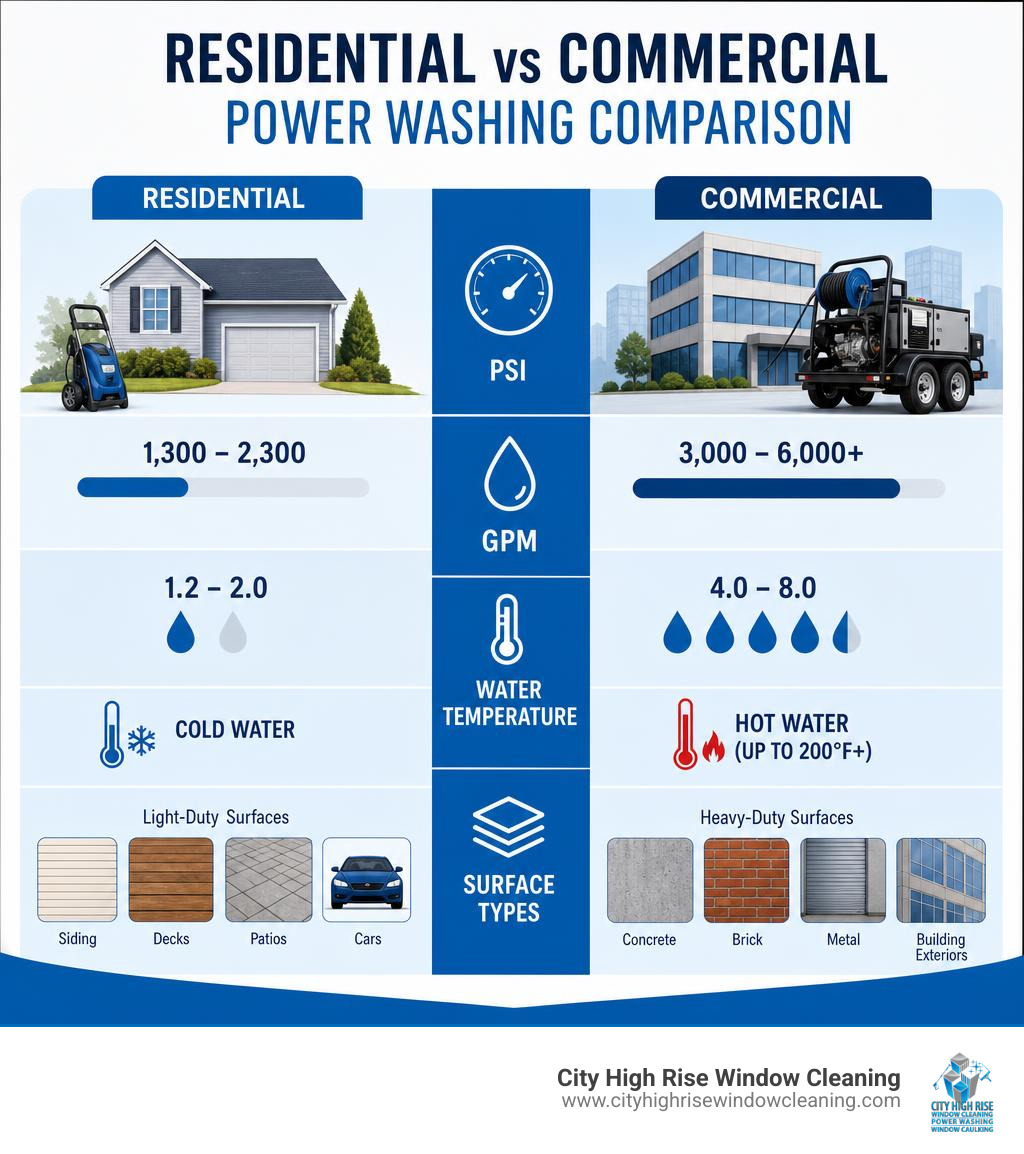
The core difference boils down to two critical metrics: PSI (Pounds per Square Inch) and GPM (Gallons per Minute). While residential units focus heavily on high PSI to blast away dirt on small surfaces, commercial cleaning relies on high GPM (water volume) to sweep away heavy grime quickly across massive square footages.
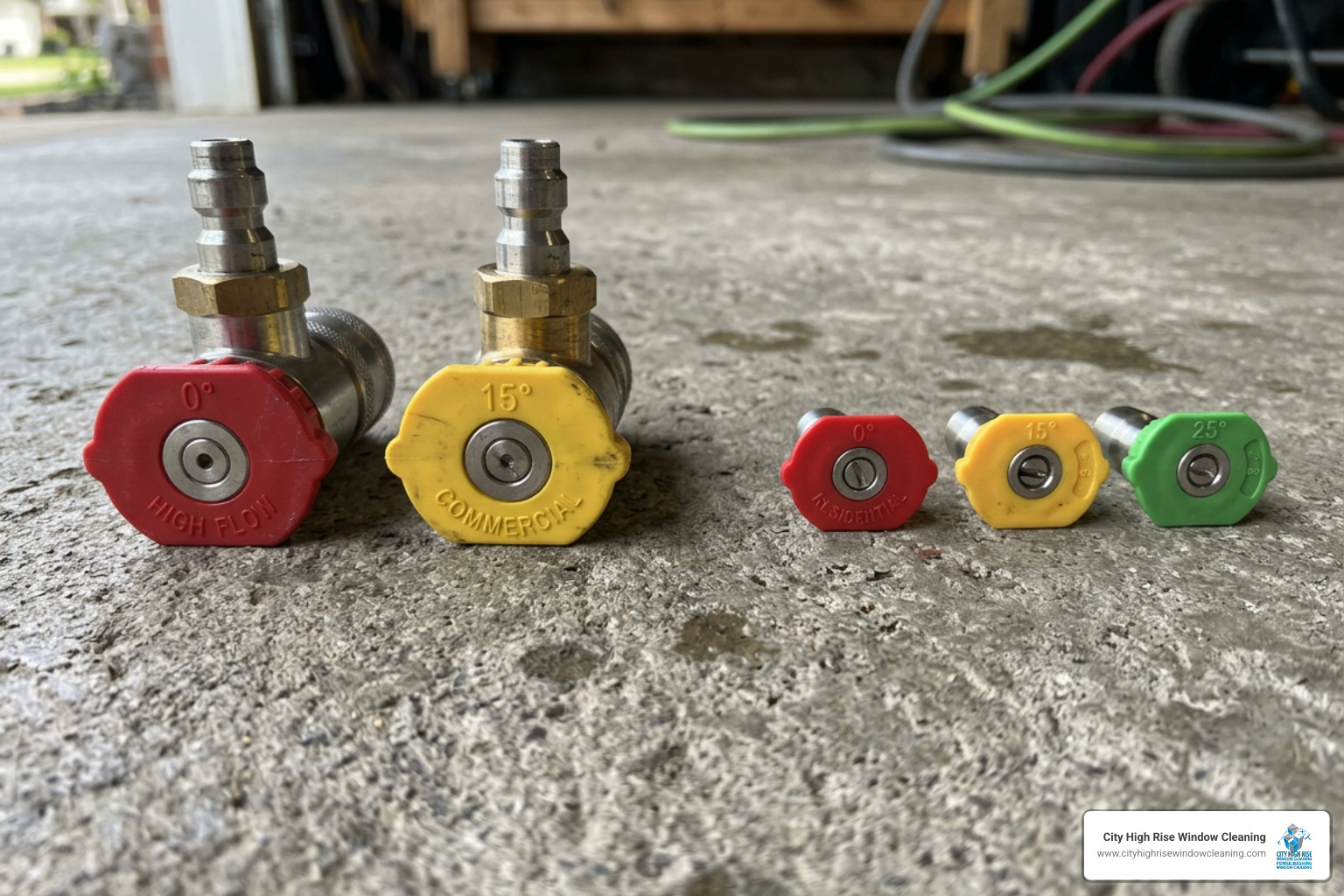
Residential machines usually run on direct-drive pumps, which spin at high RPMs and wear out after a few hundred hours of use. Commercial systems leverage belt-drive triplex pumps that run cooler, last thousands of hours, and can handle continuous daily operation. Furthermore, true commercial power washing relies on hot water capability—heating water up to 200°F—to melt grease, oil, and chewing gum, whereas residential washers are strictly cold-water units.
| Feature / Spec | Residential Pressure Washers | Commercial Power Washers |
|---|---|---|
| PSI Range | 1,500 to 3,000 PSI | 3,000 to 4,000+ PSI |
| GPM (Flow Rate) | 1.2 to 2.5 GPM | 4.0 to 12.0+ GPM |
| Pump Type | Axial / Direct-Drive | Triplex / Belt-Drive |
| Water Temp | Cold Water Only | Hot & Cold (Up to 200°F+ Steam) |
| Power Source | Electric (120V) or Small Gas Engine | Heavy-duty Gas/Diesel or 460V Electric |
| Duty Cycle | 1–2 hours per week | 8+ hours daily (Continuous) |
Using a residential machine on a commercial property is a recipe for broken equipment, striped concrete, and wasted days. If you want to dive deeper into heavy-duty setups, you can learn about industrial pressure washing services and why they require specialized engineering.
Choosing Your Beast: Commercial Power Washing Equipment Specifications
When you are looking to purchase or hire for a commercial power washing job in 2026, you need to understand the anatomy of these machines. The engine, the pump, and the drive system dictate how fast a crew can clean and how long the machine will survive the harsh winters and humid summers of the tri-state area.
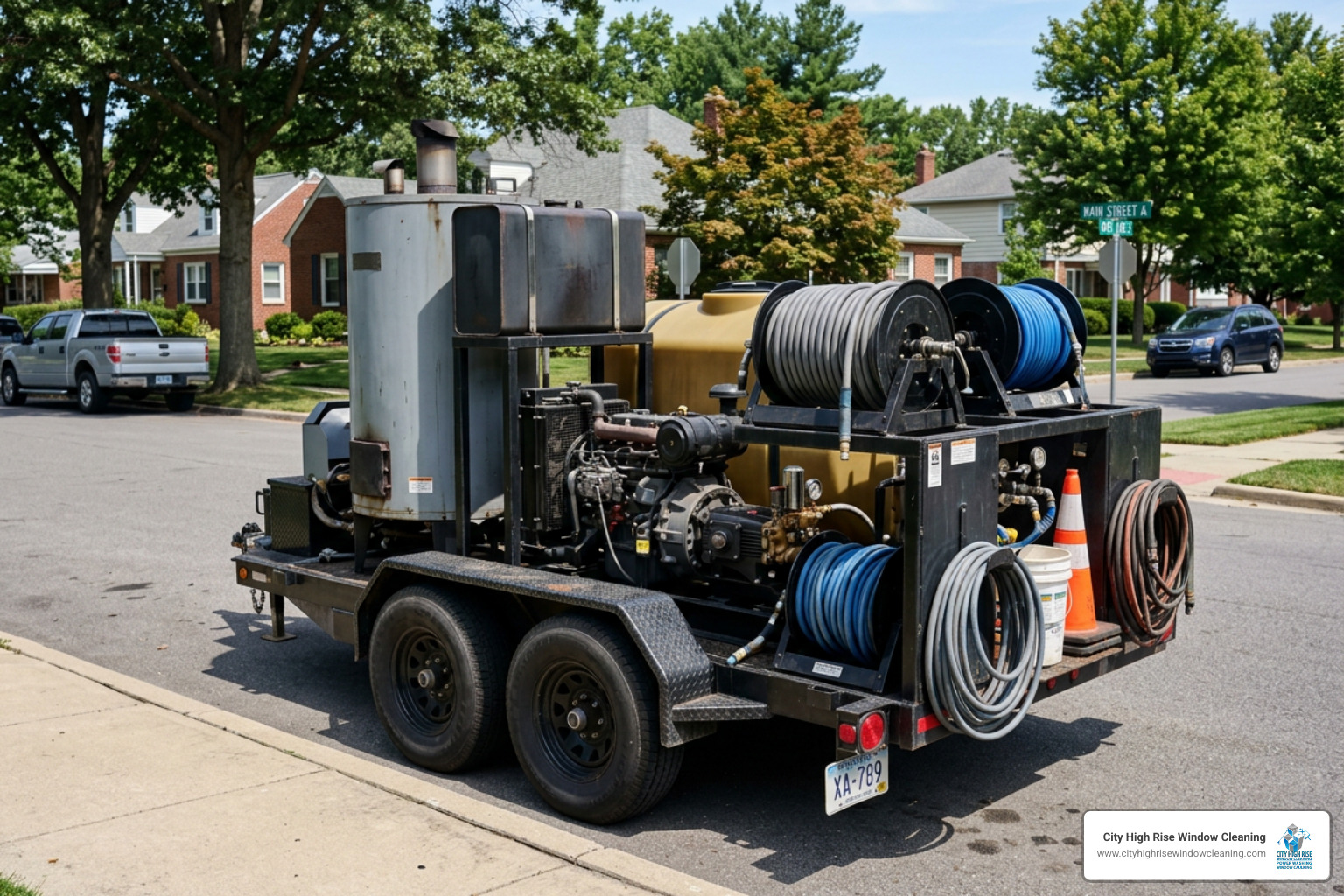
At the heart of any professional machine is the triplex pump. Unlike cheap axial pumps, triplex plunger pumps use three ceramic pistons to deliver smooth, consistent high-pressure flow.
You must also choose between direct-drive and belt-drive pumps:
- Direct-Drive Pumps: The pump is coupled directly to the engine shaft. These units are more compact and affordable, but they spin at high RPMs (typically 3,400 RPM), transferring heat and vibration from the engine. This limits their lifespan.
- Belt-Drive Pumps: A pulley system connects the engine to the pump, allowing the pump to spin at a much lower, cooler speed (around 1,400 to 1,700 RPM). The belt also acts as a shock absorber. For heavy-duty daily use, belt-drive is the gold standard.
Reliable commercial engines are manufactured by industry giants like Honda (specifically the GX series), Vanguard, or Kohler for gas units, and Kubota or Yanmar for diesel-powered trailer rigs.
For high-rise buildings and large commercial complexes, we often deploy trailer-mounted systems with onboard water tanks and diesel-fired burners. To see how these heavy-duty systems operate on vertical structures, check out our High Rise Hot Water Power Washing Services or explore our comprehensive Professional Facade Restoration Services.
Gas-Powered vs. Electric Commercial Power Washing Units
The debate between gas-powered and electric commercial power washers comes down to where you are working and what resources are available.
- Gas/Diesel-Powered Units: These offer unmatched portability and raw power. Generating 4,000+ PSI and high GPM rates, they are completely self-sufficient when paired with an onboard water tank. However, because they produce exhaust fumes, they are strictly limited to outdoor use. They also require regular engine maintenance (oil changes, spark plugs, and fuel filters).
- Electric Commercial Units: These are the unsung heroes of indoor industrial environments, food processing plants, and tight parking structures. They produce zero emissions and operate much more quietly. While you don’t have to worry about gas or oil changes, they require access to heavy-duty electrical outlets (often 240V or 480V three-phase power) and are generally heavier and less portable than their gas counterparts.
Hot Water vs. Cold Water Commercial Power Washing Systems
Can you wash greasy dinner plates in cold water without soap? Not unless you want a smeared, oily mess. The same logic applies to building exteriors, dumpster pads, and parking garages.
- Cold Water Systems: Perfect for removing dirt, mud, loose paint, and organic growth (like mildew or algae) from wood, siding, and concrete. They are lighter, less expensive, and simpler to maintain.
- Hot Water Systems: These units feature a heating coil wrapped in a fuel-burner assembly (running on diesel or kerosene) that heats the pressurized water up to 200°F or even produces wet steam. Hot water is absolutely mandatory for melting oil spills, cutting through heavy grease, removing chewing gum from sidewalks, and sanitizing surfaces without relying solely on harsh chemical disinfectants. It also accelerates drying times, which is crucial for high-traffic retail spaces.
Industry Applications and Surface Compatibility
Commercial power washing is not a one-size-fits-all service. Different industries and surfaces throughout New York, Long Island, New Jersey, and Westchester require highly tailored pressure and temperature settings to avoid catastrophic property damage.
Here is how we apply different techniques across major commercial sectors:
- Retail and Storefronts: First impressions are everything. Sidewalks in front of retail plazas collect thousands of pieces of chewing gum, spilled coffee, and foot-traffic grime. We use hot-water surface cleaners to safely lift gum and grease without etching the concrete.
- Parking Garages and Drive-Thrus: These areas are magnets for motor oil, transmission fluid, and tire marks. A cold-water washer won’t budge these stains; we apply commercial-grade degreasers combined with 200°F water to lift oil spots out of the porous concrete.
- Multi-Family and HOA Communities: Siding, brick, and stucco require a delicate touch. Blasting stucco or EIFS (Exterior Insulation and Finish Systems) with 4,000 PSI will rip holes right through the material. For these delicate surfaces, we utilize soft washing—applying specialized biodegradable detergents at low pressure (under 100 PSI) and letting the chemicals do the work before a gentle rinse.
- High-Rise Building Facades: Cleaning masonry, metal panels, and glass hundreds of feet in the air requires specialized rigging, rope descent systems (RDS), and highly trained crews.
If you manage properties in the Garden State, you can explore commercial power washing in NJ to see how local businesses keep their exteriors spotless. For buildings suffering from hard water staining or mineral buildup on exterior glass, pairing power washing with Professional Window Restoration Services can make your property look brand new.
Safety, Environmental Regulations, and Chemical Solutions
Modern commercial power washing is as much about chemistry and environmental compliance as it is about water pressure.
In New York City, Long Island, and New Jersey, environmental regulations are incredibly strict. The Environmental Protection Agency (EPA) and local municipal laws prohibit commercial wastewater—which contains oils, heavy metals, and chemicals—from entering the storm drains. Storm drains lead directly to local waterways (like the Hudson River or Long Island Sound) without filtration.
To comply with the Clean Water Act, professional operators must use wastewater reclamation systems. These setups use surface dams, vacuum booms, and filtration units to capture dirty wash water, filter out contaminants, and either reuse the water or discharge it safely into the sanitary sewer system.
[Dirty Surface] -> [Hot Water + Biodegradable Detergent] -> [Wash Water Runoff]
 |
 [Wastewater Dam/Vacuum]
 |
 [Filtration System]
 |
 [Safe Sanitary Sewer Discharge]
To achieve superior cleaning results without damaging building materials, we utilize advanced chemical solutions:
- Sodium Hypochlorite: The primary agent used in soft-wash systems to kill mold, mildew, and black algae (Gloeocapsa magma) at the root, preventing rapid regrowth.
- Surfactants: Soap additives that help the cleaning solutions cling to vertical walls and break down dirt tension.
- Sodium Hydroxide (Caustic): Heavy-duty degreasers designed to break down thick grease on dumpster pads and kitchen exhausts.
- Oxalic Acid: Excellent for removing rust stains from concrete and restoring weathered wood.
Safety is our absolute top priority. Our teams wear full Personal Protective Equipment (PPE), including safety goggles, respirators when spraying chemicals, and steel-toe boots. For high-rise and suspended scaffold work, all technicians are certified under OSHA, SPRAT, or suspended scaffold safety standards. If you are dealing with stubborn green or black stains on your building, read about algae removal power washing to understand the science behind safely eradicating organic growth.
Frequently Asked Questions About Commercial Power Washing
How much does commercial power washing cost?
Commercial pricing is highly customized and depends on several variables, including total square footage, the height and accessibility of the structure, the level of staining (oil vs. simple dust), and whether night-shift work is required to avoid disrupting your customers.
Generally, flat concrete cleaning (like parking lots or sidewalks) ranges from $0.09 to $0.40 per square foot, while vertical building washing can range from $0.15 to $0.75+ per square foot. To get a clearer picture of budgeting for your specific property, you can check out commercial power washing prices for a detailed breakdown of market rates.
How often should a commercial property be power washed?
As a rule of thumb, most commercial properties should undergo a full exterior cleaning at least once a year. However, high-traffic areas require more frequent attention:
- Storefront entryways and sidewalks: Every 1 to 3 months to manage chewing gum and soda spills.
- Dumpster pads and drive-thrus: Monthly or quarterly to control odors, rodents, and slip hazards from grease.
- Office building facades: Annually, typically in the spring, to wash away winter salt, road grime, and acid rain deposits.
Is hot water power washing safe for all building facades?
No. While hot water is incredibly effective for concrete and steel, it can cause severe damage to delicate materials. Extreme heat can cause thermal shock in historical brick and stone, leading to cracking or spalling. It can also melt vinyl siding and strip away protective sealants on wood.
Trained professionals adjust both the temperature and pressure based on the substrate, frequently utilizing low-temperature soft-washing methods for delicate stucco, EIFS, and historic brick preservation.
Conclusion
Investing in commercial power washing is one of the most cost-effective ways to preserve your real estate assets, attract high-paying tenants, and maintain a pristine brand image. But as we have explored, mastering the “beast” of professional gear requires specialized knowledge of PSI, GPM, water temperatures, chemistry, and strict environmental laws.
At City High Rise Window Cleaning, we bring over 30 years of specialized experience to every project across New York City, Long Island, New Jersey, and Westchester. Backed by our 100% customer satisfaction guarantee and an uncompromising commitment to safety, we have the advanced hot-water trailer rigs, water reclamation systems, and certified high-rise access crews to handle any commercial facade or concrete challenge safely and efficiently.
Don’t let grime and algae compromise your property’s value. Schedule High Rise Hot Water Power Washing with our expert team today.


