

How High-Rise Painting Works Without Scaffolding
Stop Overpaying for Scaffolding: Abseiling Painting Cuts Costs 50%
Summary: Abseiling painting is a professional high-rise painting method where certified technicians use industrial rope access systems — rather than scaffolding or aerial lifts — to reach and paint the exterior facades of tall buildings.
Quick answer:
| Question | Answer |
|---|---|
| What is it? | Exterior painting using rope descent systems instead of scaffolding |
| Who needs it? | Owners and managers of high-rise or hard-to-reach buildings |
| Main benefit | Up to 50% cheaper and 70% faster than traditional scaffolding |
| Is it safe? | Yes — certified professionals use dual-rope systems and redundant fall protection |
| Best for? | High-rise apartments, commercial towers, heritage buildings, and complex facades |
If you manage a high-rise building in New York City, Long Island, New Jersey, or Westchester, you already know the pain of exterior maintenance. Scaffolding is expensive, disruptive, and slow. Permits take weeks. Sidewalk sheds frustrate tenants and block storefronts. And by the time the equipment is even set up, you’ve already spent a significant portion of your budget before a single brushstroke hits the wall.
There’s a better way — and it’s been used by professional exterior maintenance teams on some of the most complex buildings in the world.
I’m Brett Hochman, CEO of City High Rise Window Cleaning, and with nearly five decades of hands-on experience in exterior building maintenance across the Tri-State area, I’ve seen how abseiling painting transforms what used to be a months-long scaffolding ordeal into a streamlined, cost-effective operation. In the sections below, I’ll walk you through exactly how it works, what it costs, and what to look for when hiring a qualified team.
Basic abseiling painting terms:
What is Abseiling Painting and How Does It Work?
At its core, abseiling painting (commonly referred to in the United States as industrial rope access painting) is the practice of suspended painting. Instead of building metal towers from the ground up or parking massive, heavy machinery on the street, technicians descend from the roof of a building using specialized ropes, harnesses, and descent control devices.
Historically, rope access was adapted from rock climbing and alpine caving techniques. Over the years, it has evolved into a highly regulated, exceptionally safe industrial trade. Today, in June 2026, it is widely recognized as the most efficient way to access high-altitude facades without disturbing the ground level.
For property managers, this method is a game-changer for protecting and restoring the building envelope. Your exterior paint isn’t just cosmetic; it is the primary defensive barrier keeping out rain, salt air, and harsh winter winds. When that barrier fails, moisture penetrates, leading to cracked masonry, rusted structural steel, and interior water damage. By utilizing Exterior High Rise Painting Services, you can address these issues quickly, ensuring your building envelope remains watertight and structurally sound.
Rope Access vs. Scaffolding: A Clear Contrast
To appreciate why rope access has taken over the high-rise maintenance industry, it helps to compare it directly to traditional methods. If you have ever had to deal with a sidewalk shed blocking your retail tenants’ signage in Manhattan or spent thousands on permits just to park an aerial lift on a busy street in Jersey City, the differences will be immediately clear.
| Feature | Traditional Scaffolding | Aerial Lifts (Boom Lifts) | Rope Access (Abseiling) |
|---|---|---|---|
| Setup Time | Days to weeks | Hours (daily setup required) | Minutes (rapid deployment) |
| Structural Footprint | Massive; blocks sidewalks and streets | Large; requires street parking/permits | Zero; completely suspended |
| Permit Requirements | Extensive DOT and local DOB permits | Street obstruction permits required | Minimal to none (varies by local roof access) |
| Building Damage Risk | High (anchors must be drilled into facade) | Medium (risk of machinery colliding with walls) | Zero (no physical contact with structural walls) |
| Tenant Disruption | High (blocked views, privacy concerns, noise) | Medium (noise, blocked ground-level access) | Extremely Low (technicians pass by quickly) |
| Overall Cost | Extremely High (rental, transport, labor) | High (machinery rental, operator costs) | Low to Medium (highly cost-effective) |
As we discuss in our dedicated guide on Abseiling Painters, avoiding the physical anchoring required by scaffolding means we protect your facade from unnecessary structural damage, preserving the integrity of historic brickwork and modern cladding alike.
The Mechanics of Rope Descent Systems (RDS)
How do we actually suspend a professional painter hundreds of feet in the air with absolute safety? The secret lies in the strict mechanics of Rope Descent Systems (RDS).
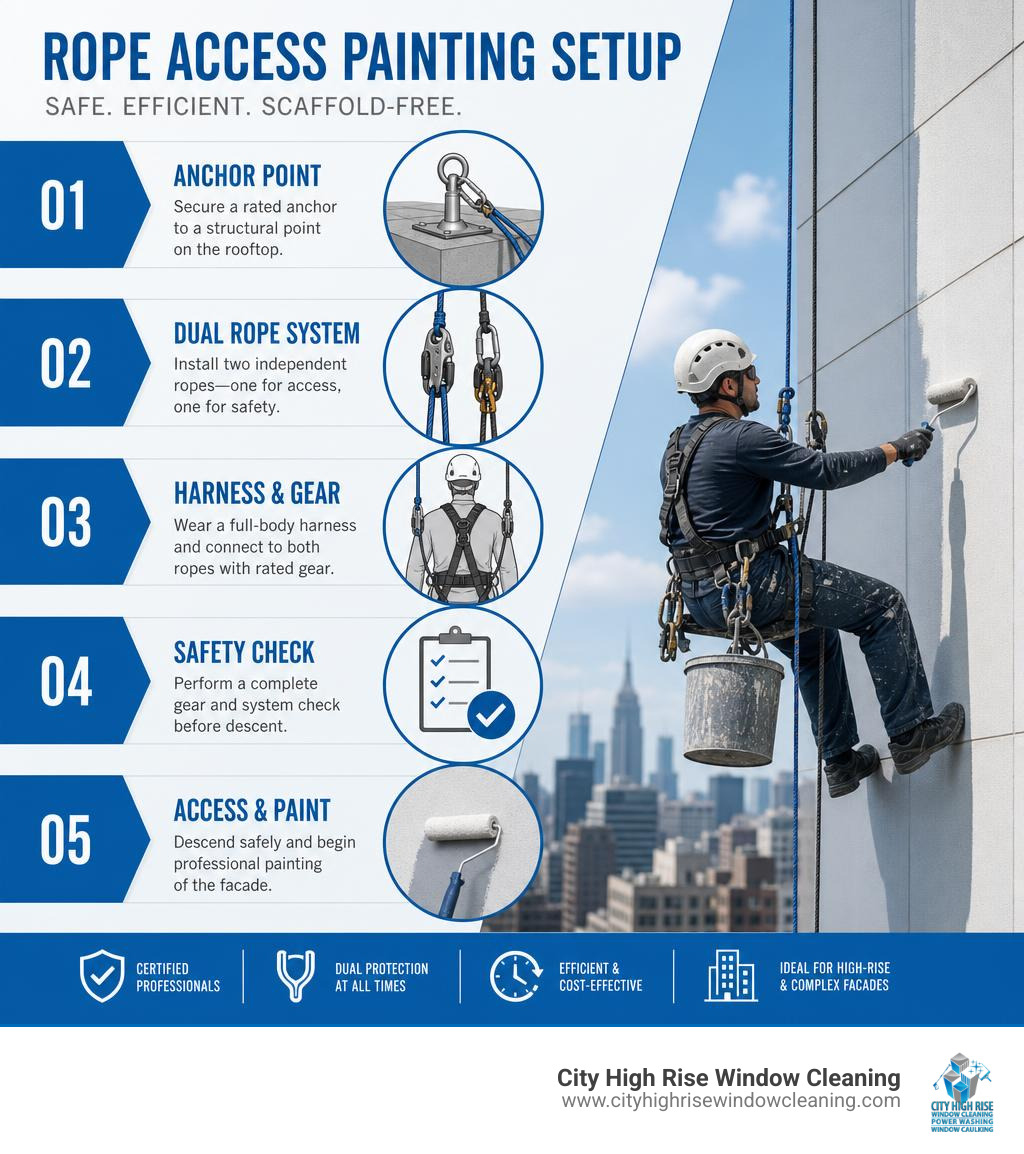
- The Dual-Rope System: Every single rope access technician is attached to two independent ropes: a primary working line and a secondary safety/backup line. If a giant meteor were to somehow sever the primary working line, the safety line’s automatic fall-arrest system engages instantly, preventing any fall.
- Certified Anchor Points: Ropes are not simply tied to a random chimney or pipe. They are secured to structurally engineered and tested roof anchors. In cases where a building lacks built-in anchors, experienced teams can rig temporary counterbalance anchor systems on the roof, which use heavy weights to establish rock-solid drop lines without drilling into the roof membrane.
- Descent Control and Harnesses: Technicians wear heavy-duty, full-body industrial harnesses. They utilize specialized descent control devices (such as descenders and backups) that allow them to smoothly control their descent speed, lock themselves in place to paint with both hands, and ascend back up if necessary.
The Financial and Operational Benefits of Rope Access
When you manage a commercial property, residential high-rise, or historic building, your primary goals are to protect your asset, stay within budget, and keep your tenants happy. Traditional scaffolding fails on almost all of these fronts—it is slow, incredibly expensive, and an eyesore. Rope access, on the other hand, maximizes project efficiency while completely maintaining your building’s aesthetic during restoration.
Why Abseiling Painting Services Cut Costs by 50%
It sounds like an exaggeration, but the data is clear: rope access painting can reduce total project costs by up to 50% compared to traditional scaffolding.
Here is why the math works so heavily in your favor:
- No Scaffolding Rental Fees: Scaffolding is rented by the day, week, or month. If bad weather delays your painting project for two weeks, you are still paying thousands of dollars for that metal sitting idle on your building.
- No Sidewalk Shed Permits: In places like New York City, putting up a sidewalk shed requires costly permits, engineering plans, and ongoing inspection fees. Rope access completely bypasses these expenses.
- Reduced Labor Hours: Because our setup takes minutes rather than days, we can complete painting projects up to 70% faster than teams using scaffolding. You pay for actual painting time, not assembly and disassembly labor.
If your building’s exterior needs more than just a fresh coat of paint, combining your painting project with our comprehensive Facade Restoration Services allows us to handle concrete repairs, waterproofing, and structural maintenance in a single, highly efficient mobilization.
Minimizing Disruption for Tenants and Operations
One of the most overlooked benefits of abseiling painting is how quiet and non-intrusive it is.
Think about the classic scaffolding experience: for months, your tenants have workers standing right outside their windows, blocking their natural light and raising serious privacy concerns. Storefronts are hidden behind dark wooden sheds, causing retail foot traffic to plummet.
With rope access:
- No Ground Footprint: There are no bulky structures blocking your building’s entrance, walkways, or parking lots.
- Increased Security: Scaffolding is essentially a ladder inviting unauthorized access to your building’s upper floors. Rope access equipment is packed up and taken to the roof or off-site at the end of every single day, leaving your building secure.
- Quiet Operations: There is no heavy machinery idling on the street or metal pipes clanging together at 7:00 AM.
Safety Standards, IRATA Certifications, and NYC Regulations
I often get asked: “Brett, hanging from a rope hundreds of feet in the air sounds terrifying. Is it actually safe?”
The answer is a resounding yes. Statistically, industrial rope access has a significantly better safety record worldwide than traditional scaffolding or aerial lifts. However, this stellar safety record is only possible because of incredibly strict international standards, rigorous training, and tight local regulations.
For a deeper dive into how we keep our teams and your property completely safe, take a look at our article on High Rise Painting.
Rigorous Training and Safety Protocols for Abseiling Painting
Professional rope access technicians are not just painters who bought some climbing gear. They are highly trained industrial athletes. The gold standards for rope access training are:
- IRATA (Industrial Rope Access Trade Association): The premier global authority on rope access safety. IRATA technicians must undergo intense practical and theoretical training, followed by strict independent exams, to progress through Level 1, Level 2, and Level 3 (Supervisor) certifications.
- SPRAT (Society of Professional Rope Access Technicians): The primary North American standard, which mirrors many of IRATA’s strict safety and operational guidelines.
Every single job site we manage requires a designated Level 3 Supervisor on-site. This individual is responsible for drafting a site-specific rescue plan, conducting daily equipment inspections, and ensuring that all redundant fall protection systems are perfectly rigged before anyone goes over the edge.
OSHA Compliance and Local Building Codes
Operating in the Tri-State area means navigating some of the strictest building codes in the world.
- NYC Department of Buildings (DOB): Rigging and rope descent systems in New York City are heavily regulated. We ensure all installations are fully compliant with DOB rules, including proper load testing of anchors and filing the necessary permits where required.
- OSHA Compliance: All of our technicians hold OSHA 10-Hour or 30-Hour safety certifications. We strictly adhere to OSHA standard 1910.27, which governs Rope Descent Systems, ensuring that no worker descends from a height greater than 300 feet without meeting specific safety and structural anchor requirements.
- New Jersey & Westchester Standards: Whether we are painting a commercial office park in Westchester or a high-rise residential complex along the New Jersey gold coast, we adapt our safety protocols to meet all local county and state safety regulations.
Surface Preparation and High-Performance Coatings
No matter how skilled a painter is, a paint job is only as good as the surface preparation. This is especially true on high-rise buildings, where the facade is constantly battered by high-velocity winds, intense UV radiation, and freezing temperatures.

Preparing High-Rise Facades for Long-Lasting Results
Before we even open a can of paint, we must ensure the substrate is clean, dry, and structurally sound. Our preparation process includes:
- High-Pressure Power Washing: We use specialized High Rise Hot Water Power Washing to blast away years of accumulated city grime, salt spray, mold, and loose, flaking paint.
- Masonry and Render Repair: If we find cracked stucco, spalling concrete, or deteriorated pointing, we repair it. Painting over damaged concrete is like putting a band-aid on a broken bone—it will fail incredibly fast.
- Rust Treatment and Priming: Metal elements, such as window frames, balconies, and structural steel, are sanded down to bare metal, treated with rust-inhibiting primers, and prepared for specialized coatings.
Selecting Weather-Resistant Paints for Extreme Exposure
The paints used on high-rise buildings are highly advanced chemical systems designed for maximum durability. We typically utilize:
- Elastomeric Coatings: These heavy-duty coatings can stretch and contract up to 100% of their original size. This flexibility is crucial for high-rise concrete and stucco, which expands and contracts with the changing seasons in the Northeast.
- High-Durability Acrylics: Formulated with excellent UV blockers to prevent the paint from fading under intense, direct sunlight.
- Epoxy and Polyurethane Systems: Used primarily on metal structures, handrails, and window frames to provide maximum chemical and abrasion resistance.
Furthermore, we carefully monitor local weather forecasts. High-performance coatings have strict temperature thresholds (typically requiring temperatures between 40°F and 90°F) and must never be applied in rainy or excessively windy conditions.
People Also Ask About Abseiling Painting
Is abseiling painting safe for high-rise buildings?
Yes. Certified rope access technicians use two independent ropes, fall-arrest backups, inspected anchors, and IRATA or SPRAT safety protocols on every drop.
How much does abseiling painting save compared to scaffolding?
Rope access painting can cut total project costs by up to 50% by avoiding scaffolding rentals, sidewalk shed permits, heavy equipment, and long setup times.
How fast can a high-rise painting project start in NYC, Long Island, Westchester, or New Jersey?
Rope access teams can often mobilize much faster than scaffold-based crews because there is little to no ground setup. Exact lead time depends on building access, weather, coating requirements, and local regulations.
What weather can delay rope access painting?
Rain, high winds, wet surfaces, and temperatures outside the coating manufacturer’s limits can delay work. Most exterior coatings require dry conditions and temperatures above roughly 40°F.
Can rope access technicians repair facade problems while painting?
Yes. While suspended, technicians can often handle concrete spall repairs, joint sealing, window frame restoration, and High Rise Window Caulking to help prevent air and water leaks.
Conclusion
When it comes to maintaining your high-rise property, you don’t have to accept the high costs, long delays, and massive disruptions of traditional scaffolding. Abseiling painting offers a faster, safer, and significantly more affordable alternative that keeps your building looking spectacular while fully protecting your structural envelope.
At City High Rise Window Cleaning, we bring over 30 years of trusted exterior building maintenance experience to every project. Serving New York City, Long Island, New Jersey, and Westchester, we stand behind our work with a 100% customer satisfaction guarantee and an uncompromising commitment to safety.
Whether your building needs a complete exterior repaint, detailed window restoration, or comprehensive facade repairs, our team of certified professionals is ready to deliver outstanding results without leaving you hanging. Explore our Exterior High Rise Painting Services to learn more about how we can help protect your investment.
Ready for a free quote? City High Rise Window Cleaning offers 24/7 live consultation. Call 917-749-8342 to speak to a live representative.


