

Everything You Need to Know About High Rise Joint Sealing
Everything You Need to Know About High Rise Joint Sealing
The Hidden Threat Inside Every High-Rise: Why Joint Sealing Can’t Be Ignored
High rise joint sealing is the process of filling and protecting the gaps between structural elements on tall buildings — and it’s one of the most critical (and most overlooked) parts of building maintenance.
Here’s what you need to know at a glance:
| What It Is | Why It Matters | How Long It Lasts |
|---|---|---|
| Sealing expansion joints, facade gaps, window perimeters, and panel joints on tall buildings | Prevents water ingress, air leakage, mold, energy loss, and structural damage | 5–10 years; inspect every 2–3 years |
| Uses silicone, polyurethane, hybrid, or precompressed foam sealants | Joints are the weakest point in any building envelope, even when all other materials are sound | Earlier in harsh climates like NYC and New Jersey |
Every high-rise building moves. Wind sway, temperature swings, and settling cause constant expansion and contraction. The joints between concrete panels, glass facades, and metal cladding are designed to flex — but only when properly sealed.
When those seals fail, water gets in. And in a 40-story building, a small leak doesn’t stay small for long.
In New York City, building owners also face regulatory pressure. Local Law 126 requires regular facade inspections, and failing joint sealants are one of the most common findings that trigger costly remediation orders.
I’m Brett Hochman, CEO of City High Rise Window Cleaning, and I’ve been working on high rise window caulking and exterior building maintenance across New York, New Jersey, and the Tri-State area since 1977. Over nearly five decades, I’ve seen how neglected high rise joint sealing turns into six-figure repair bills — and how the right maintenance program prevents it entirely.
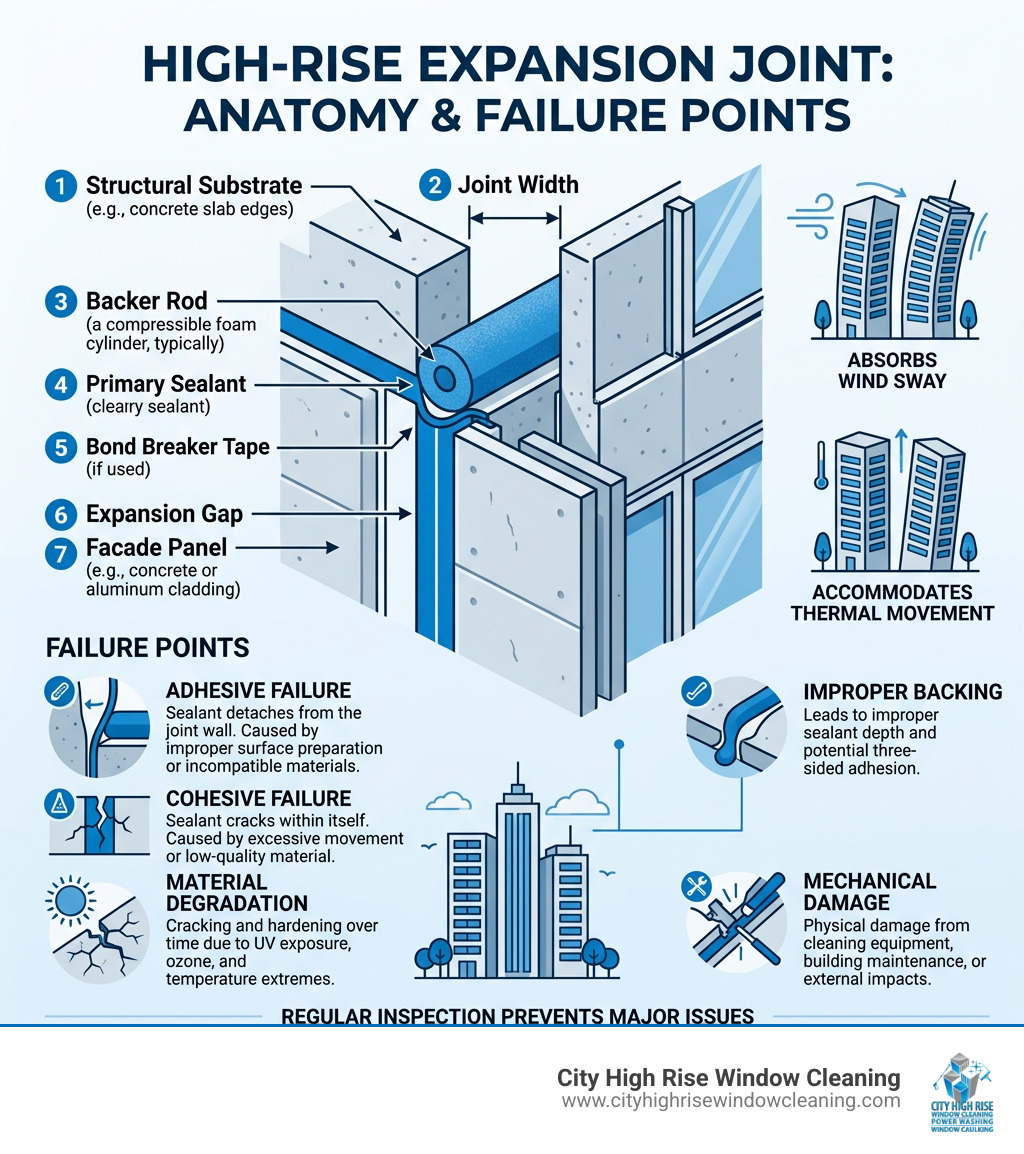
Why High Rise Joint Sealing is Critical for Structural Integrity
When I talk to building managers in Manhattan or Jersey City, I often describe a high-rise as a “living” organism. It breathes, it shifts, and it definitely moves. If you’ve ever been on the top floor of a skyscraper during a heavy windstorm, you’ve felt that slight sway. That movement is exactly why expansion joints exist.
Expansion joints are the intentional gaps designed into a building to safely absorb the heat-induced expansion and contraction of construction materials, as well as to absorb vibration and allow for movement caused by wind sway or seismic activity. Without these joints, the building would literally crack under its own pressure. However, these joints are also the “weakest link” in the building envelope.
In the high-stakes environment of a high-rise, high rise joint sealing serves several vital roles:
- Water Ingress Prevention: Water is the number one enemy of structural integrity. Once it gets past the sealant, it can cause “concrete carbonation,” where the steel rebar inside the concrete begins to rust and expand, leading to “spalling” (concrete chunks falling off the building).
- Air Leakage and Energy Loss: A failed joint is like leaving a window cracked open 24/7. In the winter, your expensive heat escapes; in the summer, your AC works overtime. Proper sealing keeps your energy bills in check.
- Seismic and Wind Handling: Products like Seismic Colorseal are engineered to handle ±50% movement (100% total). This means if you have a 4-inch joint, it can expand to 6 inches or compress to 2 inches without failing.
- Mold Prevention: Once moisture is trapped behind a facade, mold is inevitable. This creates health risks for tenants and massive liability for owners.
In our region, keeping up with Watertight Horizontal Expansion Joints is also a legal necessity. With NYC’s Local Law 126 and other facade safety regulations, an inspector will flag failed joints immediately. I always recommend staying ahead of the game by Understanding NYC Facade Regulations to avoid emergency repair costs.
Choosing the Right Materials: Silicone vs. Polyurethane vs. Hybrids
Not all caulk is created equal. If you use the wrong material on a glass curtain wall or a precast concrete panel, it will peel off within a year. In my 30+ years of experience, I’ve found that matching the sealant to the substrate is the most important step in the process.
| Material Type | Best For | Pros | Cons |
|---|---|---|---|
| Silicone | Glass, Metal, Non-porous surfaces | Extreme UV resistance, stays flexible forever | Doesn’t stick well to concrete, cannot be painted |
| Polyurethane | Concrete, Masonry, Stone | Incredible adhesion to porous surfaces, very durable | Can degrade under intense UV over time |
| Hybrids (SMP) | Windows, Dissimilar materials | Best of both worlds: paintable and UV resistant | More expensive than basic options |
For non-porous substrates like the glass facades common in Long Island City or the metal panels on new Westchester developments, silicone is the gold standard. It handles the high-intensity UV rays that hit the upper floors of a building without becoming brittle.
However, for the heavy-duty concrete foundations and parking garages we service in New Jersey, we often turn to polyurethane or advanced hybrids. For example, Sika Hybriflex SMP is a high-modulus sealant perfect for floors and areas that see a lot of foot traffic or mechanical movement.
When we perform Window Caulking, we often look for sealants that offer at least ±25% movement capability. This ensures that when the building settles or shifts, the seal remains airtight.
The Professional Process for High Rise Joint Sealing Applications
Applying sealant on a high-rise isn’t like caulking your bathtub. It requires a rigorous, multi-step process to ensure the bond lasts the full 10-year lifecycle.
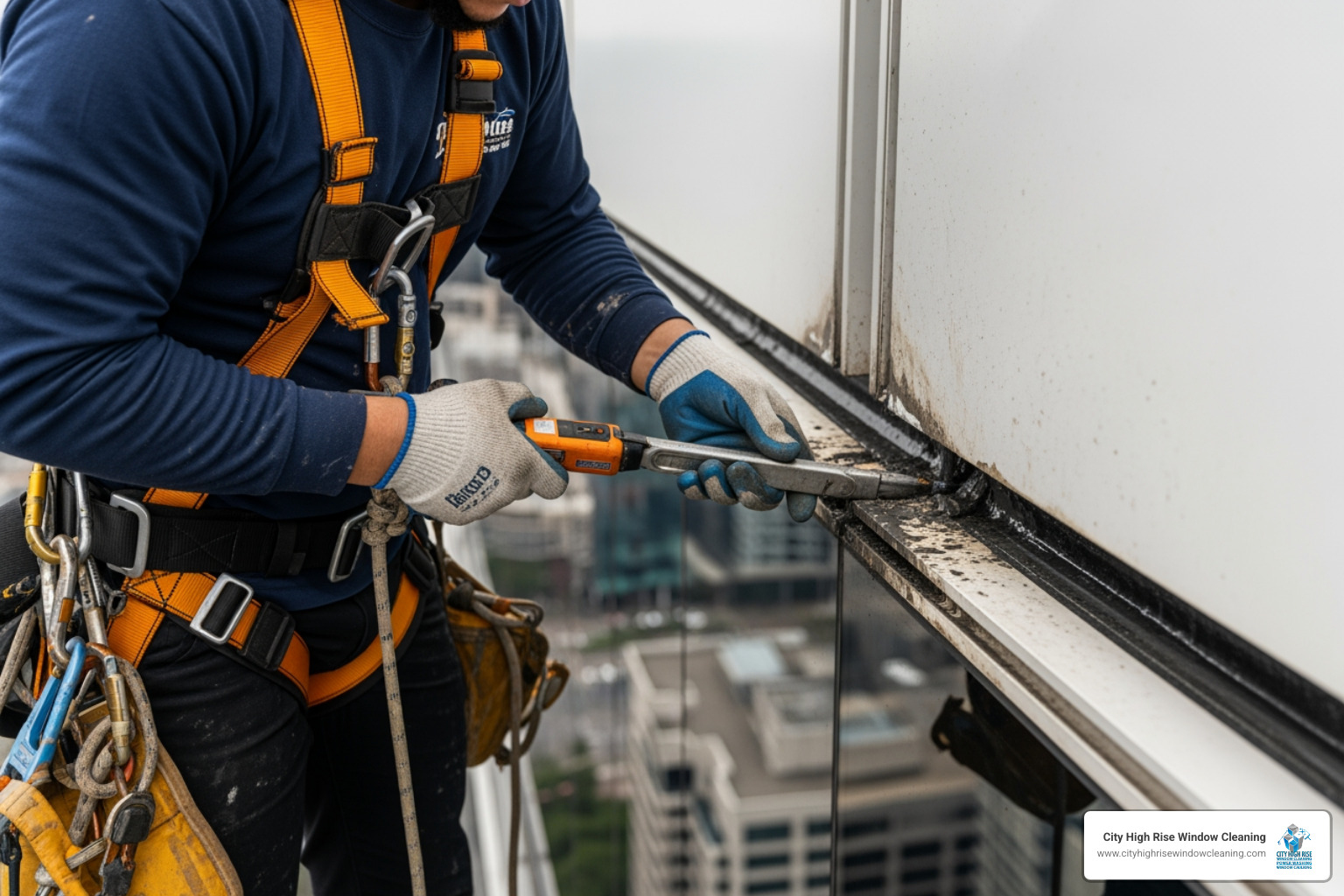
- Inspection and Leak Detection: We start by identifying where the failures are. Sometimes it’s obvious (cracking), but other times we need to perform water tests to find hidden ingress points.
- Removal of Old Material: You can’t just put new caulk over old caulk. We use specialized tools to completely strip the old, degraded sealant.
- Surface Preparation: This is where most amateurs fail. The substrate must be cleaned of dust, grease, and moisture. In some cases, we use primers to ensure the sealant “bites” into the concrete or metal.
- Backer Rod Installation: We don’t just fill the whole hole with caulk. We insert a foam “backer rod” to set the depth of the joint. This allows the sealant to form an “hourglass” shape, which is the strongest configuration for movement.
- Application and Tooling: Using professional-grade guns, we apply the sealant and then “tool” it — smoothing it out to ensure it’s pressed firmly against the sides of the joint for maximum adhesion.
As a leading New Jersey Window Caulking Company, we document every step with photos. This gives building owners peace of mind and provides a record for future facade inspections.
Advanced Solutions: Precompressed Foam and Seismic Seals
For very wide joints or areas with extreme movement, traditional liquid caulking isn’t enough. That’s where precompressed foam sealants come in.
Products like Seismic Colorseal are a game-changer for high-rise buildings. Unlike traditional caulk that is “wet” when applied, these are factory-made foam sticks that are already compressed. When we slide them into a joint, they expand, creating a permanent, tensionless bond against the walls of the joint.
- Non-Invasive Anchoring: These systems don’t require drilling into your building’s facade, which preserves the structural integrity of the concrete.
- Aesthetics: For masonry buildings where you want a clean look, 25V for masonry shadow-lines provides an economical, black-reveal effect that looks professional and sharp.
- Continuity of Seal: One of the biggest leak points is where a vertical joint meets a horizontal one. Advanced foam systems use factory-fabricated transitions (like “Universal-90s”) to ensure the seal never breaks, even at corners.
These advanced systems also offer superior acoustic performance (keeping city noise out) and thermal insulation, which is a huge plus for luxury residential towers in Manhattan.
Maintenance and Inspection: When to Call the Experts
The biggest mistake a building owner can make is waiting for a tenant to complain about a leak. By the time a leak is visible inside the building, the damage to the internal structure is already done.
Most high rise joint sealing materials have a lifespan of 5 to 10 years. However, in our region, we deal with “The Tri-State Special”: freezing winters, humid summers, and high-velocity salt air near the coast. This environment beats up sealants faster than almost anywhere else.
I recommend a visual inspection every 2 to 3 years. We look for:
- Adhesion Loss: The sealant pulling away from the side.
- Cohesive Failure: The sealant tearing down the middle.
- Crazing: Tiny cracks on the surface of the sealant.
Regular maintenance is part of a larger Facade Restoration strategy. It’s much cheaper to replace 100 linear feet of sealant today than it is to replace 100 square feet of rusted rebar and spalled concrete five years from now.
Benefits of Rope Access for High Rise Joint Sealing Projects
How do we get to those joints 50 stories up? While some companies use heavy scaffolding or expensive boom trucks, City High Rise Window Cleaning specializes in rope access (abseiling).
Rope access is often the best choice for high-rise work in NYC and Jersey City for several reasons:
- Cost-Efficiency: No need to rent a $10,000-a-month sidewalk bridge or a massive crane.
- Speed: We can set up and start working in under an hour.
- Minimal Disruption: We don’t block entrances or take up parking spaces. Your tenants won’t even know we’re there.
- Safety: Our technicians are SPRAT (Society of Professional Rope Access Technicians) certified. Statistically, rope access is one of the safest ways to work at height.
Whether it’s a skyscraper in Manhattan, a commercial complex in Westchester, or a residential tower on Long Island, our high rise window caulking services allow us to reach every “unreachable” corner of your building safely and effectively.
Frequently Asked Questions about High-Rise Joint Sealing
How long does high-rise joint sealing typically last?
Most professional-grade caulking in high-rise buildings lasts between 5 and 10 years. However, due to extreme exposure to wind and UV radiation in New York and New Jersey, visual inspections are recommended every 2 to 3 years to identify early signs of failure like cracking or loss of adhesion.
What is the best sealant for concrete high-rise structures?
Polyurethane sealants are generally preferred for porous substrates like concrete and masonry due to their excellent adhesion and abrasion resistance. For joints requiring higher movement or UV stability, hybrid silane-modified polymers (SMP) are often used to combine the benefits of silicone and polyurethane.
Can proper joint sealing reduce a building’s energy costs?
Yes. High-rise joint sealing plays a critical role in maintaining the building’s air barrier. By preventing air leakage and drafts, sealants reduce the load on HVAC systems, leading to significant energy savings and improved tenant comfort in both summer and winter.
What are the signs of failing high-rise joint sealant?
Common signs include cracking, crumbling, shrinking, or loss of adhesion (where the sealant pulls away from the building surface). Water stains on interior walls or ceilings, drafts, and increased energy bills can also indicate failing high-rise joint sealing.
Why is professional high-rise joint sealing important for NYC buildings?
Beyond preventing costly water damage and improving energy efficiency, professional high-rise joint sealing ensures compliance with stringent NYC building codes and local laws, protecting your investment and maintaining the structural integrity and aesthetic appeal of your property.
Conclusion
For over 30 years, City High Rise Window Cleaning has been the trusted partner for expert high rise joint sealing and facade maintenance across New York City, New Jersey, Westchester, and Long Island. Our commitment to 100% customer satisfaction and a safety-first culture ensures your building receives the highest quality service. Protect your investment, prevent costly damage, and enhance your building’s energy efficiency with our specialized high rise window caulking and joint sealing solutions.
Ready for a free quote? City High Rise Window Cleaning offers 24/7 live consultation. Call 917-749-8342 to speak to a live representative.


