

Step-by-Step Guide on How to Paint High Rise Buildings Safely
Step-by-Step Guide on How to Paint High Rise Buildings Safely
How to Paint a High Rise Building: Avoid $100K in Facade Fines and Water Damage
How to paint a high rise building safely comes down to six core steps:
- Pressure wash the facade to remove dirt, salt, and loose paint
- Inspect and patch all cracks, spalls, and concrete defects
- Apply an alkali-resistant primer suited to your substrate and climate
- Select the right coating system (elastomeric, acrylic, or fluoropolymer) for your facade type
- Choose a certified access method — rope descent, swing stage, or MEWP — based on building height and layout
- Apply paint in thin coats, keeping the substrate at least 5°F above the dew point between coats
If you manage a high-rise in New York City, New Jersey, or the surrounding metro area, the exterior of your building takes a beating every single year. UV exposure, wind-driven rain, freeze-thaw cycles, and urban grime don’t just hurt curb appeal — they break down the protective coating that keeps water out of your building envelope.
Left unchecked, coating failure leads to concrete carbonation, water intrusion, and costly structural repairs. In New York City, facade deterioration can also trigger compliance issues under NYC Local Law 11, which requires periodic facade inspections for buildings over six stories.
This isn’t just a cosmetic issue. It’s a structural and financial one.
I’m Brett Hochman, CEO of City High Rise Window Cleaning, and with over 48 years of hands-on experience in exterior building maintenance across NYC, Long Island, Westchester, and New Jersey, I’ve seen how a properly executed high-rise painting project protects a building’s value — and how a poorly planned one creates expensive problems. In the guide below, I’ll walk you through exactly how to paint a high rise building the right way, from first inspection to final coat.
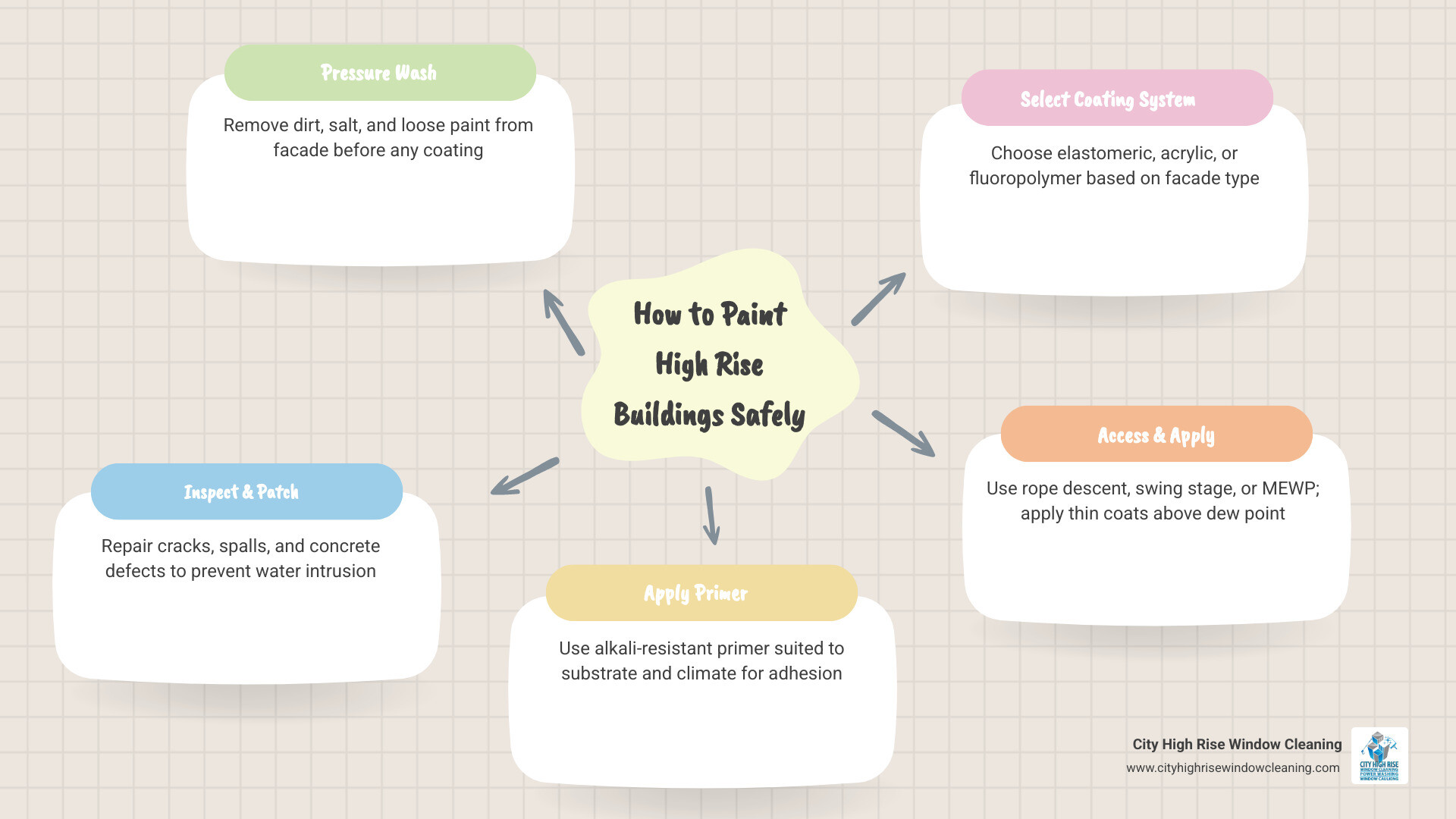
Simple guide to how to paint high rise building:
Evaluating Your Facade: When is it Time to Repaint?
Knowing when to repaint your high-rise shouldn’t be a guessing game based purely on a calendar. While concrete high-rise buildings typically require repainting or resealing every 10 to 15 years, local environmental factors in the Northeast can accelerate this timeline. For example, buildings located along the coastal areas of Long Island and the Jersey Shore face relentless exposure to salt-laden air and high winds, often requiring a fresh protective coat every 5 to 7 years to prevent severe degradation.

As a property manager, you should perform regular visual inspections of your building’s envelope. I recommend looking for these key signs of coating failure:
- Chalking: Run your hand across the facade. If a white, powdery residue transfers to your fingers, the paint’s binders have broken down under UV radiation. The paint is no longer shedding water effectively.
- Hairline Cracks: Small cracks in the paint film allow moisture to seep into the underlying concrete or stucco, leading to freeze-thaw damage during cold New York winters.
- Peeling and Blistering: This indicates that the coating has lost its adhesion to the substrate, usually due to trapped moisture or poor surface preparation during the previous paint job.
- Corrosion Bleed-Through: Rust stains spreading across concrete surfaces indicate that moisture has penetrated deep enough to reach the internal steel rebar, causing it to rust and expand.
Ignoring these early warning signs can lead to spalling concrete, structural failures, and failed safety inspections under municipal regulations like NYC’s FISP (Facade Inspection Safety Program). For a deeper dive into managing these assets, check out this High-Rise Painting Guide for Commercial Property Managers – CCR-Mag.com .
The Ultimate Blueprint: How to Paint High Rise Building Exteriors Without Disruption
Successfully painting a skyscraper or multi-family tower requires a highly structured, step-by-step execution plan. Cutting corners during any phase of the project will dramatically shorten the lifespan of the coating.
When you contract our Exterior High-Rise Painting Services, we implement a rigorous quality control framework. This includes conducting adhesion tests and measuring the Dry Film Thickness (DFT) during application to ensure the coating meets the exact specifications of the manufacturer.
Step 1: Thorough Surface Preparation and Pressure Washing
You cannot paint over dirt, salt, or failing paint and expect it to hold. The first step is always high-pressure washing. We use specialized hot water pressure washing systems to strip away years of urban grime, atmospheric soot, salt residue, and loose, peeling paint. Once washed, the substrate must be allowed to dry completely. Applying primer over a damp surface is a guaranteed recipe for blistering and premature peeling.
Step 2: Concrete Inspection, Patching, and Crack Repair
Once the facade is clean and dry, our team performs a detailed inspection. We look for structural defects, hollow-sounding concrete, and active cracks. Any loose or spalling concrete is cut out, and the exposed steel rebar is treated with rust-inhibiting coatings. We then patch the concrete to restore the building’s structural integrity. Active hairline cracks are sealed using high-performance, flexible elastomeric fillers that can accommodate structural movement.
Step 3: Priming for Harsh Climates
Priming is the bridge between your raw building facade and the new topcoat. For concrete and stucco surfaces, we apply a high-quality, alkali-resistant primer. This primer seals the porous substrate, neutralizes any high-pH alkalinity in new concrete patches, and creates a uniform surface that enhances topcoat adhesion. In coastal areas like Long Island, a robust priming step is absolutely non-negotiable to block salt water intrusion.
Step 4: Coating Application and Why How to Paint High Rise Building Projects Fail at This Stage
This is where the magic happens—and where inexperienced contractors make critical errors. The most common reason high-rise paint jobs fail is violating the dew point rule.
The substrate temperature must be kept at least 5 degrees Fahrenheit above the dew point before and during coating application. If the facade is too close to the dew point, micro-condensation forms on the surface, preventing the paint from bonding properly.
We apply the coatings in thin, even layers, allowing adequate drying time between coats to prevent solvent entrapment. Using premium, UV-resistant topcoats ensures that your building maintains its color and protective barrier for years to come. To understand how our specialists execute these high-altitude steps safely and efficiently without bulky scaffolding, read about How High-Rise Painting Works Without Scaffolding.
High-Rise Access Methods: Cost, Safety, and Efficiency Compared
Choosing the right access method is one of the most critical decisions in any high-rise painting project. The access method directly drives the project timeline, budget, and the level of disruption to your building’s occupants.
| Access Method | Max Reach / Height Limits | Setup / Rigging Time | Traffic & Occupant Disruption | Relative Cost | Best Suited For |
|---|---|---|---|---|---|
| Rope Access (RDS) | Typically up to 300 ft (OSHA limit without special variance) | Extremely fast (Hours) | Minimal (No ground footprint) | Low to Medium | Complex facades, localized repairs, tight urban spaces |
| Swing Stages | Virtually unlimited (Suspended from roof) | Moderate (Days) | Low to Moderate (Overhead hazards) | Medium | Flat, continuous facades, extensive structural repairs |
| MEWPs (Boom Lifts) | Up to 185 feet | Immediate (Drive-on) | High (Requires ground space/street closures) | Medium to High (Rental costs) | Low to mid-rise buildings, podium levels |
Choosing the Right Access Method: How to Paint High Rise Building Facades Safely
Depending on your building’s physical layout and height, we utilize several access systems to get the job done right.

- Rope Descent Systems (RDS): Also known as industrial rope access, this method allows our highly trained Abseiling Painters to descend the building using a secure, twin-rope system. It is incredibly fast to set up, leaving zero footprint on the ground and causing minimal disruption to tenants. Under OSHA regulations, RDS is generally limited to 300 feet above grade unless other means are infeasible, and stabilization is required for descents exceeding 130 feet.
- Swing Stages (Suspended Scaffolds): These platforms are lowered from the roof using electric hoists. They are ideal for large, flat facades where multiple painters need to work side-by-side with heavy equipment and large volumes of paint.
- Mobile Elevating Work Platforms (MEWPs): For mid-rise buildings or the lower podium levels of skyscrapers, telescopic boom lifts are an excellent choice. Some of the largest telescopic boom lifts available can reach up to 185 feet, allowing us to complete work quickly without rigging ropes or stages on the roof.
Safety Regulations and Certifications: The Non-Negotiables
At high altitudes, there is absolutely zero margin for error. Safety isn’t just a checkbox; it is the foundation of everything we do.
When executing high-rise painting projects in New York and New Jersey, several regulatory standards must be strictly followed:
- OSHA 1910.27 (Rope Descent Systems): This standard governs the use of RDS. It mandates that building owners must confirm in writing that each roof anchorage intended for rope access can support a minimum of 5,000 pounds in any direction. Furthermore, these anchorages must undergo an annual visual inspection and a structural certification at least every 10 years.
- OSHA Construction Scaffold Rules (1926 Subpart L): If swing stages are used, fall protection systems are strictly required for any employee working more than 10 feet above a lower level.
- IRATA & SPRAT Standards: The International Rope Access Trade Association (IRATA) and the Society of Professional Rope Access Technicians (SPRAT) are the gold standards for rope safety. These organizations require a strict twin-rope system (an independent working line and a back-up safety line). Under SPRAT guidelines, every active work site must have at least one designated Rope Access Supervisor (Level 3) on-site to oversee rigging and manage emergency rescue protocols.
To understand why working with certified crews is an ethical and legal obligation, you can read more about international rope safety systems in this guide on High Rise Building Painting Dubai | IRATA-Certified Experts .
Selecting the Right Paint Systems for Harsh Climates and Substrates
Different building materials react differently to weathering, moisture, and temperature swings. Applying the wrong paint to a substrate will lead to rapid coating failure.
- Concrete and Stucco (Masonry): These porous materials absorb moisture easily. We recommend high-performance elastomeric paints or 100% acrylic coatings. Elastomeric coatings are thick and incredibly flexible, allowing them to stretch and contract during the extreme thermal expansion and contraction of New York’s changing seasons. They effectively bridge hairline cracks, preventing wind-driven rain from entering the concrete.
- Architectural Metal Cladding (Alucobond / Steel): Metal facades require exceptional color and gloss retention. We utilize field-applied fluoropolymers (such as FEVE) or high-durability polyurethane systems. These coatings provide outstanding resistance to UV radiation and chemical degradation.
- Exterior Insulation and Finish Systems (EIFS): EIFS requires highly breathable, 100% acrylic coatings. These coatings allow internal moisture vapor to escape while preventing liquid water from penetrating the exterior barrier.
Additionally, all coatings used must comply with environmental laws. Federal architectural-coating VOC (Volatile Organic Compound) limits under 40 CFR Part 59, Subpart D set national caps at 250 g/L for flat coatings and 380 g/L for non-flat coatings. In our local New York and New Jersey markets, state-level regulations are often even stricter, requiring careful product selection to ensure environmental compliance.
Project Planning: Permitting, Logistics, and Occupant Communication
A high-rise painting project in dense urban areas like New York City, Jersey City, or Newark requires meticulous logistical planning before the first drop of paint is mixed.
- Permitting & Pedestrian Protection: In NYC, setting up staging or lifts often requires DOT street closure permits and the installation of sidewalk sheds (scaffolding protection) to protect pedestrians from falling debris.
- Occupant Communication: Tenants must be notified well in advance of the project schedule. We coordinate closely with building management to establish a clear notice cadence, advising residents when work will occur near their windows, when they need to keep their windows closed and locked, and when balcony access will be temporarily restricted.
- Wind and Weather Monitoring: High winds are a major hazard at high altitudes. We constantly monitor local weather forecasts and wind speeds to ensure our teams only operate within safe structural limits, preventing paint overspray from drifting onto surrounding properties or vehicles.
For more helpful advice on choosing a contractor who can handle these complex logistics seamlessly, read our Tips for Choosing High-Rise Painters.
Frequently Asked Questions about High-Rise Painting
How often does a high-rise building need to be repainted?
In the Northeast, a standard concrete high-rise should be repainted or resealed every 10 to 15 years. However, buildings in coastal areas of Long Island or New Jersey exposed to high humidity and salt air often require repainting every 5 to 7 years to protect the concrete from carbonation and structural damage.
What is the safest access method for high-rise painting?
Industrial rope access (utilizing IRATA/SPRAT certified technicians) is widely considered one of the safest access methods. It utilizes a redundant, twin-rope system where the worker is secured to independent anchor points. Because there is no heavy machinery or scaffolding left on site overnight, it also minimizes security and ground-level safety risks.
Can a high-rise building be painted while occupied?
Yes, absolutely. Most of our projects are carried out on fully occupied residential and commercial towers. By utilizing rope access systems instead of traditional scaffolding, we can complete the work with minimal noise, no blocked windows or entrances, and zero loss of ground-level parking spaces.
Conclusion
Protecting your high-rise building’s exterior envelope is one of the most important investments you can make to preserve its structural integrity and market value. From proper surface preparation and climate-appropriate paint selection to choosing the safest access method, every step of the process requires specialized expertise.
At City High Rise Window Cleaning, we bring over 30 years of dedicated experience in high-rise maintenance, power washing, and building restoration to every project across New York City, Long Island, New Jersey, and Westchester. Backed by our 100% customer satisfaction guarantee and an uncompromising commitment to safety, our certified teams are ready to deliver outstanding, long-lasting results for your property.
Ready for a free quote? City High Rise Window Cleaning offers 24/7 live consultation.


