

Debunking the Myths of Window Restoration vs Replacement
[2025] Window Restoration vs Replacement: Save $1,000+ Per Window (NYC/LI/NJ) — Don’t Get Sold a 20-Year “Upgrade”
Window restoration vs replacement is one of the most debated decisions in building maintenance — and most NYC-area property owners overpay because they’re pushed into replacement when restoration would deliver the same comfort for far less.
Summary (window restoration vs replacement): If your windows are structurally sound, restoration usually wins on total cost, lead time, longevity, and sustainability. Replacement is for frames/sashes that are too far gone or failed-seal modern units.
Here’s the quick answer:
| Factor | Restoration | Replacement |
|---|---|---|
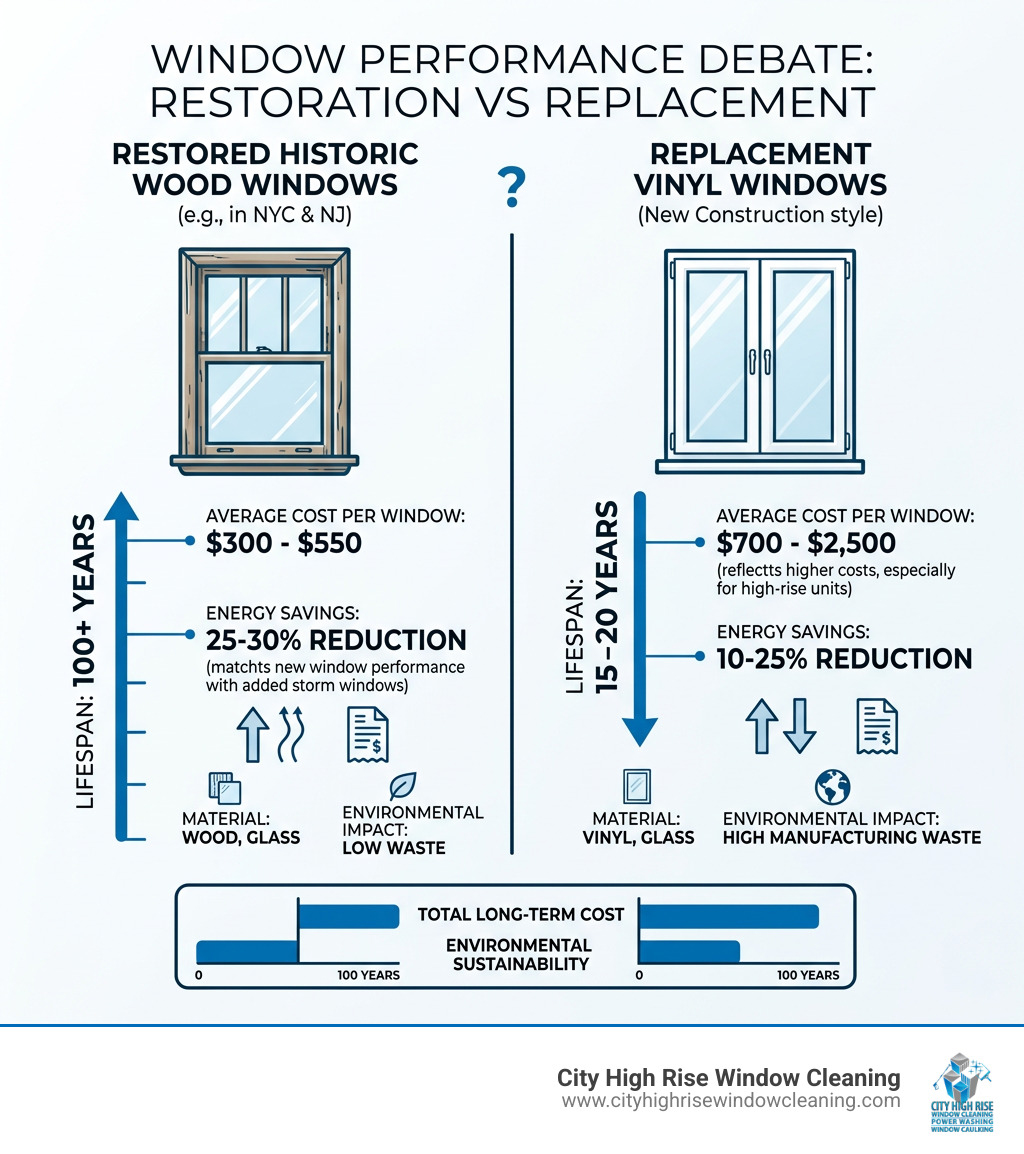
| Average cost per window | $300–$550 | $700–$2,500 |
| Lifespan | 50–100 years | 15–20 years |
| Energy efficiency | Matches new windows (with storm windows) | 10–25% bill reduction |
| Best for | Historic, structurally sound windows | Severely damaged or failed-seal units |
| Environmental impact | Low (no manufacturing waste) | High (2.3M BTUs embodied energy per window) |
| ROI at resale | Preserves authenticity and value | 62–67% return |
The bottom line: If your windows are structurally sound, restoration almost always wins on cost, longevity, and sustainability. Replacement makes sense only when damage is too severe to repair.
Windows are responsible for 25–30% of residential heating and cooling energy loss — so the stakes are real. But throwing money at full replacement is rarely the answer, especially for NYC, Long Island, Westchester, and New Jersey property owners managing dozens (or hundreds) of windows.
I’m Brett Hochman, CEO of City High Rise Window Cleaning, with over 30 years of hands-on experience in exterior building maintenance across New York, New Jersey, and the Tri-State area — including countless projects weighing the true costs of window restoration vs replacement. In this guide, I’ll cut through the noise and give you a clear, honest framework for making the right call.
Window Restoration vs Replacement: The $400 vs $2,500 Debate
When I walk onto a job site in Manhattan, Brooklyn, Jersey City, or Hoboken, the first thing property managers ask me is about the “bottom line” — fair pricing, real results, and a reasonable lead time. There is a massive misconception that “new” always means “better value.” In reality, the financial gap between window restoration vs replacement is staggering.
Let’s look at the numbers. Nationally, and especially in high-cost areas like Westchester and Long Island, window restoration costs average between $300 and $550 per window, with a solid national average sitting right around $400. Compare that to the cost of a full replacement. While you might see “budget” windows advertised for $500, a high-quality, high-rise-compatible replacement window typically ranges from $700 to $2,500 per unit once you factor in labor, custom sizing, and structural adjustments.
If you are managing a 50-unit brownstone in Brooklyn, choosing restoration over replacement could save you over $100,000 in upfront capital. For more insights on cost-saving measures, read our high-rise building maintenance blog.
But what about the long-term value? According to the 2023 Cost vs. Value report, vinyl window replacement offers roughly a 67.1% return on investment (ROI) at resale, while wood windows sit between 62% and 66%. However, these numbers don’t account for the “historic premium.” In neighborhoods like the Upper West Side or Hoboken, original, well-maintained historic windows often add more to a home’s appraisal than generic modern inserts ever could.
For a deeper dive into these figures, check out this Window Restoration vs. Replacement: Cost, Value, and Sustainability Compared guide.
| Metric | Restoration | High-End Replacement |
|---|---|---|
| Upfront Cost | $400 (Avg) | $1,500 – $2,500 |
| Lifespan | 50-100 Years | 15-20 Years |
| Repairability | High (Individual parts) | Low (Must replace whole unit) |
| ROI at Resale | High (Preserves Character) | 62% – 67% |
The Energy Efficiency of Window Restoration vs Replacement
One of the biggest “sales pitches” I hear from replacement companies is that old windows are just “leaky buckets” for your money. While it’s true that heat gain and loss through windows account for 25%-30% of residential energy use, the solution isn’t always a new window.
Modern replacement windows use Low-E glass and argon gas to boost thermal performance. However, I’ve seen time and again that properly restored historic windows — when paired with high-quality storm windows — can achieve thermal performance nearly identical to brand-new Low-E vinyl replacements.
In fact, a study by the Lawrence Berkeley National Laboratory confirmed that adding a storm window to a historic wood window can reduce heat loss by 40-50%. When we perform window restoration, we focus on sealing the gaps. By installing modern weatherstripping and high-quality caulking, we can help homeowners and co-ops across NYC, Long Island, Westchester, and New Jersey see a 10% to 25% reduction in their annual heating and cooling costs.
To tighten the building envelope and stop water intrusion, many properties pair restoration work with window caulking.
The “payback period” is the real kicker. If you spend $25,000 replacing all the windows in your Long Island home to save $300 a year on energy, it will take you over 80 years to break even. Restoration gives you the efficiency gains at a fraction of the cost, making the “green” choice also the “frugal” choice.
Assessing the Environmental Impact of Your Choice
In my 30 years in the industry, I’ve seen a lot of waste. Every year, Americans demolish 200,000 buildings, creating 124 million tons of debris. A huge portion of that is perfectly restorable windows being tossed into landfills.
When you choose window restoration vs replacement, you are making a massive statement for sustainability. Consider the “embodied energy” — the energy required to extract raw materials, manufacture, and transport a product. A single new window has an embodied energy of approximately 2,300,000 BTUs. By restoring what you already have, you eliminate that carbon footprint entirely.
Furthermore, historic windows were often built with old-growth timber. This wood is significantly denser, more rot-resistant, and more durable than the fast-growth pine or plastic polymers used in modern windows today. Tossing old-growth wood for vinyl is like trading a solid oak table for a cardboard box.
When to Choose Restoration Over Full Replacement
I always tell my clients in NYC and New Jersey: if the “bones” are good, keep them. Restoration is the clear winner when you are dealing with historic properties or windows that are structurally sound but aesthetically tired.
Original windows in older homes were designed to be repaired. They use mortise and tenon joinery, which allows a craftsman to take the window apart, replace one broken piece of wood, and put it back together. Modern windows are often “disposable” — once the seal between the double panes fails (and it will, usually in 15-20 years), the entire sash or even the whole frame often needs to be replaced.
If you have:
- Original “wavy” glass (which is impossible to replicate authentically).
- Solid wood frames with only minor surface rot.
- Windows that are “painted shut” or have broken sash cords.
- A property in a designated NYC Historic District.
Then restoration is your best path. We often combine restoration with window caulking to ensure the exterior envelope is completely watertight, protecting your investment for decades to come.
The Longevity of Window Restoration vs Replacement in Historic Homes
There is a reason those windows in that Brooklyn Heights brownstone have lasted 100 years: they were built to last. When we restore a historic window, we aren’t just making it look pretty; we are resetting the clock. A properly restored wood window can easily last another 50 to 100 years with basic maintenance (like regular residential high-rise window cleaning and a fresh coat of paint every decade).
Compare that to modern vinyl. Most vinyl windows have a functional lifespan of just 15 to 20 years. The plastic becomes brittle from UV exposure, the seals on the insulated glass units (IGUs) fail, and the frames can warp under the intense heat of a New Jersey summer.
In New York City, there’s also the legal aspect. If you live in a historic district, the Landmarks Preservation Commission (LPC) has very strict rules. Replacing historic windows with non-compliant modern ones can result in massive fines and a legal requirement to remove them and install historically accurate ones anyway. Restoration keeps you compliant and preserves the resale appeal that makes NYC real estate so valuable.
Identifying When Replacement is the Only Option
I’m an advocate for restoration, but I’m also a realist. Sometimes, a window is just too far gone. In my experience, replacement becomes the necessary choice in the following scenarios:
- Severe Structural Rot: If you can push a screwdriver through the core of the window frame or sill, the structural integrity is compromised beyond what epoxy fillers can fix.
- Catastrophic Damage: If the window frames are warped from a fire or major building settling, restoration may be physically impossible.
- Failed “Modern” Windows: If you already have 20-year-old vinyl or aluminum replacement windows that are fogging up or falling apart, they generally cannot be restored. They weren’t built for it.
- Lead Paint Hazards: In some extreme cases where lead paint has deeply saturated the wood and the cost of safe abatement exceeds the cost of a high-quality wood replacement, we might discuss replacement options.
- Functionality Needs: If you need specific modern features like “tilt-in” cleaning for a high-rise unit where exterior access is restricted, and your current frames can’t be retrofitted, a high-quality replacement might be the answer.
If you do go the replacement route, I always recommend choosing materials like fiberglass or aluminum-clad wood, which offer better longevity and thermal stability than basic vinyl.
Frequently Asked Questions about Window Restoration vs Replacement
Is window restoration actually cheaper than replacement?
Yes, in almost every case. Restoration typically costs $300–$550 per window, whereas high-quality, durable replacements (especially those required for NYC high-rises) can range from $700 to $2,500 per unit. Restoration saves you money by utilizing the existing high-quality materials already in your walls and avoiding the high labor costs of “ripping and replacing” frames.
Can restored windows be as energy-efficient as new ones?
Absolutely. When original windows are restored, weatherstripped, and paired with a high-quality interior or exterior storm window, they can match the thermal performance of a brand-new Low-E vinyl window. You get the efficiency without the “plastic” look or the short lifespan.
How long will my windows last after restoration?
Restored windows made from old-growth wood can last another 50 to 100 years with basic maintenance. In contrast, the average modern replacement window is considered “disposable,” with a functional lifespan of only 15 to 20 years before the seals fail or the hardware breaks.
Will restoration help with noise reduction in NYC?
Yes. Many of our clients in Manhattan, Queens, and Long Island City choose restoration specifically for noise. By sealing air gaps and adding a laminated glass storm window, we can significantly reduce the “street noise” that plagues city dwellers, often performing better than standard double-pane replacements.
Does restoration add more home value than replacement?
In historic or high-end neighborhoods, yes. Buyers pay a premium for original architectural details. Replacing historic windows with modern vinyl can actually decrease the value of a historic home by stripping away its character.
People Also Ask: Window Restoration vs Replacement (NYC/LI/WC/NJ)
Is it cheaper to restore windows or replace them?
Usually restore. If the frame and sash are structurally sound, restoration delivers the function you want (smooth operation, tight seals) without paying for demolition, disposal, and new units.
What are the signs my windows should be replaced (not restored)?
Severe structural rot, major warping from fire/settling, or failed seals in insulated glass units (fogging) are the most common deal-breakers.
Can window restoration stop drafts?
Yes. Drafts typically come from gaps, failed glazing, or old weatherstripping. Restoration plus targeted sealing (often including window caulking) can dramatically cut air leakage.
How long do replacement windows really last?
Many modern replacement windows are effectively 15–20 year products before seals, balances, or frames start failing—especially with intense sun, wind, and weather exposure common in NYC-area high-rises.
Is window restoration worth it for co-ops and condos?
Often, yes—because the savings compound across dozens or hundreds of windows, and you avoid the disruption of full replacement schedules and approvals.
Conclusion: Making the Right Investment for Your Property
Choosing between window restoration vs replacement doesn’t have to be a headache. At City High Rise Window Cleaning, we’ve spent three decades helping property owners across New York City, Long Island, Westchester, and New Jersey navigate these exact decisions.
Our commitment to safety and professional service means we don’t just look at the glass; we look at the entire building envelope. Whether you need a simple commercial high-rise window cleaning to assess the condition of your sills or a full-scale window restoration project to bring back the glory of your historic facade, we are here to help.
Don’t let the replacement industry convince you that your 100-year-old windows are trash. With the right care, they can outlast us all, keeping your building beautiful, efficient, and valuable for the next century.
Ready for a free quote? City High Rise Window Cleaning offers 24/7 live consultation. Contact us today to speak to a representative.


