

The Legal Side of the Ledge: High-Rise Cleaning Regulations
High Rise Window Cleaning Requirements [2025]: 8 Rules That Save NYC Owners From $15,000 OSHA Fines
Understanding high rise window cleaning requirements is critical for property owners and managers in New York City, Long Island, New Jersey, and Westchester. Ignoring these rules doesn’t just result in dirty glass; it leads to catastrophic legal liability and massive fines. This guide breaks down exactly what you need to stay compliant, safe, and efficient.
Here’s a quick look at the core requirements:
- Regulatory Compliance: Adhere to OSHA (e.g., 1910.27, 1910.66), ANSI/IWCA I-14.1, and local city/state regulations.
- Anchorage Strength: Each anchor point for Rope Descent Systems (RDS) must support 5,000 pounds in any direction for each worker attached.
- Anchor Inspections: Annual visual inspections and certification at least every 10 years (or as needed) are mandatory.
- Mandatory PPE: Full-body harnesses, shock-absorbing lanyards, helmets (ANSI/ISEA Z89.1 Class E), and appropriate footwear are essential.
- Worker Training: Personnel require specific certifications like SPRAT or IRATA, plus equipment-specific and rescue training.
- Building Owner Duties: Provide written assurance of anchor compliance and, for buildings 36+ feet, an Operating Procedures Outline Sheet (OPOS).
- Weather Restrictions: Operations must cease if wind speeds exceed 25 miles per hour; 15 mph can already create difficult conditions.
- Fall Protection: Mandatory for work at heights above 3 meters (approximately 9.8 feet), including sill work or inclined surfaces.
Maintaining the stunning facade of a high-rise building involves navigating a complex web of safety standards and legal obligations. Beyond glass, we also specialize in High Rise Hot Water Power Washing, Window Restoration, and Facade Restoration to ensure your building’s exterior remains in peak condition.
Brett Hochman, CEO of City High Rise Window Cleaning, has over 48 years of hands-on experience leading safety-first, compliance-driven services, deeply understanding all high rise window cleaning requirements. His commitment to exceeding these standards has made City High Rise Window Cleaning a trusted partner in exterior building maintenance across the Tri-State area.
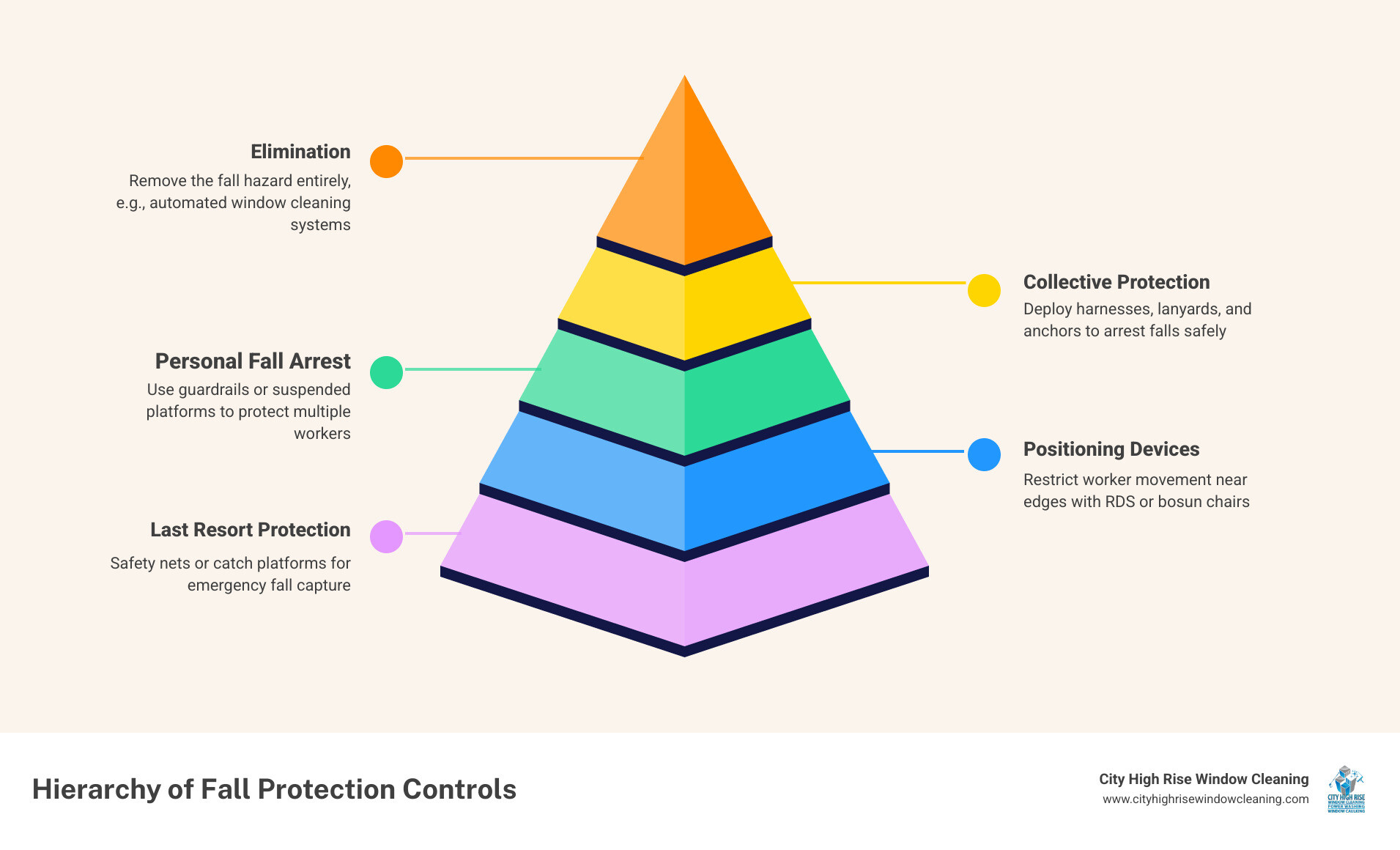
When I look out over the skylines of Manhattan or Jersey City, I don’t just see glass and steel; I see a massive grid of regulatory obligations. The backbone of safety in our industry is formed by OSHA (Occupational Safety and Health Administration) and ANSI (American National Standards Institute). Specifically, OSHA 1910.27 (Rope Descent Systems) and OSHA 1910.66 (Powered Platforms) dictate exactly how we must behave on the side of a building.
The ANSI/IWCA I-14.1-2001 standard is another heavy hitter. It was developed over five years of collaboration between window cleaners, architects, and equipment manufacturers to create a “safety bible” for the industry. For Commercial High Rise Window Cleaning, compliance isn’t a suggestion—it’s the law.
Why do we care so much? Because the stakes are high. While occupational fatalities remain low—typically only one or two per year across 1.5 million exposures—every single one of those is preventable through strict adherence to these frameworks.
Specific Training and Certification High-Rise Window Cleaning Requirements
You can’t just hand a squeegee to someone and tell them to hop over the ledge. In my 30 years of experience, I’ve seen that the best technicians are those who treat this as a craft. We look for certifications from SPRAT (Society of Professional Rope Access Technicians) or IRATA (International Rope Access Trade Association). These organizations ensure that workers understand “the physics of the fall.”
A “competent person” must oversee the site, capable of identifying hazards and authorized to stop work immediately. Whether we are acting as a Manhattan High Rise Window Cleaning Company or working in the suburbs, every team member must have equipment-specific orientation. If the rig changes, the training changes.
Rooftop Anchorages: Load Capacity and Certification Standards
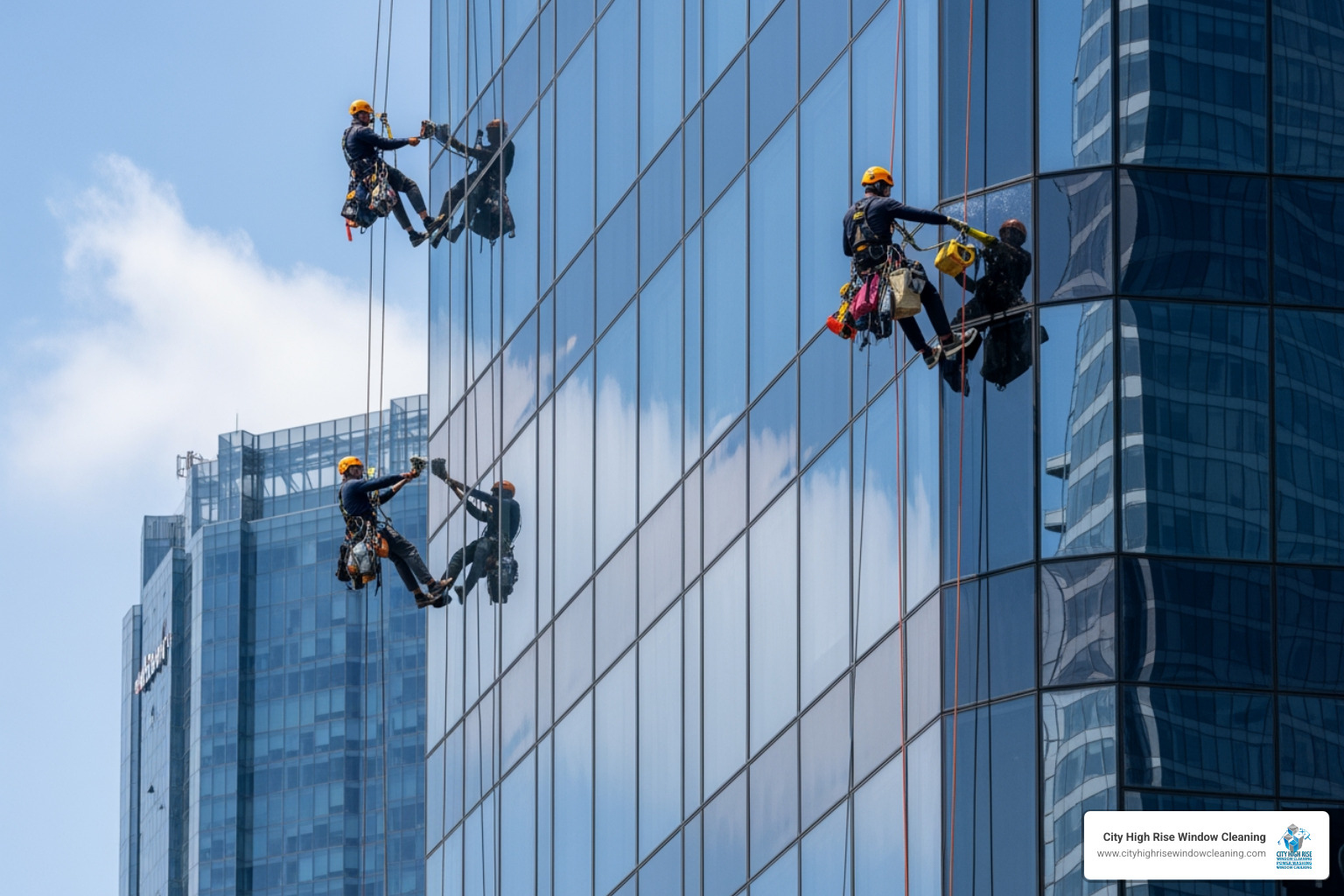
The anchor is the most important piece of metal on your building. Under current high rise window cleaning requirements, each anchorage used for a Rope Descent System (RDS) must be capable of supporting 5,000 pounds in any direction for every worker attached to it. That’s roughly the weight of a full-size SUV hanging from a single point.
Building owners are legally required to provide written information to the cleaning contractor confirming that these anchors have been identified, tested, and certified. If you don’t have that paperwork, I cannot legally put a man over the side.
Structural Integrity and High-Rise Window Cleaning Requirements for Anchors
It’s not enough to install an anchor and forget it. We follow a strict maintenance schedule:
- Annual Visual Inspections: A competent person checks for rust, cracks, or movement.
- 10-Year Certification: A professional engineer must perform a structural “deep dive” to recertify the system’s integrity.
In areas like Brooklyn, where older architecture meets new glass towers, we often deal with different structural challenges. Whether it’s adhesive anchors that need load testing every five years or parapet walls that need engineer-verified tie-backs, a Brooklyn High Rise Window Cleaning Company must ensure the building’s “skeleton” can handle the load.
| Feature | Rope Descent Systems (RDS) | Suspended Platforms (Swing Stages) |
|---|---|---|
| Max Height | Generally 300 feet | No specific height limit |
| Anchor Load | 5,000 lbs per worker | 4x rated load (engineered) |
| Stabilization | Required over 130 feet | Continuous guide rails/rollers |
| Primary Use | Hard-to-reach areas | Large, flat facades |
Mandatory PPE and Fall Arrest Systems for Vertical Work
Personal Protective Equipment (PPE) is our last line of defense. For Residential High Rise Window Cleaning, the gear is just as rigorous as it is for a 50-story office tower. A Personal Fall Arrest System (PFAS) consists of three main parts: the harness, the connector (lanyard or SRL), and the anchorage.
We use double-lock carabiners because they won’t accidentally “roll out” if they rub against the building. Every technician wears a full-body harness designed to distribute the force of a fall across the thighs, pelvis, chest, and shoulders.
Footwear and Equipment High-Rise Window Cleaning Requirements
Safety starts at the toes. We require footwear with a high slip resistance index to handle wet ledges. Helmets must be ANSI/ISEA Z89.1 Class E, which protects against both impact and electrical hazards.
Even the tools are regulated. We use tool lanyards to prevent a squeegee from becoming a “gravity-powered missile” targeting a pedestrian on a New Jersey High Rise Window Cleaning Company job site. We also use rope padding to prevent the building’s sharp edges from chafing our lifelines.
Access Methods: Rope Descent Systems (RDS) vs. Suspended Platforms
How we get to the window changes the rules we follow.
- Rope Descent Systems (RDS): These are the “abseiling” setups. OSHA generally limits RDS to 300 feet above grade. If we go higher, we need a special feasibility study. Also, if the drop is more than 130 feet, we must use stabilization (like suction cups) to keep the worker from swinging in the wind.
- Suspended Platforms (Swing Stages): These are the motorized “baskets.” These require annual load testing and documented operator training.
For buildings 36 feet or taller, owners often need an Operating Procedures Outline Sheet (OPOS). This document acts as a roadmap for us, showing where the anchors are and how to safely navigate the building’s unique features. At City High Rise, we review these Services and protocols before a single rope is uncoiled.
Environmental Hazards and Public Safety Protocols
The weather is our most unpredictable partner. High winds are the biggest threat. Industry standards are clear: if wind speeds hit 25 mph, we pack up and go home. Even at 15 mph, the “sail effect” on a platform can make work incredibly dangerous.
Public safety is equally paramount. When we operate as a Long Island City High Rise Window Cleaning Company, we don’t just look up; we look down. We implement:
- Exclusion Zones: Barricading the sidewalk so no one walks under the “drop zone.”
- “Danger: Work Overhead” Signs: Placed at every pedestrian access point.
- Spotters: Trained personnel on the ground to manage foot traffic and watch for hazards.
People Also Ask: High-Rise Window Cleaning Requirements
What are the OSHA requirements for high-rise window cleaning?
OSHA requires that all equipment, including Rope Descent Systems (RDS) and powered platforms, be inspected and maintained. Specifically, OSHA 1910.27 requires building owners to provide written assurance that rooftop anchors can support 5,000 lbs per worker. Workers must also use a Personal Fall Arrest System (PFAS) and receive documented training.
How often do window cleaning anchors need to be certified?
Under current high rise window cleaning requirements, anchors must have a visual inspection annually by a competent person. A formal recertification by a professional engineer is required at least every 10 years, or whenever a building undergoes structural changes that could affect the anchor’s integrity.
At what wind speed must high-rise window cleaning stop?
Safety protocols dictate that all high-rise window cleaning operations must cease when wind speeds reach 25 miles per hour. However, many professional companies in NYC and New Jersey will stop work at 15-20 mph if gusts create unstable conditions for the technicians or equipment.
Does my building need an Operating Procedures Outline Sheet (OPOS)?
Yes, if your building is 36 feet (about 3 stories) or taller and uses specialized equipment like a permanent roof carriage or a suspended scaffold, an OPOS is required. This document outlines the safe path for workers and identifies all approved anchor points.
What is the difference between SPRAT and IRATA certification?
Both SPRAT (Society of Professional Rope Access Technicians) and IRATA (International Rope Access Trade Association) provide rigorous training for rope access. IRATA is the international standard, while SPRAT is more common in North America. Both ensure technicians can perform rescues and understand the mechanical limits of their gear.
Conclusion: Ensuring Compliance in New York, Long Island, Westchester, and New Jersey
Navigating high rise window cleaning requirements can feel like a full-time job for building managers. That’s why choosing an experienced partner is vital. With over 30 years of experience serving New York City, Long Island, New Jersey, and Westchester, I’ve built City High Rise Window Cleaning on a foundation of 100% customer satisfaction and uncompromising safety. For more information on how we maintain these standards, read our guide on Safety Standards in NYC Window Cleaning.
From Service Area coverage in Midtown to the specialized needs of coastal New Jersey, we handle the paperwork, the anchors, and the heights so you don’t have to. Whether you need standard cleaning, Post Construction Cleaning, or professional Residential High Rise Window Cleaning, we ensure your property stays beautiful and—more importantly—compliant.
Ready for a free quote? City High Rise Window Cleaning offers 24/7 live consultation. Call 917-749-8342 to speak to a live representative.


