

Getting Your Gaps Together with Building Envelope Sealant
Building Envelope Sealant: Stop Leaks, Cut Air Loss 40%, Avoid Costly Repairs [NY/NJ]
Building envelope sealant is a flexible, elastomeric material used to seal joints, gaps, and transitions in a building’s outer shell — blocking air, water, and moisture from getting in.
Quick answer: What does building envelope sealant do?
- Stops water intrusion at joints, window perimeters, and panel connections
- Reduces air leakage by up to 40%, cutting heating and cooling costs
- Accommodates building movement caused by thermal expansion, wind, and load shifts
- Prevents mold, freeze-thaw damage, and structural deterioration
- Extends the life of facades, windows, and surrounding materials
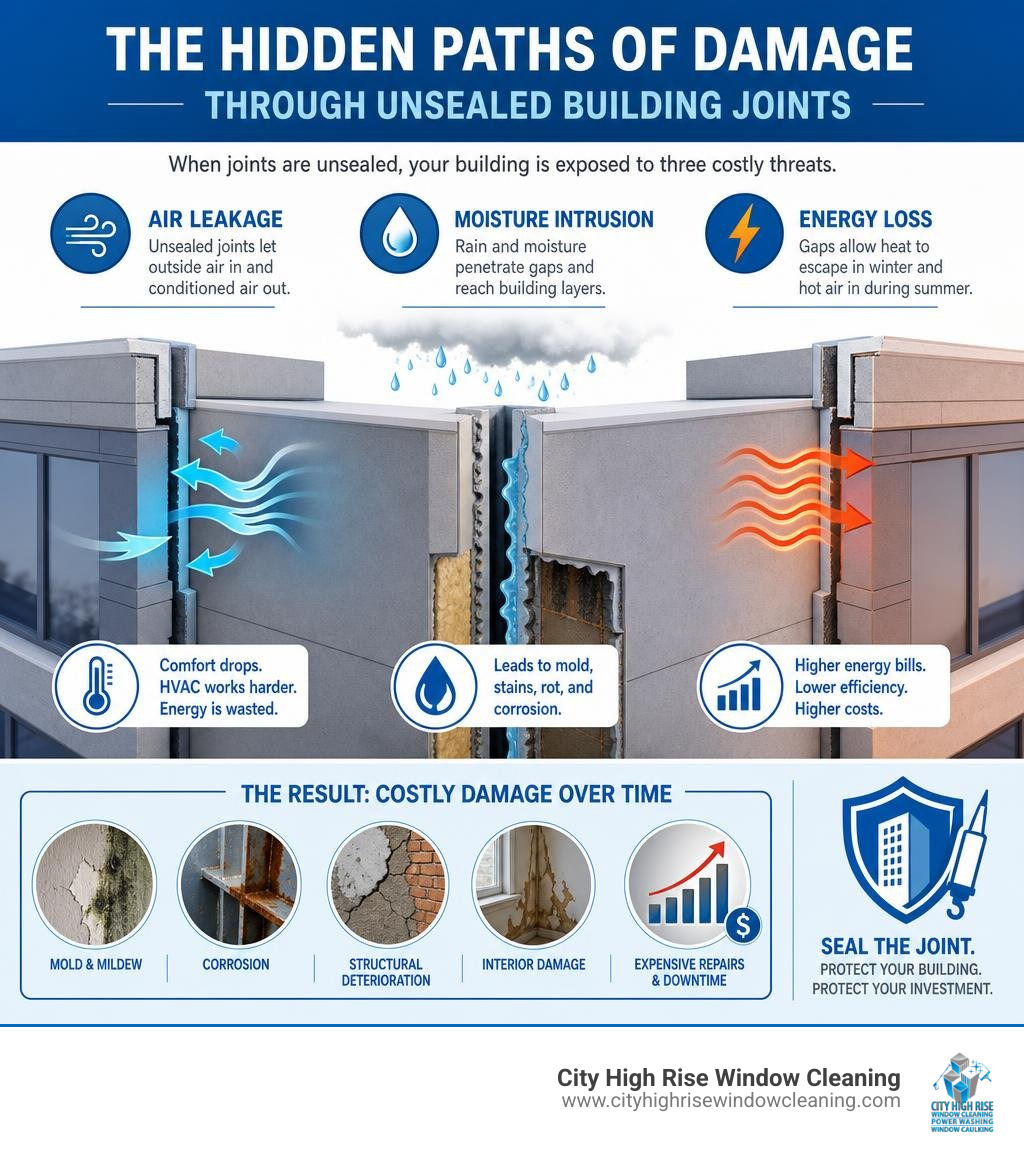
Here’s the problem most building owners don’t see coming: the joints and gaps in your facade are always moving. Every temperature swing, every wind load, every seasonal shift pushes and pulls your building’s materials apart — just a little. Over time, without a properly performing sealant, those tiny gaps become expensive problems.
Moisture intrusion through failed sealants is one of the most costly issues in modern construction, often triggering mold growth, corrosion of structural steel, and interior damage that runs far deeper than the original gap ever did.
I’m Brett Hochman, CEO of City High Rise Window Cleaning, and with nearly five decades of hands-on exterior building maintenance across New York City, New Jersey, Long Island, and Westchester, I’ve seen how the right — or wrong — building envelope sealant choice plays out on real facades. In this guide, I’ll walk you through everything you need to know to protect your property.
Simple guide to Building envelope sealant terms:
What is a Building Envelope Sealant and Why Does Your Property Need It?
A building envelope is the physical barrier that separates the conditioned interior of a building from the unconditioned outdoor environment. It includes the foundation, walls, roof, windows, and doors. Within this assembly, the building envelope sealant acts as the elastic glue holding the weather protection layer together.
Many people mistake joint sealants for a minor finishing trade detail. In reality, they are highly engineered, critical system components. Without them, the continuous air and water barrier of your building breaks down completely.
Air Barrier Continuity and Energy Efficiency
Buildings with high-performance building envelopes can achieve up to 30% energy savings compared to standard construction. When you maintain a continuous air barrier, you stop drafts and keep conditioned air inside where it belongs. When sealants fail, the building envelope loses its airtightness, forcing HVAC systems to work overtime to compensate for thermal loss.
Moisture Control and Structural Durability
Water is the single greatest enemy of structural longevity. When water infiltrates a facade, it does not just ruin the drywall; it corrodes structural steel studs, rusts concrete rebar, and causes wood framing to rot.
In our local Tri-state climate, freeze-thaw cycles are brutal. Water gets trapped behind masonry or concrete panels during a mild winter day, freezes overnight, expands, and literally cracks the facade apart. By utilizing a high-performance sealant, you create a watertight shield that prevents this cycle from starting. For more detailed insights on protecting your building’s structural health, you can read about Waterproofing Your Building Envelope Protecting Structure & Health.
To truly understand how these systems work together, check out More info about building envelope experts to see how professional diagnostics keep your property safe.
The Main Types of Sealants: Silicone, Polyurethane, and Hybrid Polymers
Selecting the right sealant chemistry is crucial. Choosing the wrong product can result in premature joint failure, ugly staining on natural stone, or paint peeling away.
Below is a technical comparison of the three primary sealant families used in modern commercial and residential construction as of June 2026:
| Feature / Property | Silicone Sealants | Polyurethane Sealants | Hybrid Polymers (MS / STPE) |
|---|---|---|---|
| Movement Capability | High to Ultra-High (±50% to +100/-50%) | Medium (±25% to ±50%) | Medium to High (±35% to ±50%) |
| UV & Weather Resistance | Excellent (does not degrade) | Moderate (prone to UV chalking) | Very Good to Excellent |
| Paintability | No (paint will bead up and peel) | Yes | Yes (highly compatible with latex) |
| Substrate Compatibility | Excellent on non-porous (glass, metal) | Good on porous (concrete, wood) | Broad (excellent primerless adhesion) |
| VOC Content | Low | Moderate to High | Very Low (often <20 g/L) |
| Staining Risk | High (fluid migration on stone) | Low | Extremely Low (non-staining) |
Traditional Silicone and Polyurethane Building Envelope Sealant Performance
Silicone Sealants
Silicone is the gold standard for high-movement weathersealing. It is inorganic, meaning sunlight, ozone, and extreme temperatures do not break down its polymer backbone.
For high-movement expansion joints, ultra-low-modulus sealants like DOWSIL™ 790 Silicone Building Sealant | Dow Inc. are unmatched. They can handle an incredible +100% extension and -50% compression, pulling very little stress on the adhesion line. This makes them perfect for sealing precast concrete panels, natural stone, and curtainwall mullions. For high-rise buildings, choosing the right silicone is the difference between a 20-year seal and a 3-year leak. Learn more about these applications in More info about high-rise joint sealing.
Polyurethane Sealants
Polyurethane sealants are tough, highly abrasion-resistant, and easily paintable. They adhere beautifully to porous substrates like concrete and masonry. However, they are organic materials. Over time, UV exposure causes polyurethane to dry out, chalk, crack, and lose its elastomeric properties. They typically have a shorter service life (10 to 15 years) compared to high-grade silicone (20+ years).
Modern Hybrid Polymers: MS and STPE Building Envelope Sealant Solutions
Hybrid sealants combine the best traits of silicones and polyurethanes. Silyl-Terminated Polyether (STPE) and Modified Silicone (MS) polymers offer excellent UV resistance and flexibility without the drawbacks of traditional chemistries.
- Paintability: Unlike silicone, hybrids can be painted over with standard acrylic or latex paints as soon as they are tack-free.
- Low VOC & Eco-Friendly: Formulations like EVOSEAL MS and HE925 – BES Sealant (Black, Gray, White) – Product Data feature 100% solids formulas with minimal solvent content, keeping VOC emissions extremely low (often under 20 g/L).
- Substrate Compatibility: Products like TOSSEAL™ 1000 MS Sealant | Modified Silicone for Façade and Joint Sealing and DOWSIL™ Contractors Paintable Sealant | Dow Inc. offer outstanding primerless adhesion to aluminum, vinyl, concrete, and masonry while remaining completely non-staining on sensitive stone facades.
Key Performance Characteristics and Joint Design
Applying sealant is not just about squeezing a trigger and smoothing it with a finger. It is a precise science of joint geometry.
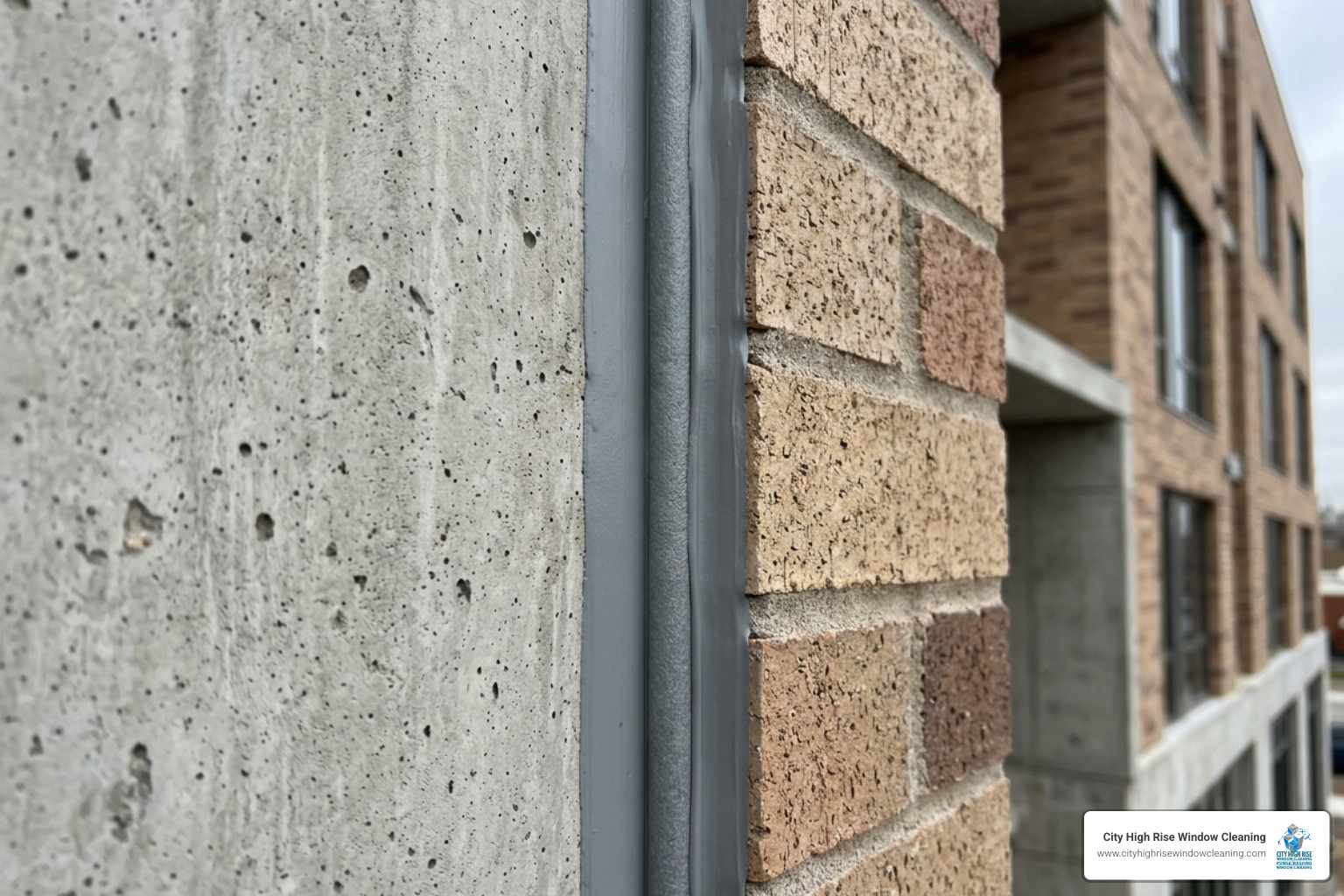
When designing or repairing joints under ASTM C920 standards, we must focus on three main physical properties:
- Movement Capability: High-performance sealants accommodate joint expansion and contraction. If a joint moves ±50%, the sealant must be rated to stretch and compress by that exact margin without tearing.
- Modulus: This refers to the force required to stretch the sealant. Low-modulus sealants stretch easily, making them ideal for delicate substrates like EIFS or concrete panels where you do not want the sealant pulling hard against the joint wall. High-modulus sealants are stiffer and better suited for high-traffic pedestrian joints or structural glazing.
- Adhesion: The sealant’s ability to stick to the joint walls.
The Golden Rule of Joint Design: Width-to-Depth Ratio
A sealant joint must never be deeper than it is wide. If it is, the sealant cannot stretch properly, leading to cohesive failure (tearing in the middle) or adhesive failure (peeling off the wall).
- For joints up to 1/2 inch wide: The depth of the sealant should equal the width (1:1 ratio), but never less than 1/4 inch deep.
- For joints wider than 1/2 inch: The depth should be capped at 1/2 inch (2:1 width-to-depth ratio).
- Backer Rod Installation: Always insert a closed-cell or open-cell backer rod into the joint before caulking. This controls the depth of the sealant, provides a firm backing for tooling, and acts as a bond breaker to prevent “three-sided adhesion” (which restricts movement and destroys the joint).
Installation, Substrate Preparation, and Preventing Common Failure Modes
Even the most expensive, high-performance building envelope sealant will fail if the installer cuts corners during preparation.
Step-by-Step Substrate Preparation
- Remove Old Sealant: Use mechanical cutters or knives to completely remove old, failed caulk.
- Clean the Joint Walls: Use a wire brush or grinder on concrete and stone. For metal and glass, use the “two-rag solvent wipe” method. Wipe the substrate with a solvent-dampened lint-free cloth, then immediately follow with a clean, dry cloth to lift contaminants.
- Prime (If Required): Perform adhesion tests. Some substrates (like highly porous sandstone or certain plastics) require a specific primer to guarantee long-term adhesion.
- Install Backer Rod: Pack the backer rod to the correct depth without puncturing it.
- Apply and Tool: Gun the sealant smoothly into the joint. Tool it immediately with a spatula to press the sealant firmly against the joint walls, ensuring 100% contact and a neat, clean finish.
Preventing Common Failure Modes
- Adhesive Failure: The sealant peels away from the substrate. This is almost always caused by poor cleaning, moisture on the substrate during application, or omitting a required primer.
- Cohesive Failure: The sealant tears down the middle. This happens when the joint moves beyond the sealant’s rated capability, or when three-sided adhesion occurs because no backer rod or bond-breaker tape was used.
Our team at City High Rise Window Cleaning works across New York City, Long Island, New Jersey, and Westchester. We deal with coastal winds off the Atlantic, high-humidity summers, and freezing winter temperatures. We adjust our application methods and material selections to match these localized climate challenges. If you need professional help, check out our window caulking services to ensure your property’s exterior joints are sealed properly by experts.
Frequently Asked Questions About Building Envelope Sealants
How does a building envelope sealant improve energy efficiency?
By sealing gaps around windows, expansion joints, and structural transitions, sealants can reduce overall air leakage by up to 40%. This drastic reduction keeps conditioned air inside, lowers heating and cooling loads on HVAC systems, and eliminates uncomfortable drafts. Local programs like the Building Envelope | NYC Accelerator emphasize air sealing as a primary step to lowering building emissions. For residential and light commercial structures, regional specialists like Air Sealing | Green Team LI | Huntington, Long Island, NY and Air Sealing Company in New Jersey – Aeroseal consistently prove that sealing these gaps is the most cost-effective way to lower utility bills.
How often should building envelope sealants be inspected and replaced?
High-performance elastomeric sealants typically have a service life of 10 to 20 years. However, due to the intense weather exposure in the Tri-state area, we highly recommend professional inspections at least every 5 years. Catching minor cracks, chalking, or cohesive failures early allows for localized repairs before water penetrates deep into the wall assembly.
Can hybrid polymer sealants be painted?
Yes! One of the biggest advantages of modern STPE and MS hybrid polymers is their paintability. While traditional silicone rejects paint, hybrid sealants can be painted over with standard latex or acrylic architectural coatings as soon as they cure. This makes them highly popular for window perimeters, storefront facades, and decorative siding applications where color matching is critical.
Conclusion
Your building’s facade is constantly under attack from wind, rain, UV radiation, and shifting temperatures. Investing in high-quality building envelope sealant and professional installation is the most effective way to protect your structural investment, cut energy costs, and prevent water damage.
At City High Rise Window Cleaning, we bring over 30 years of specialized experience in high-rise window cleaning, power washing, and exterior building restoration to every project. Backed by our 100% customer satisfaction guarantee and an uncompromising commitment to safety, we ensure that your property’s joints, windows, and facade transitions remain completely watertight.
Don’t wait for a costly interior leak to tell you your caulking has failed. Schedule professional window caulking services with my team today to keep your building secure.
Ready for a free quote? City High Rise Window Cleaning offers 24/7 live consultation.


