

Brick by Brick: A Guide to Historic Masonry Repair
Brick by Brick: A Guide to Historic Masonry Repair
Why Historic Masonry Repair Is Critical for Your Building’s Future
Historic masonry repair is the process of restoring, stabilizing, and maintaining the brick, stone, terra cotta, and mortar of older buildings — without causing further damage in the process.
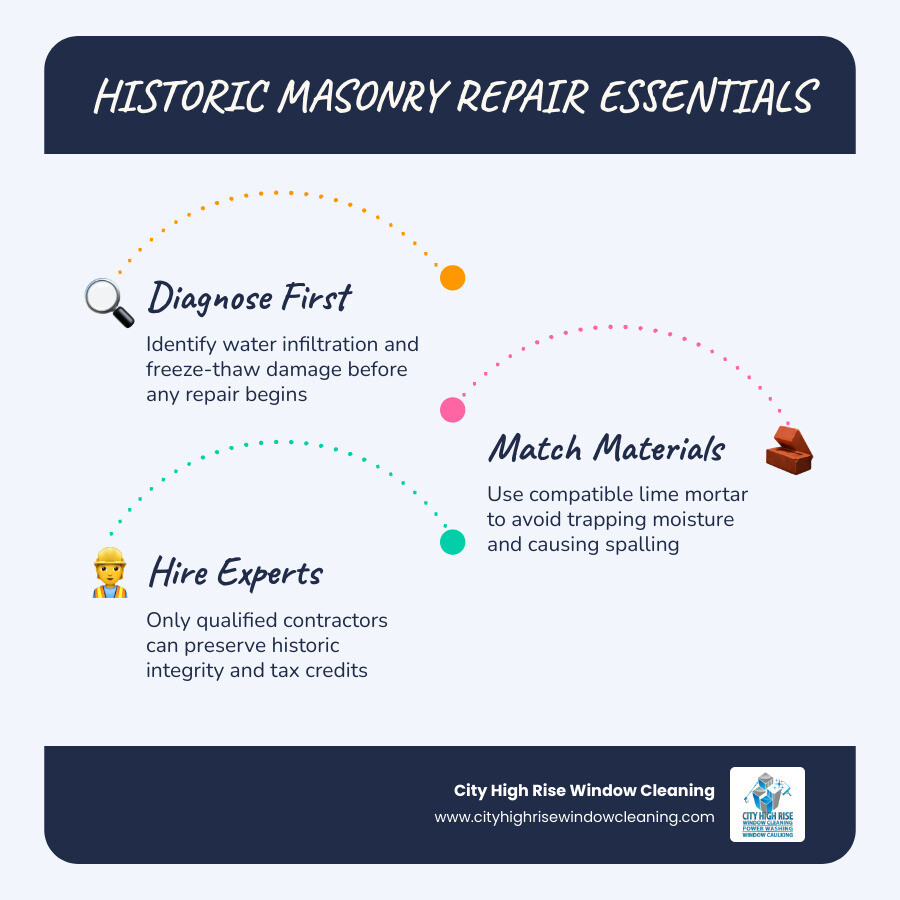
If you need the short version, here’s what matters most:
- Use lime mortar, not Portland cement — modern cement traps moisture and can destroy historic brick
- Diagnose before you repair — water infiltration is the most common hidden cause of masonry failure
- Match materials exactly — wrong composition, color, or texture can void historic tax credits and accelerate deterioration
- Hire qualified contractors — look for documented experience with historic structures and knowledge of preservation standards
- Act early — small cracks and spalling get expensive fast if ignored
Historic masonry is not just an aesthetic concern. Buildings 50 years or older with architectural or cultural significance represent a major portion of the U.S. building stock — and they require a fundamentally different approach than modern construction. The same freeze-thaw cycles, water infiltration, and material fatigue that affect any building hit historic structures harder, because their original materials — soft brick, lime mortar, hand-cut stone — were never designed to work with today’s rigid, moisture-blocking repair products.
Get it wrong, and you don’t just fail to fix the problem. You make it worse. Incompatible mortars, harsh chemical cleaners, and impermeable sealants are among the leading causes of accelerated deterioration in historic masonry buildings.
Get it right, and a well-maintained masonry structure can last centuries.
I’m Brett Hochman, CEO of City High Rise Window Cleaning, and with nearly five decades of hands-on exterior building maintenance experience across New York City, Long Island, Westchester, and New Jersey, I’ve seen how critical proper historic masonry repair is to protecting both a building’s structure and its long-term value. In the sections ahead, I’ll walk you through exactly what it takes to do it right.
Historic masonry repair word list:
- Building facade repair
- Commercial facade restoration
- historic window restoration near me
Why Historic Masonry Demands Specialized Preservation
To understand why historic masonry repair requires a specialized touch, we have to look at how buildings were built before the mid-20th century. Modern buildings rely on cavity walls, weep holes, and internal flashing systems to divert moisture away from the interior. They are designed to block water at the outer skin.
Historic buildings, on the other hand, rely on “mass wall” systems. These thick masonry walls act like a giant sponge. They absorb rainwater during a storm and slowly breathe it back out into the air as vapor when the sun comes up. This natural process is called vapor permeability.
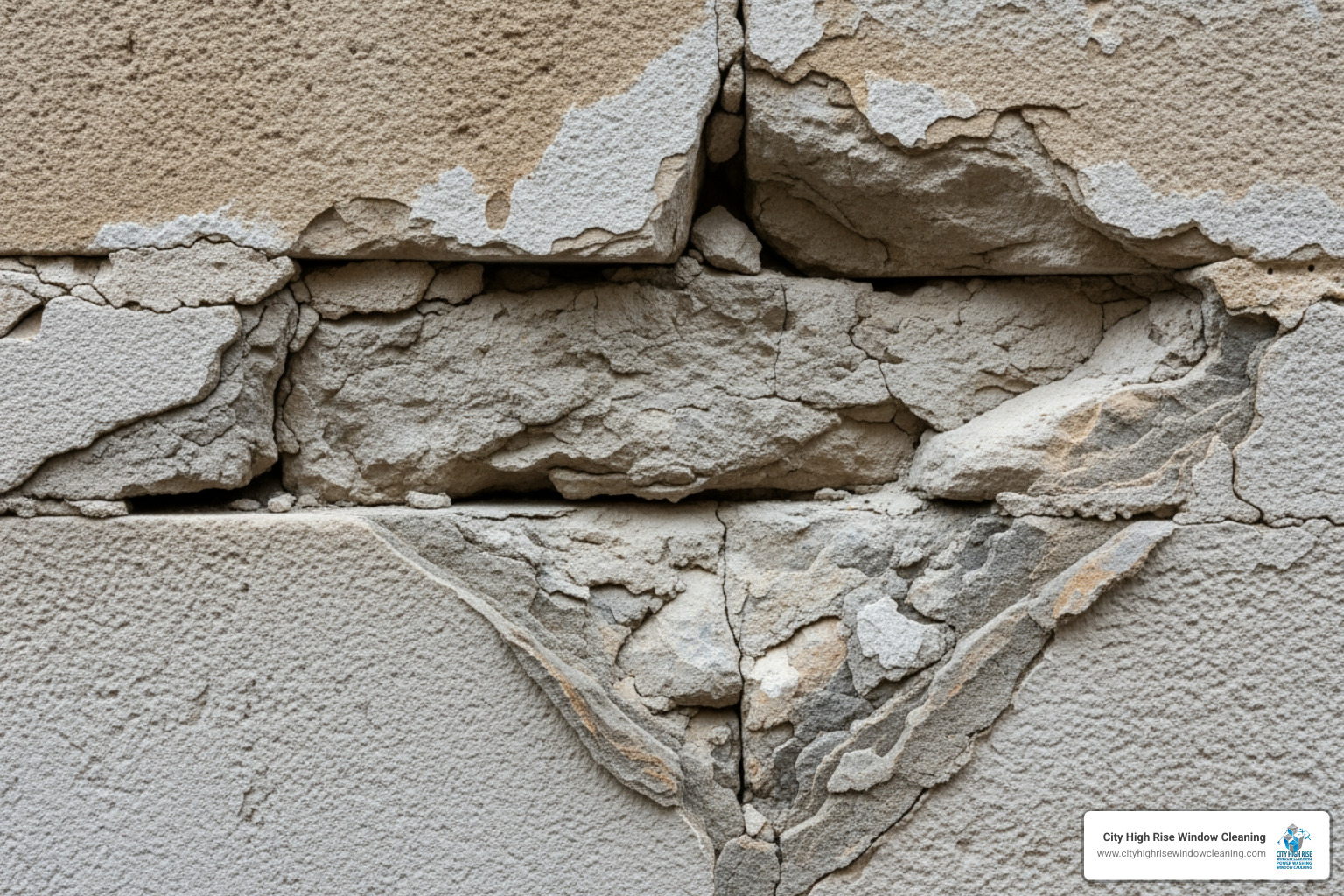
If you apply a modern waterproof sealant or an impermeable synthetic coating to a historic mass wall, you trap that moisture inside. When the freezing winter temperatures hit New York, Long Island, Westchester, or New Jersey, that trapped water expands. The result? The face of your beautiful historic brick or stone cracks, breaks, and pops off. This destructive process is known as spalling.
Over time, undetected water infiltration inside a mass wall system does more than damage the surface. It can rust internal structural steel supports, rot timber floor joists, and eventually lead to sudden structural failures. This is why preserving the natural breathing cycle of historic masonry is the golden rule of restoration. To keep your building’s envelope healthy, you must approach repairs with materials that match the physical properties of the original structure.
If you want to keep your property structurally sound and compliant with local preservation laws, you can learn more about NYC building restoration or discover the A to Z of facade repair to understand the wider scope of exterior building maintenance.
Traditional Lime Mortar vs. Modern Cement
One of the most common—and expensive—mistakes I see building owners make is using modern masonry cement to repair historic brickwork. Mortar typically comprises 20 to 25 percent of a masonry wall system. Because it makes up such a large portion of the wall, choosing the wrong mortar is a guaranteed way to destroy historic masonry.
Before the early 20th century, masonry structures were built using traditional lime mortar (a simple mixture of sand, lime, and water). Modern masonry cement, on the other hand, contains Portland cement, ground limestone, and air-entraining agents.
While modern Portland cement is incredibly strong, rigid, and fast-setting—which is great for modern steel-framed buildings—it is completely incompatible with historic brick and stone. Historic bricks were fired at lower temperatures, making them much softer and more porous than modern bricks. If you sandwich a soft historic brick between joints of rock-hard, inflexible modern cement, the brick becomes the weakest link. When the building naturally settles or shifts due to thermal expansion, the modern mortar won’t budge. Instead, the soft historic bricks will crack and crush under the pressure.
Traditional lime mortar has a low compressive strength and high flexibility. It is designed to be softer than the surrounding brick or stone, acting as a sacrificial element that absorbs building movement. Furthermore, lime mortar is highly vapor-permeable, allowing moisture to escape through the joints rather than trapping it inside the brick. It even has “self-healing” properties: when minor hairline cracks form, rainwater dissolves free lime within the mortar and redeposits it into the cracks, knitting them back together over time.
| Characteristic | Traditional Lime Mortar | Modern Portland Cement |
|---|---|---|
| Compressive Strength | Low (Softer than the brick) | High (Harder than historic brick) |
| Flexibility | High (Accommodates building movement) | Low (Rigid, brittle under stress) |
| Vapor Permeability | High (Allows the wall to breathe) | Low (Traps moisture inside the wall) |
| Self-Healing Properties | Yes (Free lime fills micro-cracks) | No (Cracks remain and expand) |
| Primary Binder | Lime putty or hydraulic lime | Portland cement |
When performing repairs, contractors must follow strict historic preservation guidelines to ensure the mortar matches the original historic mix. For federal and public buildings, this often means adhering to the strict guidelines outlined in the Read the UFGS 04 03 00 Conservation Treatment specifications, which require laboratory testing of original mortar samples to match binder-to-aggregate ratios, sand color, and grain size.
Best Practices for Historic Masonry Repair
Preserving a historic facade requires patience, specialized tools, and a deep respect for original materials. You cannot simply pull up to a 100-year-old building with a high-pressure power washer and a bucket of off-the-shelf mortar and expect a good result. In fact, abrasive cleaning methods like sandblasting or high-pressure washing can permanently strip the hard protective outer glaze off historic bricks, leaving the soft inner core exposed to rapid weathering.

Instead, best practices dictate using the gentlest means possible. Cleaning should begin with low-pressure water and natural bristle brushes, moving to mild chemical cleaners or specialized steam cleaning only when absolutely necessary. Every single repair material introduced to the building must be physically and chemically compatible with the original substrate.
If your building’s exterior is showing signs of age, it is vital to work with professionals who understand these delicate balances. I encourage you to explore our commercial facade restoration services to see how we handle these high-stakes projects.
Diagnosing Damage Before Historic Masonry Repair
Before picking up a trowel, a professional must conduct a thorough diagnostic assessment. If you skip this step, you are simply treating the symptoms of masonry distress while ignoring the underlying disease.
Diagnostics start with a meticulous visual inspection to identify signs of cracking, bowing, spalling, and efflorescence (salty white deposits left behind by evaporating water). However, because many structural issues are hidden deep within thick mass walls, we often employ non-destructive testing (NDT) methods.
Ground-penetrating radar (GPR) and surface-penetrating radar allow us to map internal voids, locate structural steel, and check the placement of reinforcement anchors without damaging the historic fabric. We also use flatjack testing—inserting thin, inflatable bladders into mortar joints—to measure the actual compressive stress and mechanical properties of the existing masonry in situ. Understanding how water moves through the facade is equally critical, which is why we monitor water infiltration routes using thermal imaging and moisture meters. To keep your historic property safe and compliant, you should understand the importance of exterior building maintenance as a proactive shield against major structural failures.
Essential Techniques in Historic Masonry Repair
Once the diagnosis is complete, we use several highly specialized techniques to restore the structural and aesthetic integrity of the building:
- Repointing (Tuckpointing): This involves carefully raking out deteriorated, loose mortar to a depth of roughly two to two-and-a-half times the width of the joint. We use hand chisels or specialized low-speed pneumatic tools to avoid damaging the brick edges. The joint is then packed with compatible lime mortar in thin layers, which are compacted and finished to match the original historic joint profile.
- Dutchman Repairs: When a portion of a historic stone block is severely damaged but the rest is sound, we perform a Dutchman repair. We cut out the damaged section and precisely fit a matching piece of new stone (sourced to match the original quarry’s color, grain, and texture) into the void, securing it with non-corrosive dowels and lime-based adhesive.
- Stone Patching: For minor ornamental stone damage where a Dutchman repair is impractical, we use custom-formulated, mineral-based restoration mortars (such as Jahn mortar). These specialized patching compounds are engineered to match the physical properties—like vapor permeability and thermal expansion—of the specific stone being repaired.
- Brick Replacement: When individual historic bricks are completely crushed or spalled, we carefully extract them. We source matching period bricks from local salvage yards or architectural reclamation projects to ensure they match the original color, density, and size.
- Composite Reinforcement: In cases of severe structural cracking or seismic vulnerability, we can integrate modern composite materials. By using the “indentation technique,” we can embed high-strength carbon or glass fiber composite strips within the bed joints of the masonry during reconstruction, providing incredible tensile strength without altering the exterior appearance of the building. You can read about composite applications in heritage buildings to see how cutting-edge engineering preserves historical aesthetics.
Case Studies in Structural Preservation
To see these preservation principles in action, we can look at several landmark projects that demonstrate how modern engineering and traditional craftsmanship come together:
The Monadnock Building (Chicago, IL)
Completed in 1891, the 16-story Monadnock Building remains one of the tallest and most famous examples of historic mass masonry construction in the world. Because it does not have a steel frame, its load-bearing brick walls must support the entire weight of the building, requiring base walls that are an incredible 6 feet thick. Preserving a building of this scale requires a deep understanding of structural load distribution and continuous monitoring to ensure that modern environmental changes do not disrupt the delicate balance of the mass masonry system.
The Charleston County Courthouse Restoration
This historic building, originally constructed in 1753, underwent a massive $2.5 million restoration. The project involved repairing over 6,000 square feet of stucco, 2,500 linear feet of mortar joints, and replacing 300 square feet of period brick. Because matching the original materials was critical to maintaining its historic tax credit eligibility, the restoration team went so far as to source period-appropriate brick from nearby historic demolition sites, ensuring a seamless aesthetic and physical match. You can learn about the Charleston Courthouse restoration to see the logistical and material challenges of preserving 18th-century structures.
Notre Dame Cathedral (Paris, France)
Following the devastating fire of 2019, the restoration of Notre Dame Cathedral presented unprecedented challenges in historic masonry consolidation. While collapsed sections of the vaulted stone ceilings had to be completely reconstructed, surviving vaults that suffered severe thermal shock from the fire had to be consolidated. Engineers used specialized lime-based grouts and consolidants to repair internal delamination—where the upper layers of the stone had separated—restoring the original thickness and structural stability of the 800-year-old vaults. To understand the immense scale of this triumph, you can read more about how Notre Dame was reconstructed to how it used to be.
Altgeld Hall Bell Tower (Urbana-Champaign, IL)
Built in 1897 in the Romanesque style, the Altgeld Hall Bell Tower required significant structural reinforcement to withstand wind and seismic loads. To accomplish this without altering its landmarked exterior, engineers cored vertical, horizontal, and through-wall reinforcement directly into the tower’s mass masonry walls. These rods were secured using a customized Cementitious Compatible Injected Fill (CIF) grout, which filled internal voids between the sandstone exterior and brick backing. The team used surface-penetrating radar throughout the multi-staged injection process to verify that the grout completely filled the voids without creating high-pressure blowouts. You can read the Altgeld Hall Bell Tower reinforcement study to dive deep into the technical data behind this complex structural save.
Frequently Asked Questions about Historic Masonry
Why is modern Portland cement bad for historic brick?
Modern Portland cement is extremely hard, rigid, and virtually waterproof. Historic bricks are soft and porous. When you use Portland cement to repoint historic brick, it creates a rigid joint that does not allow for thermal expansion or moisture evaporation. As a result, moisture becomes trapped behind the cement. During freeze-thaw cycles, this trapped water expands, causing the face of the historic brick to crack and pop off (spall). Over time, the rigid cement will literally crush the softer historic bricks around it.
How do you match historic mortar for repointing?
Matching historic mortar requires a scientific approach called mortar analysis. A small sample of the original mortar is taken from a protected area of the building and tested in a laboratory. The binder (usually lime) is dissolved using acid, leaving behind the sand aggregate. We then analyze the sand’s color, grain size distribution, and mineral composition. This allows us to recreate a matching mortar mix using the correct ratio of lime binder to aggregate, ensuring the new mortar matches the original in color, texture, strength, and vapor permeability.
What certifications should a historic masonry contractor have?
When hiring a contractor for historic masonry repair, look for firms with a dedicated Quality Control Plan and specialized training in historic preservation. Key qualifications include having a designated Historic Masonry Consultant, highly trained Masonry Applicators with documented experience on buildings of similar age, and familiarity with the Secretary of the Interior’s Standards for the Treatment of Historic Properties. In the tri-state area, they must also be thoroughly versed in local safety and compliance standards, such as New York City’s Facade Inspection & Safety Program (FISP/Local Law 11).
Conclusion
Preserving the architectural heritage of New York City, Long Island, Westchester, and New Jersey is a responsibility I don’t take lightly. Historic buildings are the soul of our communities, but they require active, informed stewardship to survive. From the soft brownstones of Brooklyn to the historic brick warehouses of New Jersey, proper historic masonry repair is the single most important investment you can make to protect your building’s structural integrity, maintain its value, and comply with strict local safety regulations like Local Law 11.
At City High Rise Window Cleaning, we bring over 30 years of exterior building expertise, a 100% customer satisfaction guarantee, and an uncompromising commitment to safety to every project we touch. Whether you need a historic facade cleaned, repointed, or fully restored, my team has the specialized knowledge to do the job right—preserving your building’s past while securing its future.
If your historic windows also need attention, you can get professional window restoration services to ensure your entire building envelope remains beautifully integrated and watertight.
Ready for a free quote? City High Rise Window Cleaning offers 24/7 live consultation. Call 917-749-8342 to speak to a live representative.


