

Avoiding the Drop: Lessons from High-Rise Cleaning Incidents
Avoiding the Drop: Lessons from High-Rise Cleaning Incidents
7 Deadly High-Rise Window Cleaning Accidents: How NYC Owners Avoid $447K Fines
High-rise window cleaning accidents are rare — but when they happen, the consequences are catastrophic.
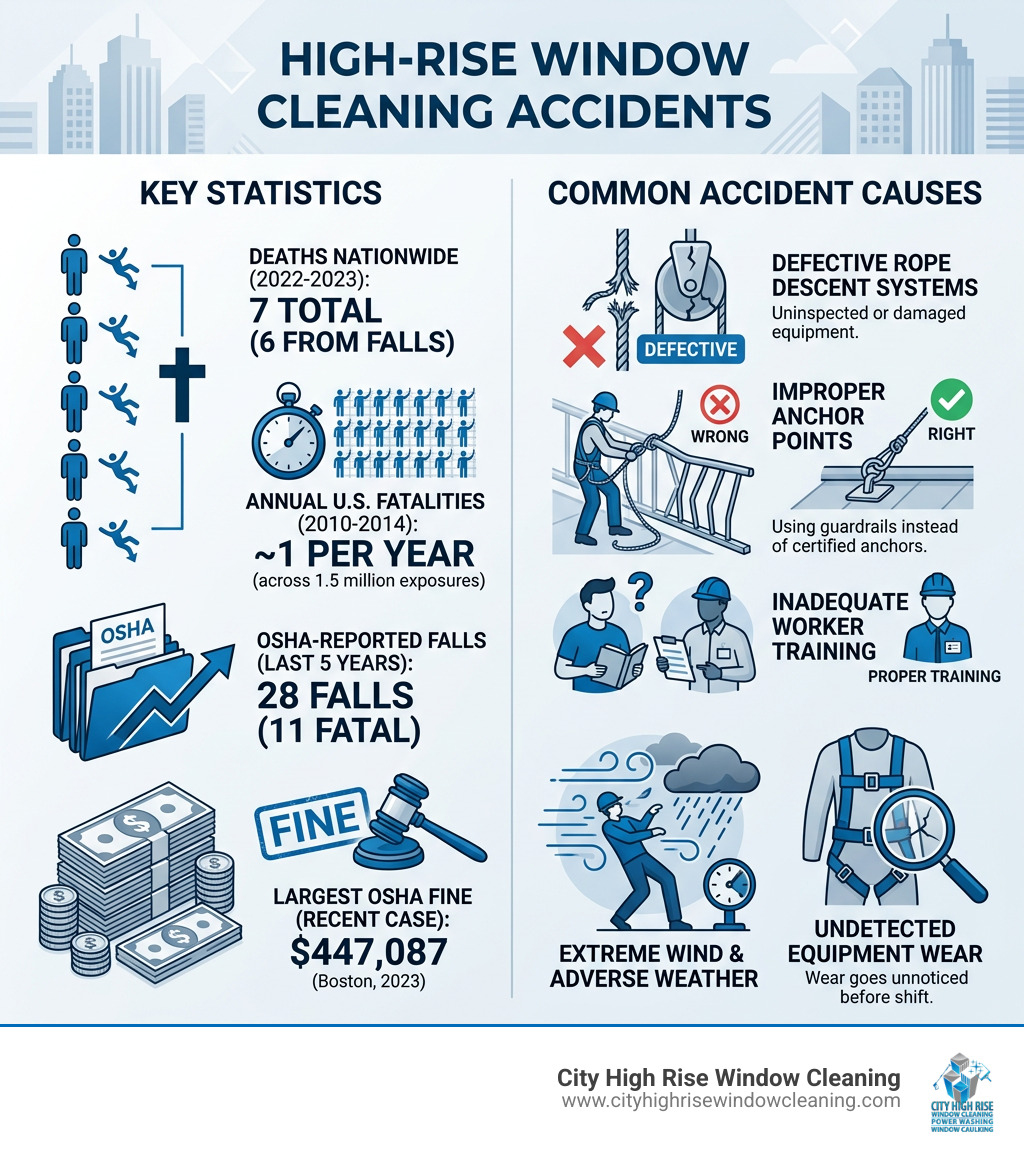
Here’s a quick overview of what you need to know:
| Factor | Key Data |
|---|---|
| Annual U.S. fatalities (2010-2014) | ~1 per year across 1.5 million exposures |
| Deaths nationwide (2022-2023) | 7 total, 6 from falls |
| OSHA-reported falls (last 5 years) | 28 falls, 11 fatal |
| NYC daily falls | ~15 window washers per day |
| Largest OSHA fine (recent case) | $447,087 — Boston, 2023 |
The most common causes of accidents include:
- Uninspected or defective rope descent systems
- Improper anchor points (e.g., using guardrails instead of certified anchors)
- Inadequate worker training
- Extreme wind and adverse weather
- Equipment wear that goes undetected before a shift
The industry has come a long way. In the 1930s, one in every 200 New York City window cleaners died on the job each year. Modern safety standards have dramatically cut that number — but zero risk doesn’t exist, and recent fatalities prove that complacency kills.
I’m Brett Hochman, CEO of City High Rise Window Cleaning, with over 48 years of hands-on experience in exterior building maintenance and a career built around preventing high-rise window cleaning accidents before they happen. The case studies and lessons in this guide reflect what I’ve seen — and what every building owner in NYC, Long Island, Westchester, and New Jersey needs to understand.
The Reality of High-Rise Window Cleaning Accidents in NYC
When I look out over the Manhattan skyline, I see more than just glass and steel; I see a high-stakes environment where safety isn’t just a suggestion—it’s a lifeline. To understand the gravity of high-rise window cleaning accidents, we have to look at how far we’ve come. Back in the 1930s, New York City was a different world. It’s estimated that one out of every 200 window cleaners lost his life annually. In those days, a “safety belt” was often just a piece of leather that might or might not hold.

Today, the numbers tell a much more encouraging story, but one that still demands our full attention. Between 2010 and 2014, the International Window Cleaning Association (IWCA) noted that only about one fatality per year occurred among U.S. high-rise cleaners. When you consider there are roughly 1.5 million “exposures” (individual work sessions) annually, the statistical risk is incredibly low. However, recent data shows a slight uptick that keeps me up at night. Between January 2022 and December 2023, seven window washers died nationwide—six of them from falls. In a city like New York, where thousands of windows are cleaned daily, OSHA reports that roughly 15 window washers experience some form of a fall incident every single day. Most are minor or caught by secondary systems, but they are all warnings.
For building managers, ensuring that your Commercial High-Rise Window Cleaning partner isn’t just “fast” but “fail-safe” is the only way to protect your property and the lives of those working on it.
Statistical Comparison to Other Dangerous Jobs
It might surprise you to learn that, statistically, cleaning windows on a 50-story skyscraper in Jersey City or White Plains is often safer than driving a taxi in Manhattan. While the heights are dizzying, the industry is heavily regulated. According to Latest OSHA incident data, the fatality rate for window cleaners is lower than that of logging workers (100 deaths per 100,000), fishermen (80 per 100,000), and even roofers (47 per 100,000).
Even taxi drivers, with a rate of 18 deaths per 100,000, face more daily peril than a properly trained high-rise technician. The difference is the “catastrophic potential.” A taxi fender-bender is a headache; a window cleaning equipment failure is a headline. This is why we treat every single harness clip with the same intensity as a pilot checking their engines before takeoff.
Case Studies: When Equipment and Protocol Fail in High-Rise Cleaning
I’ve spent nearly five decades in this industry, and I’ve learned that most high-rise window cleaning accidents aren’t “freak occurrences.” They are the result of a chain of small failures. Take the famous 2014 incident at the World Trade Center. Two cleaners were stranded 69 stories up when a cable on their scaffold developed a slack, leaving them dangling at a terrifying angle. Thankfully, they were rescued uninjured, but it served as a global reminder of how quickly things can go wrong.
Perhaps the most miraculous—and tragic—case I often discuss is that of the Moreno brothers. In 2007, their platform failed at the 47th floor. Tragically, one brother died instantly, but the other survived the 47-story fall. Doctors noted he required 24 pints of blood and achieved an 80% recovery. It’s a story of survival that defies physics, but it’s a story no one should ever have to tell. More recently, news from KABC – Source:KABC and other outlets have highlighted how even modern rigs can become “pendulums” in high winds, smashing into the very glass they were meant to clean.
Lessons from the 100 Summer Street High-Rise Window Cleaning Accidents
The October 2023 tragedy at 100 Summer Street is a case study every building owner in the Tri-State area should memorize. Nicholas Marks, a veteran cleaner with over 20 years of experience, fell to his death while preparing to clean a high-rise tower. The Official OSHA Citation for 100 Summer Street Incident revealed a heartbreaking series of preventable errors.
The investigation found that the anchor line snapped while he was climbing into his bosun’s chair. Worse, the backup lifeline also failed. OSHA cited the employer for willful violations, including:
- Failure to inspect ropes at the start of the shift.
- Using roof guardrails as anchor points instead of certified building anchors.
- Lack of training on how to identify frayed or damaged ropes.
- Failure to use padding to protect ropes from sharp edges.
The resulting $447,087 fine is a drop in the bucket compared to the loss of life, but it highlights the legal and financial ruin that follows a refusal to follow basic safety protocols.
Top Causes of Fatal Falls and Near-Misses in High-Rise Window Cleaning
In my 48 years, I’ve seen that high-rise window cleaning accidents usually boil down to a few critical “failure points.” If you are a property manager in Long Island or Westchester, these are the red flags you need to watch for during Residential High-Rise Window Cleaning operations.
- Equipment Erosion and Wear: Ropes and cables aren’t immortal. Constant exposure to UV rays, salt air (especially near the Jersey Shore or Long Island Sound), and building chemicals can weaken fibers.
- Frayed Ropes and Cables: A single “burr” or sharp piece of metal on a building’s facade can act like a saw against a tensioned rope. If the crew isn’t using edge protectors, they are flirting with disaster.
- Lack of Proper Training: Just because someone isn’t afraid of heights doesn’t mean they are a technician. Professional certification in rope access is non-negotiable.
- Improper Use of Anchor Points: This is a major one. I’ve seen crews tie off to vents, pipes, or guardrails. These are not designed to hold the weight of a falling human.
- Failure to Conduct Pre-Shift Inspections: Every piece of gear must be touched and inspected every single morning. No exceptions.
- Using Unapproved or Makeshift Equipment: “MacGyvering” a solution on a 30th-story ledge is a recipe for a funeral.
How Weather Triggers High-Rise Window Cleaning Accidents
Weather is the most unpredictable variable in our work. In NYC, the “canyon effect” can turn a 15 mph breeze at street level into a 40 mph gust at the top of a skyscraper. When wind catches a platform, it creates a “pendulum effect.”
As seen in this Video of NYC swaying rig, high winds can cause a rig to swing out of control, smashing windows and putting both the workers and pedestrians below in extreme danger. At City High Rise Window Cleaning, we monitor weather data in real-time. If the wind exceeds safe thresholds, we pack it up. A clean window is never worth a life.
Regulatory Standards and Prevention Strategies for NYC High-Rises
New York has some of the strictest safety standards in the world, and for good reason. As a premier Manhattan High-Rise Window Cleaning Company, we live and breathe these regulations.
NY Labor Law 240, often called the “Scaffold Law,” is particularly important. It places the ultimate responsibility for worker safety on building owners and contractors. If a worker falls because proper safety equipment wasn’t provided or maintained, the owner is often held “strictly liable.” This means you can’t just point the finger at the cleaning company; you have a vested interest in ensuring they are following the law. Furthermore, FISP (Facade Inspection Safety Program) inspections, formerly known as Local Law 11, require regular checks of a building’s exterior, which includes the very anchor points our teams use.
Advanced Safety Equipment and Fall Protection Systems
The gear has evolved significantly since I started. We now utilize:
- Enhanced Harness Systems: Designed to distribute pressure and prevent “suspension trauma” if a worker is left hanging.
- Self-Retracting Lifelines (SRLs): These act like a car’s seatbelt, locking instantly if they sense a sudden drop.
- Permanent Anchor Systems: We advocate for building owners to install certified, tested anchors that are integrated into the building’s structure.
- SPRAT/IRATA Rope Access: This is the “gold standard.” These technicians are trained in dual-rope systems, meaning they always have a 100% redundant safety line.
For more information on how building managers can stay ahead of these risks, check out our Essential High-Rise Safety Tips for Building Managers.
Frequently Asked Questions about High-Rise Window Cleaning Safety
How common are fatalities in high-rise window cleaning?
Statistically, fatalities are rare, with approximately one death per year in the U.S. despite 1.5 million annual exposures. However, non-fatal falls and equipment malfunctions occur more frequently in high-density areas like New York City, Long Island, and Westchester. The key is that while deaths are rare, the potential for them is present every day, which is why we never lower our guard.
What are the main causes of equipment failure in high-rise cleaning?
Most failures stem from a lack of thorough pre-shift inspections, using unapproved anchorages (like roof guardrails), and rope erosion caused by contact with sharp building edges or hidden metal components. In the 100 Summer Street case, it was a combination of defective ropes and improper anchors that led to the tragedy.
What legal protections do window cleaners have in New York?
New York Labor Law Sections 202 and 240(1) provide strict liability protections for workers. These laws hold building owners and contractors responsible for providing proper safety equipment. If you are a building owner, this means you must vet your contractors thoroughly to ensure they are fully insured and OSHA-compliant to protect yourself from massive legal claims.
Conclusion: Securing Your High-Rise Against Accidents
High-rise window cleaning accidents are almost always preventable. They are not acts of God; they are usually the result of skipped steps, uninspected gear, or poor training. When you hire a window cleaning service, you aren’t just paying for clear glass—you are paying for the peace of mind that comes with a rigorous safety culture.
City High Rise Window Cleaning brings over 30 years of experience, a 100% customer satisfaction guarantee, and a safety-first culture to every project. Whether you are managing a luxury residential tower in Brooklyn, a corporate headquarters in Stamford, or a commercial complex in New Jersey, we ensure your building’s facade is impeccably clean and your property is protected from liability. Don’t gamble with “budget” services that cut corners on safety. Trust us for professional, safe, and reliable Professional High-Rise Services.
Ready for a free quote? City High Rise Window Cleaning offers 24/7 live consultation. Call 917-749-8342 to speak to a live representative.


