

Building Envelope Restoration 101: Keeping the Outside Out
Building Envelope Restoration 101: Keeping the Outside Out
Your Building’s Biggest Threat Is the One You Can’t See — Until It’s Too Late
Building envelope restoration is the process of repairing and rehabilitating a building’s exterior systems — including cladding, windows, sealants, and waterproofing — to stop moisture intrusion, prevent structural damage, and extend the life of the building.
Here’s what it covers at a glance:
| Component | What It Does | Why It Fails |
|---|---|---|
| Cladding & facades | Shields the structure from weather | UV exposure, impact, age |
| Windows & doors | Seals openings against air and water | Failed sealants, worn frames |
| Joint sealants | Fills gaps between materials | Freeze-thaw cycles, shrinkage |
| Waterproofing membranes | Blocks moisture at walls and below grade | Cracking, delamination |
| Roofing systems | Top-layer weather barrier | Age, ponding water, storm damage |
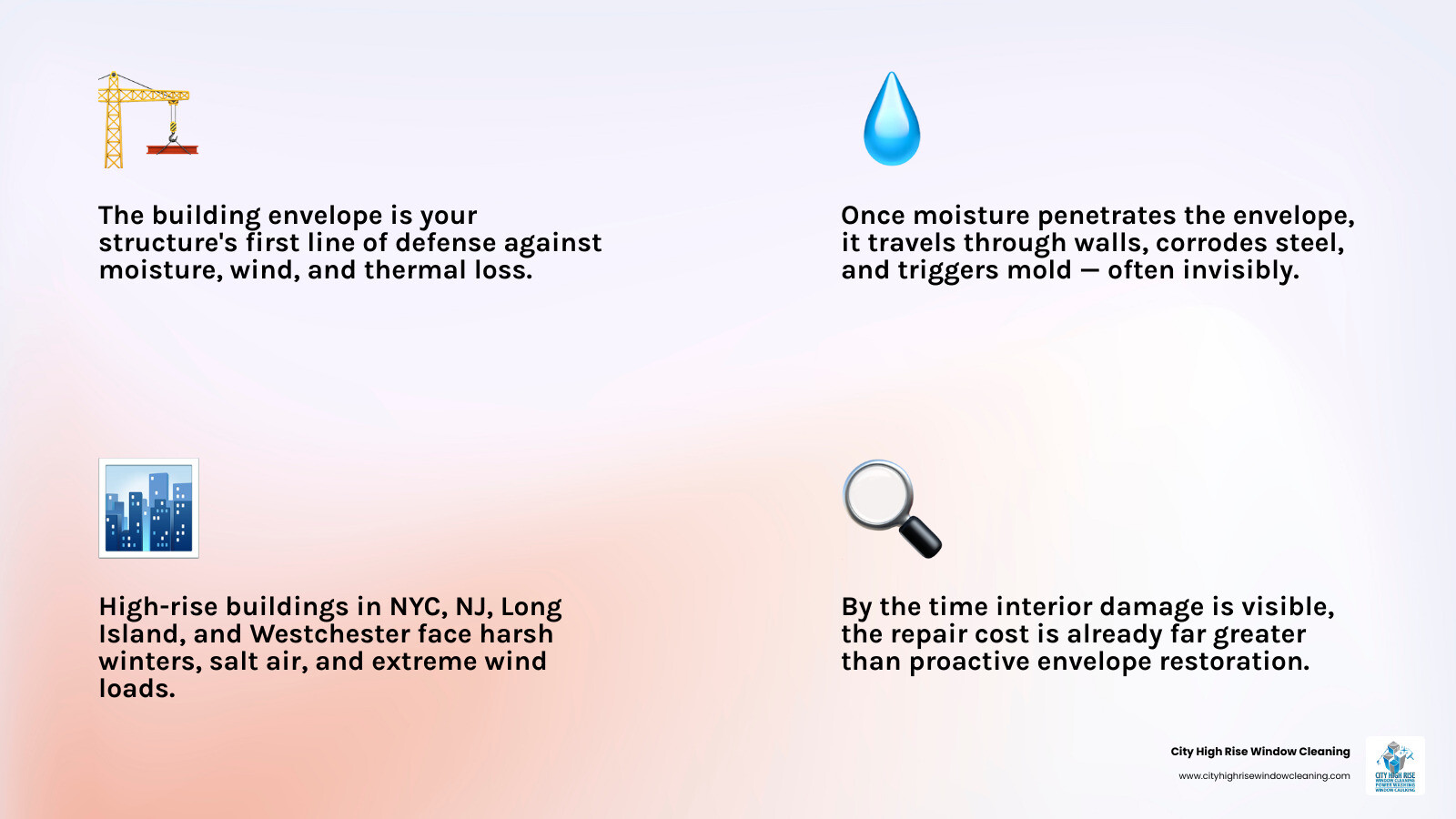
Think of the building envelope as a shell. Every crack, gap, or failing seal is an opening for water — and water is the enemy. Once moisture gets in, it doesn’t stay put. It travels through walls, corrodes steel, rots framing, and triggers mold. The damage compounds quietly, and by the time it’s visible inside, the repair bill is already much larger than it needed to be.
This is especially true for high-rise buildings in New York, New Jersey, Long Island, and Westchester, where harsh winters, coastal salt air, and relentless wind loads put the envelope under constant stress.
I’m Brett Hochman, CEO of City High Rise Window Cleaning, and I’ve spent over 48 years working on the exteriors of commercial and residential high-rises across the NYC metro area — from building envelope restoration projects to facade repairs, window caulking, and waterproofing. I’ve seen what happens when envelope maintenance gets deferred, and this guide is built to help you avoid those costly mistakes.
According to the National Institute of Building Sciences, investing in building maintenance and hazard mitigation consistently delivers significant long-term savings compared to reactive repair — a principle that applies directly to envelope restoration.
Quick Building envelope restoration definitions:
- Building facade repair
- Commercial facade restoration
- Window seal replacement
What is a Building Envelope and Why Does It Fail?

The building envelope is the physical separator between the conditioned interior of a building and the unconditioned exterior environment. It is your property’s primary line of defense. A fully functional envelope must manage water, control air flow, regulate temperature, and withstand physical structural loads.
When we talk about the envelope failing, we rarely mean a catastrophic collapse. Instead, failure typically starts small: a tiny tear in a flashing membrane, a hairline crack in a concrete facade, or a dried-out bead of caulking around a 15th-story window.
Because a building is a dynamic system, these minor entry points allow water to penetrate under wind pressure. Once inside the wall assembly, that water can become trapped. It undergoes freeze-thaw cycles, rusting out steel structural supports such as lintels and rebar, then deteriorating drywall and insulation.
Understanding how these systems fail is the first step toward protecting your investment. If you suspect your property’s exterior is compromised, you can learn more about professional facade restoration services to see how we address these vulnerabilities before they escalate.
Common Signs of Building Envelope Failure
In my decades of maintaining high-rise properties in the Tri-State area, I have learned that buildings almost always tell you when they are in trouble. You just have to know what to look for.
Here are the most common warning signs that your building envelope is failing:
- Water Intrusion and Interior Leaks: The most obvious sign. If you see water stains on interior ceilings, bubbling paint near windows, or damp drywall, your envelope has been breached.
- Efflorescence: This is a white, powdery substance that appears on brick, concrete, or stucco surfaces. It occurs when water dissolves mineral salts within the masonry, carries them to the surface, and evaporates, leaving the salt behind. It is a clear indicator of active water movement through your walls.
- Cracking Stucco and Spalling Concrete: When moisture gets behind stucco or concrete, it rusts the embedded metal lath or reinforcing steel. As steel rusts, it expands, cracking the masonry and causing chunks of concrete to break off. This is a major safety hazard for pedestrians below.
- Failing Sealants and Caulking: If the sealants around your windows, expansion joints, or metal panels are cracking, peeling, or pulling away from the substrate, they are no longer keeping water out.
- Drafts and Uncontrolled Air Leakage: If your HVAC systems are working overtime or tenants are complaining about drafts, air is bypassing your thermal barrier, driving up energy costs.
To dive deeper into how industry experts identify and remediate these issues, you can learn more about building envelope experts and their specialized diagnostic toolkits.
Environmental Stressors in the Tri-State Area
Our local geography presents a perfect storm of environmental challenges for building envelopes. Properties in New York City, Long Island, Westchester, and New Jersey must endure a highly aggressive climate.
First, we experience extreme freeze-thaw cycles. During a typical winter, water enters tiny masonry pores during a mild day, freezes overnight when temperatures drop, and expands. This expansion forces cracks wider, allowing even more water in during the next thaw.
Second, coastal properties in Long Island and coastal New Jersey face high levels of salt air. Salt is highly corrosive; it accelerates the rusting of structural steel components, metal cladding, and window frames. Combine this with intense UV exposure that bakes and degrades exterior sealants, and you have a recipe for rapid material degradation.
Finally, high-rise buildings in places like Manhattan and Jersey City are subjected to immense wind loads. Wind pressure acts like a plunger, forcing rainwater through microscopic cracks in the building facade that would otherwise shed water under normal conditions.
Because of these severe conditions, local municipalities have enacted strict safety laws. In New York City, the Facade Inspection & Safety Program (FISP), historically known as Local Law 11, requires buildings over six stories to have their exterior walls and appurtenances inspected every five years by a Qualified Exterior Wall Inspector. Failing to address envelope failures can lead to fines, unsafe building classifications, and legal liability.
The Critical Components of Above-Grade Building Envelope Restoration

A successful building envelope restoration is never a one-size-fits-all patch job. It requires a holistic approach that treats the exterior of the building as an integrated system.
When we perform restoration work, we address every critical above-grade component, including:
- Facades and Cladding: Repairing the main structural face of the building, whether it is brick masonry, concrete, stucco, or metal composite panels.
- Balconies and Terraces: Restoring cracked concrete slabs, replacing worn waterproofing membranes, and securing loose railings.
- Windows and Wall Openings: Repairing frames, replacing failed glass units, and ensuring proper flashing.
- Cornices, Projections, and Canopies: Repairing decorative structural elements that are highly susceptible to wind and water damage.
- Curtain Walls: Ensuring the structural glazed systems that clad many modern high-rises remain watertight and properly anchored.
One of the most vulnerable transition points in any building envelope is where the windows meet the surrounding wall. To protect these critical joints, see our High-Rise Window Caulking and Sealant Services.
Facade and Cladding Rehabilitation
Whether your building is a historic brick structure in Brooklyn or a modern glass-and-metal tower in Jersey City, the facade cladding must remain structurally sound.
For masonry buildings, facade rehabilitation often involves brick repointing – scraping out old, decayed mortar and replacing it with fresh mortar matched to the historic strength of the brick. We also perform structural repairs like replacing rusted steel lintels over windows and installing helical ties to secure bowing brick wythes.
For modern buildings clad in metal composite materials, we specialize in high-end structural panel restoration. You can read more about these specialized techniques in our More info about Alucobond restoration services guide, which details how we clean, seal, and restore composite cladding to its original luster and structural integrity.
Window and Joint Sealant Restoration
If the facade is the body of your building, the joints and sealants are the ligaments. They allow different building materials, which expand and contract at different rates when temperatures change, to move without cracking.
Over time, sealants lose their elasticity due to UV exposure and age. When sealants fail, they leave wide-open pathways for water. During a restoration, we carefully cut out the old, failed sealant, clean the joint substrates, install a proper backer rod to control joint depth, and apply high-performance silicone or polyurethane sealants.
Integrating window frame flashing with the surrounding weather-resistant barrier is also critical to ensure that any water that does bypass the outer cladding is safely funneled back to the exterior. For an in-depth look at how to manage these critical gaps, read our comprehensive Guide to building envelope sealants.
How Professionals Diagnose and Repair Envelope Failures
Before picking up a trowel or a caulking gun, we must accurately diagnose exactly why and where the envelope is failing. Guesswork in this industry leads to expensive callbacks and unresolved leaks.
We utilize a combination of visual, non-destructive, and destructive testing methods to build a precise map of your building’s health:
| Diagnostic Method | How It Works | Best Used For |
|---|---|---|
| Visual Inspection | Close-up physical observation via industrial rope access or suspended scaffolding. | Identifying surface cracks, spalling, and obvious sealant failures. |
| Infrared Thermography | Thermal imaging cameras detect temperature differences caused by trapped moisture. | Locating hidden water leaks behind cladding or within roof assemblies. |
| Moisture Meter Testing | Electronic probes measure the electrical resistance of materials to determine moisture content. | Quantifying the depth and severity of water penetration in wood, drywall, or masonry. |
| Destructive Testing | Carefully removing small sections of cladding or gypsum board to inspect internal components. | Verifying the condition of hidden structural steel, flashing, and framing. |
By combining these diagnostic techniques, we can design practical, engineered solutions that address the root cause of the failure—not just the surface symptoms.
Step-by-Step Building Envelope Restoration Process
A professional building envelope restoration project follows a strict, structured sequence to ensure quality control, safety, and long-term durability:
- Investigation & Analysis: We perform a thorough diagnostic assessment of the building using visual inspections, thermal imaging, and moisture mapping to identify every point of failure.
- Design & Engineering: We develop a detailed scope of work and design practical engineering solutions. This includes selecting materials that are highly compatible with the existing structure and local environmental stressors.
- Mobilization & Safety Setup: We secure the necessary permits, set up safe rigging (such as suspended scaffolding or industrial rope access systems), and implement pedestrian protection measures at street level.
- Execution & On-Site Monitoring: Our skilled technicians perform the repairs—removing damaged materials, prepping substrates, and installing new waterproofing, masonry, and sealants. Throughout this phase, project managers perform frequent on-site observations to ensure absolute adherence to the design specifications and manufacturer requirements.
- Quality Assurance & Testing: We perform water spray testing on newly restored windows and joints to verify they are completely watertight before we de-mobilize.
- Project Closeout: We conduct a final walkthrough with the property owner or manager, provide warranties, and establish a preventative maintenance schedule.
Proactive Maintenance vs. Deferred Repair Costs
When property managers are faced with tight budgets, it can be tempting to put off exterior maintenance. However, deferring building envelope restoration is one of the most expensive mistakes a property owner can make.
When you ignore a failing envelope, the damage does not remain linear; it escalates exponentially. A $5,000 joint sealant repair left unaddressed for two seasons can easily turn into a $50,000 structural concrete and mold remediation project.
Proactive restoration protects your building’s structural integrity, preserves its market value, improves energy efficiency, and prevents costly emergency repairs. Furthermore, a well-maintained, watertight envelope drastically reduces tenant turnover and shielding you from expensive legal liabilities.
If you own or manage a property in New Jersey, you can read our detailed breakdown on Why NJ properties need facade restoration to see how local weather patterns accelerate deferred maintenance costs.
Choosing the Right Building Envelope Restoration Contractor
Restoring a high-rise building envelope is a highly complex undertaking that requires specialized engineering knowledge, rigging expertise, and an unwavering commitment to safety.
When selecting a contractor for your project, look for the following criteria:
- Deep Local Experience: The Tri-State area has unique architectural styles and highly specific building codes. Choose a contractor with at least 30 years of experience working directly in New York City, Long Island, New Jersey, and Westchester.
- Uncompromising Safety Standards: Working at heights requires rigorous safety protocols. Ensure your contractor has an impeccable OSHA safety record, carries comprehensive insurance coverage, and utilizes fully certified rigging professionals.
- Rigorous Project Management: Look for a team that provides active on-site monitoring and detailed progress reports. A proactive approach to project administration helps resolve unexpected site conditions before they lead to delays or cost overruns.
- A 100% Satisfaction Guarantee: Your contractor should stand firmly behind their craftsmanship, offering robust warranties and a commitment to getting the job done right the first time.
Frequently Asked Questions About Building Envelope Restoration
What is included in a building envelope restoration?
A comprehensive building envelope restoration can include facade repair, brick repointing, concrete or stucco repair, balcony restoration, window caulking, joint sealant replacement, cladding restoration, flashing repair, and waterproofing improvements.
How often should a building envelope be inspected in NYC?
Under NYC’s Facade Inspection & Safety Program (FISP / Local Law 11), buildings over six stories must be inspected every five years. Property managers should also schedule annual visual checks to catch leaks, cracked sealants, and masonry movement early.
What are the most common causes of building envelope failure?
The most common causes are water infiltration, freeze-thaw cycles, UV-damaged sealants, structural movement, poor original installation, and lack of routine maintenance.
How do I know if my building needs envelope restoration?
Look for interior leaks, bubbling paint, efflorescence, spalling concrete, cracked stucco, loose masonry, failed caulking, drafts, or rising energy bills. These signs often mean water or air is getting past the exterior barrier.
Is building envelope restoration worth the cost?
Yes. Timely restoration helps prevent larger structural repairs, mold remediation, tenant complaints, emergency leak calls, and compliance issues. In most cases, fixing small exterior failures early is far less expensive than waiting.
Conclusion
Your building’s envelope is its shield against the elements. In our demanding Northeast climate, keeping that shield intact requires vigilance, expertise, and timely action. Investing in professional building envelope restoration is not just an expense – it is a critical preservation strategy that safeguards your property’s structural integrity, boosts its energy efficiency, and protects its long-term financial value.
At City High Rise Window Cleaning, we bring over 30 years of hands-on exterior restoration experience to every project across New York City, Long Island, New Jersey, and Westchester. Whether you need high-rise joint sealing, historical brick repointing, or a complete facade overhaul, our team delivers safe, compliant, and guaranteed results.
If your windows are drafty, leaking, or showing signs of frame rot, Get professional window restoration services from our expert team to seal out the weather for good.
Ready for a free quote? City High Rise Window Cleaning offers 24/7 live consultation.


