

Why your NJ property needs building facade restoration right now
Why your NJ property needs building facade restoration right now
Stop NJ Facade Decay: Save 90% on Building Repairs Before Fines Hit
Building facade restoration New Jersey property owners need isn’t just a cosmetic fix — it’s how you protect your investment, keep your tenants safe, and avoid six-figure repair bills down the road. According to the International Masonry Institute, proactive maintenance is the most cost-effective way to manage aging structures and prevent catastrophic envelope failure.
Here’s what you need to know at a glance:
- What it is: Facade restoration repairs and waterproofs your building’s exterior — brick, stucco, stone, concrete, or glass — before damage spreads
- Why it’s urgent in NJ: Freeze-thaw cycles, coastal salt air, and urban pollution accelerate masonry cracking, caulking failure, and water infiltration faster than in most U.S. markets
- What it costs: Restoration typically saves property owners up to 90% compared to full material replacement
- Who needs it: Any NJ building showing cracked stucco, spalling brick, efflorescence, rusted lintels, or water stains inside
- How often: Annual inspections are recommended — minor issues caught early cost a fraction of deferred repairs
New Jersey’s urban buildings in cities like Jersey City, Hoboken, Newark, and North Bergen face relentless punishment from the elements. A pre-war condominium in Jersey City’s St. Peter’s neighborhood, for example, required full facade restoration and structural reinforcement — work that could have been far less disruptive if caught earlier. That’s the pattern seen across the state: small cracks become water channels, water channels become structural failures.
I’m Brett Hochman, CEO of City High Rise Window Cleaning, and with over 48 years of hands-on experience in facade restoration and exterior building maintenance across New Jersey and the greater NYC metro area, I’ve seen how proactive building facade restoration New Jersey projects save property owners enormous sums compared to emergency repairs. Let’s walk through exactly what you need to know to protect your building.
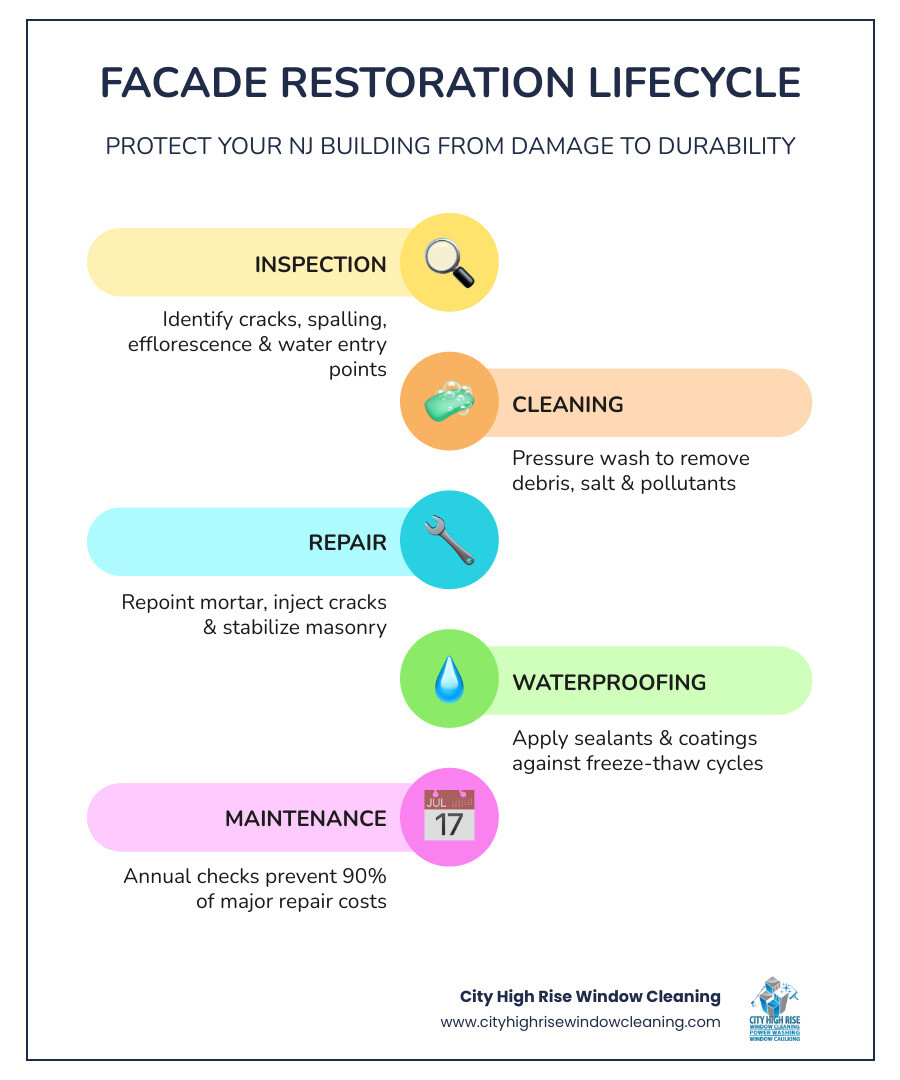
Common Signs Your Building Facade Restoration New Jersey Project is Overdue
In my three decades of traversing New Jersey skylines, I’ve learned that buildings talk to you—if you know how to listen. If you’re managing a property in Newark or Jersey City, your facade is likely screaming for help through several “symptoms.” Ignoring these isn’t just an aesthetic choice; it’s a gamble with your building’s structural integrity.
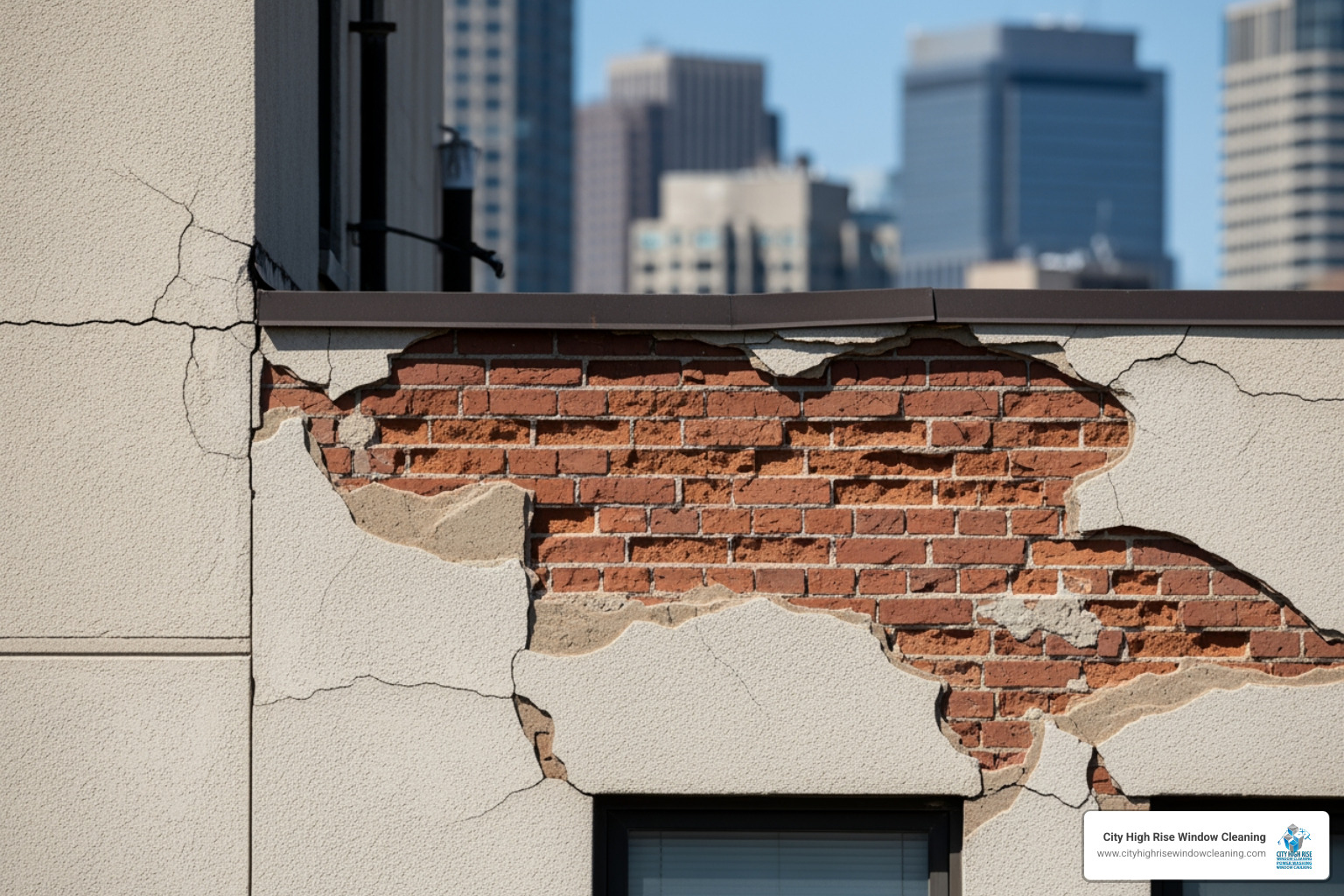
1. Spalling Masonry and Cracked Stucco
If you see chunks of brick or concrete popping off the face of your building, that’s spalling. This usually happens when moisture gets behind the surface, freezes, and expands. In New Jersey’s volatile climate, this cycle repeats dozens of times every winter. Similarly, cracks in stucco act like open straw holes, sucking water directly into your building’s envelope.
2. Efflorescence (White Powdery Stains)
Have you noticed a white, salty-looking powder on your brick walls? That’s efflorescence. It’s a sign that water is moving through the masonry, dissolving salts, and leaving them behind as it evaporates. It’s a giant red flag that your internal drainage or waterproofing has failed.
3. Rusted Lintels and Deteriorating Caulking
Lintels are the steel beams above your windows and doors. When they rust, they expand (a process called “rust jacking”), which can literally lift the bricks above them, causing massive diagonal cracks. This is often paired with deteriorating caulking. If your window seals look brittle, cracked, or are pulling away, you’ve lost your first line of defense against the driving rain off the Hudson.
4. Water Infiltration
If your tenants are reporting damp drywall or “mystery leaks” during heavy storms, the culprit is often the facade. By the time water shows up on the inside, the damage to the exterior is usually extensive. This is where professional window restoration and masonry repair become non-negotiable.
Essential Services for Comprehensive Facade Restoration in New Jersey
When I take on a building facade restoration New Jersey project, I look at it as a multi-layered defense system. We don’t just “patch” things; we restore the building’s ability to fight off the environment.
- Brick Repointing and Replacement: We carefully remove failing mortar and replace it with new material that matches the original’s strength and color. If the bricks themselves are “soft” or crumbling, we swap them out to restore structural stability.
- Terracotta and Stone Stabilization: For historic buildings in places like Hoboken, terracotta requires specialized pinning and patching techniques to preserve the architectural character while ensuring pieces don’t fall onto the sidewalk.
- Elastomeric Coatings: Think of this as a high-tech, stretchy “skin” for your building. It bridges small cracks and provides a 100% waterproof barrier that still allows the building to “breathe.”
- High-Rise Waterproofing: This involves a combination of through-wall flashing, high-performance sealants, and specialized coatings.
For many of my clients, the most critical step is working with a New Jersey Window Caulking Company to ensure every single penetration in the facade is airtight and watertight.
The Financial Impact: Why Restoration Beats Replacement
I often tell property managers: “You can pay me a little now to restore it, or you can pay a demolition crew a lot later to replace it.” The math is overwhelmingly in favor of restoration.
The ROI of Building Facade Restoration New Jersey
Research shows that glass restoration alone can save property owners up to 90% compared to the cost of full panel replacement. Imagine a high-rise with 4,000 damaged glass panels. Replacing them could cost $40 million. Restoring them? Roughly $5 million. That’s a $35 million difference that stays in your pocket.
| Feature | Restoration | Full Replacement |
|---|---|---|
| Cost | 10% – 20% of replacement | 100% Cost |
| Time | Weeks | Months or Years |
| Disruption | Minimal | High (Scaffolding/Noise) |
| Waste | Low (Repair focused) | High (Demolition debris) |
| Environmental Impact | Sustainable | High Carbon Footprint |
Beyond glass, restoring your metal panels—such as Alucobond Restoration—prevents the need for expensive, custom-ordered replacements that often have lead times of six months or more. Restoration keeps your building looking brand new without the “new construction” price tag.
Choosing the Right Partner for Building Facade Restoration New Jersey
New Jersey isn’t a place for amateurs. You need a partner with:
- Safety Compliance: High-rise work is dangerous. We prioritize OSHA standards and rigorous rigging inspections.
- 30+ Years of Experience: I’ve been doing this since 1991. I know how NJ buildings age.
- Material Matching: There’s nothing worse than a “patchwork” building. We ensure new mortar and stone match the 50-year-old originals.
- Comprehensive Management: You shouldn’t have to hire five different guys. We handle everything from high-rise window cleaning services in New Jersey to structural masonry repair.
Navigating New Jersey Building Codes and Safety Regulations
While New Jersey doesn’t have a single statewide “Local Law 11” like New York City, many NJ municipalities are adopting similar, rigorous standards. We use NYC’s FISP (Facade Inspection Safety Program) as our benchmark because if a building is safe by NYC standards, it’s safe anywhere.
Regular structural assessments are becoming the norm in Jersey City and Hoboken. These inspections don’t just keep you compliant; they drastically reduce your liability. If a piece of masonry falls and hits a pedestrian, “I didn’t know it was loose” isn’t a legal defense. Proactive restoration provides the documentation you need to prove you are maintaining a safe environment.
Proper window caulking and sealants are also often required to meet modern energy codes, helping you avoid fines and lower your utility bills simultaneously.
Step-by-Step Guide to a Professional Facade Restoration Process
When City High Rise Window Cleaning arrives at your site, we follow a meticulous process to ensure nothing is missed.
- Comprehensive Site Assessment: We use high-resolution cameras and physical “sounding” (tapping the masonry) to find hollow spots and hidden damage.
- Professional Cleaning: We perform high-pressure washing or steam cleaning to remove decades of NJ smog and pollutants. This isn’t just for looks; we need a clean surface for new materials to bond to.
- Structural Repairs: This includes crack injection, brick replacement, and reinforcing rusted steel lintels.
- Sealant Replacement: We strip out old, failed caulk and install high-grade silicone or urethane sealants around all windows and expansion joints.
- Protective Coating: Finally, we apply waterproof sealers or elastomeric coatings to lock out moisture for the next decade.
To keep your building in top shape between major projects, I highly recommend checking out our blog on preventative maintenance for high-rises.
Frequently Asked Questions about Building Facade Restoration
How much does facade restoration cost in New Jersey?
Pricing is highly variable based on the building’s height, the specific materials (brick vs. glass vs. Alucobond), and the extent of the damage. However, the rule of thumb is that restoration typically saves property owners up to 90% compared to the cost of a full “rip and replace” project.
How does the New Jersey climate affect building exteriors?
NJ is a “perfect storm” for facades. We have high humidity, coastal salt air that eats through metal, and extreme freeze-thaw cycles. These conditions cause materials to expand and contract violently, leading to the cracks and leaks we see every day.
What is the difference between repointing and restoration?
Repointing is a specific task: removing and replacing the mortar between bricks. Restoration is the “big picture.” It includes repointing, but also involves cleaning, waterproofing, structural repairs, and glass polishing.
Why is choosing an experienced contractor crucial for New Jersey facade projects?
An experienced contractor knows the local “quirks”—like the specific type of brownstone used in Hoboken or the wind loads on a Jersey City high-rise. We also understand local permitting and how to work safely in crowded urban environments without disrupting traffic or tenants.
How often should a building facade in New Jersey be inspected?
I recommend a professional visual inspection every year. A full-scale hands-on inspection should happen every 5 years. Catching a $500 caulking issue today prevents a $50,000 mold and masonry issue next year.
Conclusion: Protect Your Investment with Professional Restoration
Your building’s facade is its first line of defense and its most important visual asset. At City High Rise Window Cleaning, we bring 30 years of experience and a 100% satisfaction guarantee to every building facade restoration New Jersey project. Whether you’re managing a historic low-rise in Hoboken or a modern glass tower in Jersey City, we have the tools and the expertise to keep your property safe, dry, and valuable.
Don’t wait for the next big storm to find out your facade is failing. Proactive maintenance is the only way to avoid the astronomical costs of emergency repairs.
New Jersey High Rise Window Cleaning Company Request a professional consultation for your New Jersey facade
Ready for a free quote? City High Rise Window Cleaning offers 24/7 live consultation.


