

The Ultimate Guide to High-Rise Painting Equipment
The Ultimate Guide to High-Rise Painting Equipment
Avoid $13,260 Fines: High Rise Building Painting Equipment That Keeps NYC Projects Moving
High-rise building painting equipment covers every tool, platform, and safety system used to apply coatings to building facades above ground level – and choosing the wrong gear can cost you time, money, or worse.
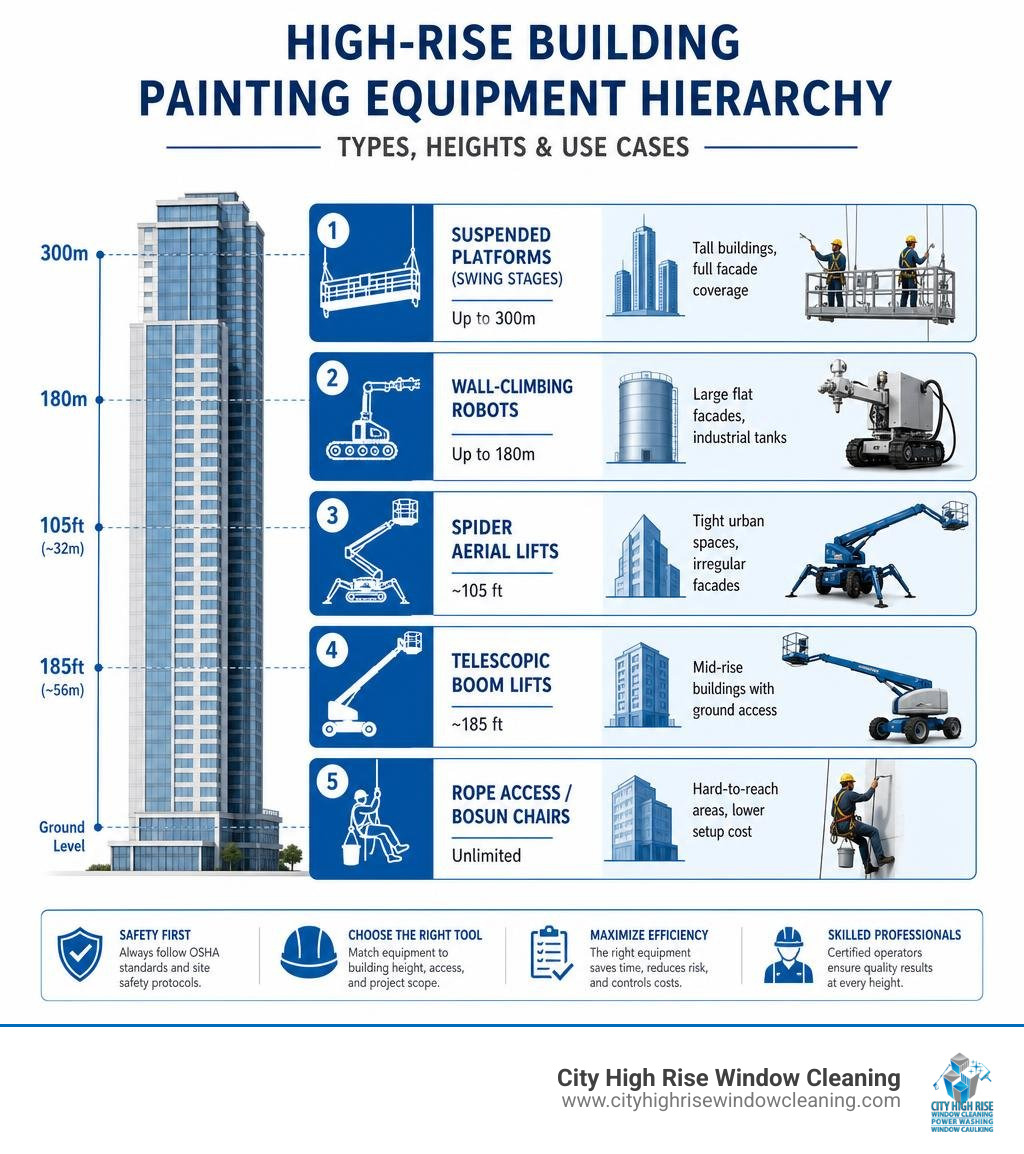
Here is a quick breakdown of the main equipment types used in 2026:
| Equipment Type | Best For | Max Height |
|---|---|---|
| Suspended platforms (swing stages) | Tall buildings, full facade coverage | Up to 300m |
| Telescopic boom lifts | Mid-rise buildings with ground access | ~185 ft |
| Spider aerial lifts | Tight urban spaces, irregular facades | ~105 ft |
| Rope access / Bosun chairs | Hard-to-reach areas, lower setup cost | Unlimited |
| Wall-climbing robots | Large flat facades, industrial tanks | Up to 180m |
Painting a high-rise is not like painting a house. At hundreds of feet in the air, the difference between a smooth project and a catastrophic failure comes down to one thing: the engineering and certification of your access equipment.
For property owners and managers in New York City, Long Island, New Jersey, and Westchester, the stakes are even higher. Local regulations – including FISP compliance and OSHA fall protection standards – add layers of legal responsibility on top of the physical challenge. Getting it wrong means project delays, fines starting at $13,260, or worse.
This guide walks you through every major category of high-rise painting equipment – from suspended platforms and aerial lifts to robotic sprayers – so you can make informed decisions for your building.
I’m Brett Hochman, CEO of City High Rise Window Cleaning and a specialist in high-rise building painting equipment with over 48 years of hands-on exterior building maintenance experience across the NYC metro area. I hold multiple OSHA certifications including Fall Protection, Scaffolding Principles, and Aerial Lift Training, and I’ve personally overseen hundreds of high-altitude painting and facade restoration projects on some of New York’s most demanding structures.
High rise building painting equipment vocab to learn:
- abseiling painters
- exterior high-rise painting services
- how high rise painting works without scaffolding
Primary Access Systems for High-Altitude Painting
When we look up at a skyscraper, we rarely think about how the crew actually got up there. But in my line of work, the access system is the foundation of everything. If your crew doesn’t feel stable, they aren’t going to paint a straight line — it is as simple as that. Choosing the right primary access system is a delicate balance of safety, building architecture, and budget.

There are four primary access systems used in high-rise building painting today:
- Suspended Scaffolding (Swing Stages): These are temporary platforms suspended by ropes or cables from the roof. They can move vertically, giving painters dynamic access to massive vertical columns of a building.
- Fixed Scaffolding: Built from the ground up, fixed scaffolding is incredibly stable and allows multiple trades to work simultaneously. However, it takes weeks to assemble and dismantle, making it highly impractical and cost-prohibitive for supertall structures.
- Aerial Lifts: Mobile units like telescopic boom lifts and compact spider lifts offer quick setup times and excellent maneuverability, but they are limited by ground conditions and maximum height restrictions.
- Rope Access (Industrial Abseiling): Using specialized climbing gear, certified technicians rappel down the side of a building. It requires zero footprint on the ground and minimal setup time. If you want to know more about how this works, you can read about how high rise painting works without scaffolding.
Suspended Platforms: The Workhorse of High Rise Building Painting Equipment
In high-rise painting, suspended platforms — commonly called swing stages — are the absolute workhorses. If you are painting a flat, continuous facade on a 20-story or 50-story tower, this is almost certainly the system you will use.
These platforms rely on motorized hoists to climb up and down steel wire ropes. The industry standards for these platforms are defined by the modular ZLP series, which we see deployed daily across New York City and New Jersey. Understanding the specifications of these units is crucial for matching the equipment to your project’s load requirements:
- ZLP500: This model has a rated load capacity of 500kg (about 1,100 lbs) and a lifting speed of 9 meters per minute. The lifting part weighs 410kg in steel or a lighter 290kg in aluminum, requiring 800kg of counterweight on the roof.
- ZLP630: A step up in capacity, the ZLP630 can lift 630kg at a speed of approximately 9.5 meters per minute with a standard 100-meter lifting height. It utilizes an LTD63 hoist and requires 1000kg of counterweight.
- ZLP800: Engineered for heavier loads, this model supports up to 800kg at a lifting speed of 8.5 meters per minute, powered by dual 2kw motors.
- ZLP1000: The heavy-duty giant of the series, supporting a massive 1000kg load capacity at a speed of 8.3 meters per minute, using 10.2mm steel wire ropes.
For detailed engineering details, you can look at the ZLP series suspended platform specifications.
A key aspect of these platforms is their modularity. They can be constructed from painted steel, hot-galvanized steel (highly resistant to corrosion), or lightweight aluminum alloy. They are built using modular sections (usually 1m to 3m in length) that can be bolted together to create a platform up to 7.5 meters long, as seen in the 7.5m CE Swing Stage Platforms High Rise Building Painting.
The way the platform attaches to the hoist system depends on the stirrup configuration:
- End Stirrups: Mounted at the very ends of the platform. This is the most economical and common setup.
- Frame Stirrups: These slip over the platform like a frame, leaving the building corners completely clear for painters to reach.
- L Stirrups: Placed at the rear of the platform, keeping the entire front working surface completely unobstructed. This is ideal when working on flat, modern curtain walls.
When standard roof-mounted suspension mechanisms (outriggers) cannot be installed due to limited roof space or delicate roof structures, we often use heavy-duty parapet clamps. These clamps secure directly to the building’s concrete parapet wall and are an excellent, low-cost alternative for rigging a Painting steel ZLP630 working on height facade cleaning gondola.
Aerial Lifts and Rope Access Alternatives
While suspended platforms dominate flat facades, they aren’t always the right choice. If your building has a complex architectural layout, deep setbacks, or is under 15 stories, alternative access methods are often much more efficient.
Telescopic boom lifts are incredible pieces of machinery. They can drive right onto a job site, extend their massive arms, and place a painter exactly where they need to be. The largest telescopic boom lifts can reach heights of up to 185 feet. However, they require stable, level ground and a massive footprint. In crowded parts of New York City or Hoboken, getting permits to block a lane of traffic for a boom lift can be a logistical nightmare that dramatically increases your exterior building painting cost.
For tight urban alleyways or courtyards where a standard boom lift cannot fit, we turn to spider lifts. These compact, track-mounted aerial lifts can fold up to fit through a standard double door and then deploy stabilizing outriggers (resembling spider legs) to reach heights up to 105 feet.
Then, there is industrial rope access. Using dual-rope systems, specialized harnesses, and ergonomic descent chairs (often called Bosun chairs), abseiling painters can descend from the roof to paint hard-to-reach areas. Rope access has virtually no height limit and requires zero street level footprint, which can significantly lower the overall exterior building painting cost by eliminating expensive equipment rentals and street closing permits. If you want to dive deeper into the planning side of things, check out our guide on commercial painting NYC secrets for property managers.
Key Factors for Selecting High Rise Building Painting Equipment
Choosing the right high rise building painting equipment is not a guessing game. It is a highly calculated decision that requires analyzing several critical factors.
Here is a comparison table to help you understand the tradeoffs between the primary access methods:
| Access Method | Setup Time | Wind Sensitivity | Ground Footprint | Cost Efficiency (Tall Buildings) |
|---|---|---|---|---|
| Fixed Scaffolding | Very High (Weeks) | Low | High | Very Low |
| Suspended Platforms | Medium (1-2 Days) | High | None | High |
| Aerial Lifts (Boom) | Low (Hours) | Medium | High | Medium (Mid-rise only) |
| Rope Access | Very Low (Hours) | Medium | None | High |
When planning a project in our local service areas — whether it is a high-rise office in Manhattan, a condo building in Long Island, or a commercial facility in New Jersey — several factors guide our selection:
- Building Height & Shape: For structures under 100 feet, boom lifts or spider lifts are often fastest. For supertalls over 150 feet, suspended platforms or rope access are mandatory. If the building has complex geometries, balconies, or deep decorative cornices, rope access is usually the only practical way to get painters close enough to the surface.
- Wind Shear and Weather: Wind is the ultimate enemy of high-altitude work. At ground level, it might feel like a gentle breeze, but at 300 feet, wind shear can slam a suspended platform against a glass facade. Standard suspended platforms must be tied back to the building to prevent swaying, and operations must shut down if wind speeds exceed 25 mph.
- Local NYC Regulations and FISP Compliance: In New York City, the Facade Inspection Safety Program (FISP, formerly Local Law 11) requires regular inspections of buildings over six stories. If facade repairs or painting are required, the equipment used must comply with strict NYC Department of Buildings (DOB) codes. This includes having a certified 62-Hour Site Safety Foreman on site and ensuring all rigging is stamped by a licensed Professional Engineer (PE).
Safety Features and Certifications for High Rise Building Painting Equipment
In my 48 years in this industry, I have always said: safety is not an option; it is the entire job. When you are hanging hundreds of feet in the air, you rely entirely on engineering redundancies.
Under OSHA standard 1910.28, employers must provide robust fall protection systems for any employee exposed to a fall hazard. For suspended platforms, this means a dual-line system. The platform is suspended by primary hoist ropes, but each worker must also be secured to an independent safety line via a full-body harness and a rope grab device.
Key safety mechanisms you must look for on any suspended platform include:
- Anti-Tilt Safety Locks (e.g., LS30 model): These automatically lock onto the safety wire rope if the platform tilts more than 3 to 8 degrees, preventing the platform from sliding or slipping.
- Overspeed Safety Locks: These act like the seatbelts in your car; if the hoist motor fails and the platform begins to drop too quickly, the lock instantly engages to stop the fall.
- No-Power Manual Descent: In the event of a total power failure, this mechanical system allows operators to safely lower the platform to the ground manually.
- Engineered Roof Anchors: Every tieback and roof anchor must be capable of supporting a static load of 5,000 pounds per worker in any direction. Under OSHA regulations, building owners are responsible for ensuring these anchors undergo annual visual inspections and are recertified by a professional engineer every 5 to 10 years (5 years for chemically fastened anchors).
For operators in New York City, anyone stepping onto a suspended scaffold must hold an active 32-Hour Suspended Scaffolding Card. Furthermore, rope access technicians must hold certifications from recognized bodies like IRATA (Industrial Rope Access Trade Association) or SPRAT, ensuring they are trained in advanced rescue maneuvers. If you are hiring a team in New Jersey, make sure to work with NJ commercial painters that won’t leave you hanging.
Surface Preparation, Application, and Robotic Painting Gear
You can have the most expensive paint in the world, but if the surface isn’t prepped correctly, it will peel off within a year. Preparing a facade at extreme heights requires specialized equipment designed to contain mess and withstand harsh conditions.

Before a single drop of paint is applied, the facade must be thoroughly cleaned of dirt, salt, carbon buildup, and loose paint. We achieve this using high-pressure power washers (often operating at 3,000 to 4,000 PSI) with hot water capability to cut through decades of urban grime. If you want to learn more about how critical this step is, read our article on pressure washing and painting.
For paint application, traditional rollers and brushes are used for detail work, but for large-scale facades, airless paint sprayers are the industry standard. These systems pump paint at extreme pressures (up to 3,000 PSI) through a tiny spray tip, atomizing the paint into a fine mist that creates a flawless, uniform coat.
However, spraying paint at high altitudes comes with a massive challenge: overspray drift. A light breeze can carry paint mist hundreds of feet, landing on parked cars, neighboring buildings, or pedestrians. To prevent this, high-rise painters utilize containment netting, wind shields, and specialized low-overspray spray tips. If you are dealing with interior high-rise spaces like atriums, the gear is slightly different, as detailed in the ultimate guide to painting high walls and ceilings with ease.
Automated and Robotic High Rise Building Painting Equipment
We are living in an exciting era where technology is rapidly changing how we maintain buildings. In 2026, automated and robotic systems are transitioning from experimental concepts to real-world job site solutions. These devices are designed to eliminate the human safety risks of high-altitude work while drastically improving speed and consistency.
One of the most impressive developments is the Wallhiker TSW-01 Painting Wheeled Wall-Climbing Robot. This robotic system uses advanced suction or magnetic mechanisms to adhere directly to vertical surfaces. It features:
- A maximum moving speed of 18 meters per minute.
- A painting efficiency of 100 to 300 square meters per hour (which is up to 5 times faster than manual rolling).
- A load capacity of 60kg, allowing it to carry its own airless spray gun and paint lines.
- Parameterized control systems that adjust the moving speed dynamically to guarantee a perfectly consistent paint film thickness.
Another major player is the TR500 exterior wall spraying robot. This heavy-duty system is designed to operate on building facades up to 180 meters tall. It has an unladen weight of 650kg (950kg fully loaded with paint and equipment) and operates on a 3-phase AC380V power supply. The TR500 features advanced safety protocols, including wind speed monitoring, posture monitoring, and an automatic emergency release function that safely lowers the robot to the ground if power is lost.
Additionally, patents like a high-rise exterior wall painting device – Eureka | Patsnap showcase systems that integrate three separate phases of facade maintenance — pre-cleaning, multi-color painting, and post-paint protective sealing — into a single, automated unit. These robots use stabilizing shock-absorbing chassis and multi-axis mechanical legs to adapt to wall irregularities and resist wind shear.
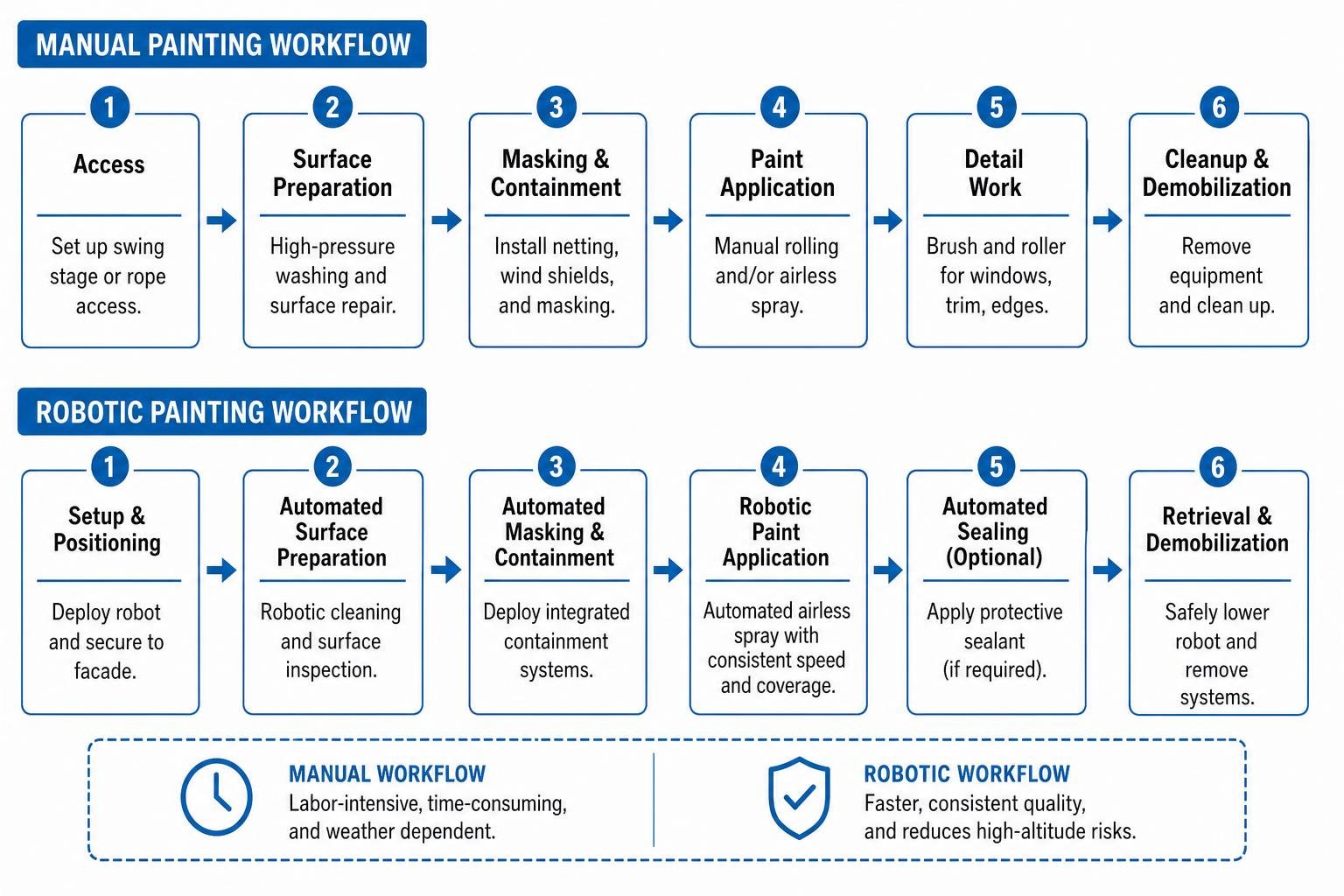
While these robots are incredible for large, flat, windowless facades (like industrial tanks, warehouses, or concrete towers), they still struggle with complex architectural features, windows, and decorative trim. For most high-rise buildings in New York and New Jersey, a hybrid approach — combining automated prep and spray systems with skilled manual painters for detailing — delivers the best results. For more localized insights, check out our guide on commercial painting in Long Island.
Frequently Asked Questions about High-Rise Painting Equipment
What is the safest equipment for painting a building over 150 feet?
Suspended platforms (swing stages) and certified rope access systems are the safest and most practical options for buildings over 150 feet, as telescopic boom lifts max out around 185 feet and become highly susceptible to wind shear.
How do weather conditions impact high-rise painting equipment operations?
High winds (exceeding 25 mph or 8.3 m/s for robotic systems), rain, and extreme temperatures halt operations. Wind causes paint overspray drift and destabilizes suspended platforms, posing severe safety risks. Rain prevents paint from adhering and curing, while extreme cold or heat can cause coatings to fail prematurely.
What roof anchoring requirements must be met for suspended scaffolds?
OSHA requires roof anchors and tiebacks to support at least 5,000 pounds per worker in any direction. These systems must undergo annual inspections and 5-to-10-year recertifications by a licensed professional engineer. Building owners must provide written proof of compliance before any suspended scaffold work begins.
Conclusion
Whether you are managing a historic high-rise in downtown Newark, a luxury high-rise condo in Long Island, or a corporate skyscraper in Manhattan, choosing the right high rise building painting equipment is the single most important decision of your project. The right setup ensures a flawless, long-lasting finish, keeps your project on schedule, and – most importantly – ensures that every worker returns home safely at the end of the day.
At City High Rise Window Cleaning, we bring over 30 years of localized experience in high-altitude building maintenance, power washing, and facade restoration across New York City, Long Island, New Jersey, and Westchester. We also coordinate related exterior maintenance services, including high rise hot water power washing and facade restoration, when a building needs cleaning, repair, and coating work handled under one safety-first plan. We back all of our work with a 100% customer satisfaction guarantee and an uncompromising commitment to safety and local regulatory compliance. If you want to learn more about how we can transform your building, explore our guide on how to transform your business with expert commercial building painting solutions.
Ready for a free quote? City High Rise Window Cleaning offers 24/7 live consultation. Call 917-749-8342 to speak to a live representative.


