

The Clean Slate: A Guide to Residential Post Construction Cleaning
The Clean Slate: A Guide to Residential Post Construction Cleaning
Your Renovation Is Done — But Your Home Isn’t Ready Yet
Residential post construction cleaning is a specialized, multi-phase process that removes construction dust, debris, adhesive residue, paint splatters, and grout haze from a newly built or renovated home — making it safe, healthy, and truly move-in ready.
Here is a quick overview of what it covers and what to expect:
| What You Need to Know | Quick Answer |
|---|---|
| What it is | Deep cleaning after a build or renovation — far beyond regular housekeeping |
| Who needs it | Homeowners after any renovation, remodel, or new construction |
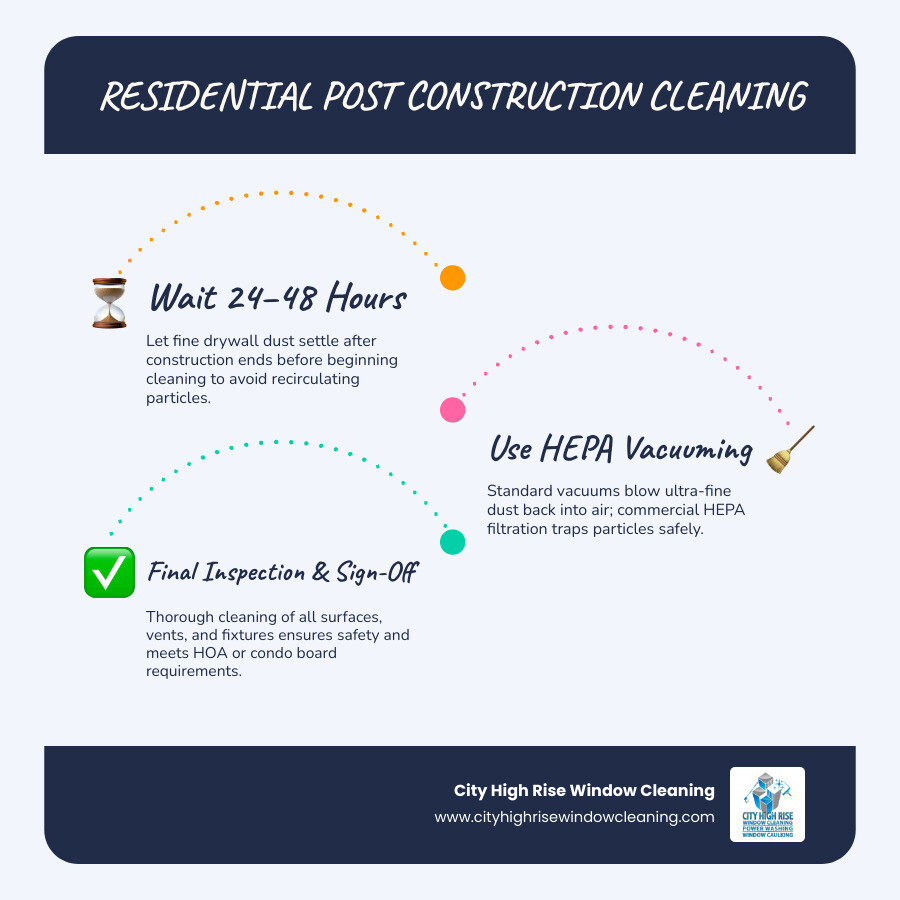
| When to start | Wait 24–48 hours after construction ends for dust to settle |
| How long it takes | 3–10 hours depending on project scope |
| Typical cost | $250–$900+ depending on property size and location |
| Key tool required | Commercial HEPA-filter vacuum — standard vacuums cannot handle construction dust |
| Who is responsible | Contractors handle basic site clearing; detailed cleaning falls to the homeowner |
The moment the last contractor walks out, most homeowners expect to see a finished, gleaming home. What they actually find is a layer of fine drywall dust coating every surface — inside cabinets, inside vents, on brand-new fixtures — and debris that no broom or household vacuum can truly handle. Construction dust is not ordinary household dirt. It is ultra-fine particulate matter that infiltrates every corner of a space, and it requires specialized equipment and technique to remove safely.
For homeowners in New York City, Long Island, New Jersey, and Westchester, where high-rise renovations and dense residential builds are common, this challenge is especially acute. Dust travels between units. HVAC systems pull fine particles through entire buildings. And in many cases, HOA or condo board rules require professional cleaning sign-off before a renovation deposit is released.
I’m Brett Hochman, CEO of City High Rise Window Cleaning, and with over 48 years of experience in exterior building maintenance and post-construction cleaning services across the NYC tri-state area, I have seen the damage that improper residential post construction cleaning can cause to new finishes, air quality, and building systems. This guide covers everything you need to know to get it done right.
Simple Residential post construction cleaning word guide:
- post construction cleaning contractors
- how much does a post construction cleaning cost
- construction cleaning company
What is Residential post construction cleaning and Why is it Essential?
Many homeowners ask me, “Brett, why can’t my regular weekly cleaning service just wipe down the house after my renovation?”
The answer is simple: residential post construction cleaning is entirely different from standard residential cleaning. Regular cleaning is designed to manage organic dust, pet dander, and daily grime. Post-construction cleaning, on the other hand, deals with industrial-grade residues. We are talking about micro-fine sheetrock and drywall dust, paint overspray, adhesive residues, concrete film, and grout haze.
Think of post-construction cleaning like proofreading a book. The contractors have written the story—they built the walls, laid the tiles, and hooked up the plumbing. But without a professional “proofreader” to go over every single detail, the final product is full of distracting, messy errors.
If you are excited about seeing a pristine, finished home the moment construction wraps up, you will likely be disappointed without a dedicated post-cleanup phase. Standard cleaning supplies and household vacuums are simply not built to handle this type of debris. In fact, trying to clean up after a major build with standard tools will often ruin your vacuum and smear the dust deeper into your newly painted walls.
To understand the full scope of what this process entails, you can read our Post-Construction Cleaning Complete Guide or explore our dedicated Post-Construction Cleaning Services page.
The Hidden Dangers of Post-Construction Dust
The primary reason professional cleaning is non-negotiable is safety. Construction dust is not just unsightly; it is a legitimate health hazard. Drywall dust contains fine gypsum and silica particles. When inhaled, these micro-particles can irritate the respiratory tract, trigger asthma attacks, and cause long-term lung issues.
Furthermore, during a renovation, your HVAC system continues to pull air from the active construction zone. This means fine dust is circulated deep into your air ducts, heating vents, and air conditioning units. If you do not perform a thorough, HEPA-grade extraction, every time your climate control kicks on, it will redistribute a fresh layer of silica dust throughout your home.
Protecting your family from fine particulate matter after a home remodel requires a top-to-bottom extraction strategy that targets both visible surfaces and hidden air paths.
Who is Responsible: The Contractor or the Homeowner?
A common point of confusion is who actually has to do this work. Many homeowners assume that because they paid a general contractor thousands of dollars for a renovation, the cleaning is included in the contract.
In reality, most general contractors are only responsible for a “broom-clean” standard. This means they will pick up large wood scraps, sweep up the heaviest sawdust, remove their tools, and haul away the major trash. Their primary focus is structural safety, meeting building codes, and completing the physical build. They are not professional detail cleaners.
Leaving the fine, meticulous detailing to the contractor is a recipe for disappointment. The responsibility for transforming that “broom-clean” site into a safe, livable home ultimately falls on the homeowner. To understand how to navigate this transition smoothly, check out our guide on From Construction Chaos to Clean Comfort: A Guide to After Build Cleaning.
The Three Critical Phases of After-Build Cleanup
Professional residential post construction cleaning is never done in a single, rushed pass. Because dust continues to settle as air currents move through the home, we utilize a highly structured, sequential three-phase approach.
Each phase has a distinct purpose, and skipping any of them will result in dust quickly resettling on your clean surfaces. For a deeper look at this workflow, read our guide on From Dust to Done: Mastering Post-Construction Cleanup.
Phase 1: The Rough Clean
The rough clean takes place immediately after the heavy construction wraps up, sometimes even before the contractors have finished their final punch-list items.
The goal of this phase is to prepare the space for detailed cleaning. We focus on:
- Collecting and removing leftover packaging, plastic coverings, and small construction debris.
- Scrubbing down concrete or plywood subfloors to ensure new flooring or carpets can be laid down on a perfectly flat, grit-free surface.
- Removing protective stickers, manufacturer labels, and tape from newly installed windows, glass doors, toilets, and appliances.
If you want to know more about how we manage this initial stage, you can read The Clean Slate: Your Guide to Post-Construction Debris Removal.
Phase 2: The Light Clean (Deep Cleaning)
This is the most labor-intensive and detail-oriented phase of the entire process. The light clean is where the real transformation happens.
During this phase, we clean every room from top to bottom. We pay special attention to:
- Cabinet Interiors: Vacuuming and wiping down the inside of every single drawer, cabinet, and closet. Drywall dust easily penetrates closed doors, leaving a gritty layer where you plan to store your clean dishes and clothes.
- Detailed Vacuuming: Using commercial-grade HEPA-filter vacuums to extract fine dust from baseboards, crown molding, window tracks, and door frames.
- Tile and Grout: Carefully washing newly tiled walls and floors to remove stubborn grout haze without scratching the delicate surfaces.
To see what goes into this intensive deep clean, check out Deep Cleaning Post Construction.
Phase 3: The Final Touch-Up
Even after a thorough light clean, fine dust particles suspended in the air will slowly settle over the next 24 to 48 hours. The final touch-up is a quick, meticulous pass completed just before you move your furniture back in.
During this phase, we:
- Wipe down all horizontal surfaces one last time to capture any newly settled dust.
- Erase smudges, fingerprints, and shoe markings left behind by contractors during final inspections.
- Polish glass, mirrors, chrome fixtures, and stainless steel appliances so they shine perfectly.
This final step ensures your home is truly move-in ready. You can review our detailed checklist for this phase in Your Checklist for a Perfect Construction Final Clean.
Step-by-Step Execution and Checklists
To achieve a spotless result, you must work systematically. If you clean the floors first and then wipe down the ceiling fans, you will simply dump dust back onto your clean floors. Always work from top to bottom, and from the back of the house toward the front exit.
Room-by-Room Checklist for Residential post construction cleaning
Here is the exact checklist my teams use when cleaning high-end homes and apartments across New York and New Jersey. You can also print out our master checklist from From Dusty Disaster to Spotless Sanctuary: Your Post-Construction Final Clean Checklist.
1. Throughout the Entire Home (All Areas)
- [ ] HEPA-vacuum ceilings, walls, and light fixtures to pull down static-clinging dust.
- [ ] Wipe down the tops of doors, door frames, door knobs, and hardware.
- [ ] Clean baseboards, trim, and crown moldings.
- [ ] Vacuum window tracks, frames, and sills before washing the glass.
- [ ] Wipe down all electrical outlets, light switches, and thermostat covers.
2. Kitchens
- [ ] Vacuum and wash the inside and outside of all cabinets, drawers, and shelving units.
- [ ] Remove protective film and stickers from new appliances (refrigerator, dishwasher, oven).
- [ ] Clean and sanitize countertops, backsplashes, and sinks.
- [ ] Polish chrome, brass, or stainless steel faucets and hardware.
- [ ] Clean the interior and exterior of all appliances.
3. Bathrooms
- [ ] Thoroughly scrub toilets, tubs, and showers to remove plaster or grout residue.
- [ ] Clean vanity mirrors, countertops, and sinks.
- [ ] Wipe down the inside of medicine cabinets and vanity drawers.
- [ ] Polish all metallic fixtures and showerheads.
- [ ] Clean wall tiles and remove any lingering grout haze.
4. Windows and Glass
- [ ] Scrape away paint splatters, silicone, and plaster drips from window glass using specialized glass-safe blades.
- [ ] Wash interior and exterior window panes (for high-rise apartments or multi-story homes, this requires professional rigging or specialized equipment).
- [ ] Wipe down exterior window frames and clear weep holes of construction debris.
Note: For properties in NYC, Long Island, and Westchester, high-rise or hard-to-reach exterior windows are our specialty. You can learn more about how we handle these safely on our Residential Window Cleaning Services page.
Why DIY Fails: The Value of Professional Residential post construction cleaning
I often see ambitious homeowners attempt to tackle post-construction cleaning themselves to save a few dollars. While I admire the DIY spirit, this is one area where professional intervention pays for itself.
First, standard household vacuums are simply not equipped for this work. Drywall dust is so fine that it passes right through standard vacuum filters, blowing straight out of the exhaust and back into your air. Even worse, the abrasive nature of silica and plaster dust can quickly burn out a standard vacuum motor. Professional teams use industrial-grade vacuums equipped with multi-stage HEPA filtration systems that capture microscopic particles down to 0.3 microns.
Second, removing construction residues like paint splatters, adhesive tape residue, silicone caulk, and grout haze requires chemical expertise. Using the wrong solvent or abrasive pad on a brand-new marble countertop, hardwood floor, or custom window pane can cause permanent, costly scratches and chemical burns. Professionals know exactly which pH-neutral cleaners and specialized tools to use to preserve your new investments.
For a deeper dive into why standard household cleaning methods fall short, read our article on Deep Cleaning House After Construction.
Understanding the Costs and Timelines of Post-Construction Cleanup
Let’s talk numbers. Because every renovation is unique, post-construction cleaning is rarely priced at a simple flat rate. The cost depends heavily on the size of your home, the volume of debris, and how much fine dust has migrated throughout the property.
| Project Type | Average Square Footage | Estimated Duration | Typical Cost Range (NYC Tri-State Area) |
|---|---|---|---|
| Bathroom Remodel Only | 50 – 150 sq. ft. | 3 – 5 hours | $245 – $325 |
| Kitchen Remodel Only | 150 – 300 sq. ft. | 5 – 7 hours | $325 – $455 |
| Small Apartment / Condo | 600 – 1,200 sq. ft. | 4 – 8 hours | $250 – $500 |
| Full Home Gut Renovation | 2,000 – 3,500 sq. ft. | 7 – 10+ hours | $590 – $900+ |
Note: These ranges reflect typical industry pricing in high-cost-of-living areas like New York and New Jersey in 2026. For a complete breakdown of pricing factors, read The Ultimate Post-Construction Cleaning Cost Guide for 2026.
Key Factors Influencing the Cost
When we prepare a quote for a client in Long Island, Westchester, or Manhattan, we look at several specific variables:
- Debris Volume: Is there left-behind construction waste, or is it just fine dust?
- Property Size and Layout: High-rise condos with strict elevator access hours and trash disposal rules require more coordination and labor than a single-family home in Westchester.
- Level of Detail: Custom finishes like delicate wallpaper, high-end stone, or expansive glass require specialized care and slower, more meticulous work.
To learn more about how these variables impact your final estimate, read Unveiling Post-Construction Cleaning Costs: What You Need to Know.
How Long Does the Process Take?
A standard post-construction clean for a localized renovation (like a kitchen or bathroom) typically takes 3 to 7 hours. A full home cleanup can easily take 10 hours or more, often requiring a larger team of 3 to 5 specialists to complete in a single day.
We also have to coordinate around drying times for newly sealed grout, freshly painted walls, or refinished floors. It is critical to schedule the cleaning window after all active trades have completely finished their work, but before you begin moving your furniture back in.
Frequently Asked Questions About Post-Construction Cleaning
How soon after construction can professional cleaning begin?
I always recommend waiting 24 to 48 hours after the contractors have packed up before starting the deep clean. Fine construction dust remains suspended in the air for hours. If we clean too quickly, that airborne dust will simply settle back down onto our freshly cleaned surfaces overnight. Waiting a day or two allows the dust to land, making our extraction process far more effective.
Can post-construction cleaning remove paint splatters, adhesive, and grout haze?
Yes, but it requires specialized techniques. We use plastic scrapers, specialized glass-safe razor blades, and targeted solvents to dissolve adhesive and paint drips without scratching your new wood, tile, or glass. Grout haze is removed using mild, acidic cleaners formulated specifically for tile safety.
Is post-construction cleaning necessary for new builds or just renovations?
It is absolutely necessary for both. In fact, new builds often contain more dust than minor renovations. Throughout the months-long building process, drywall sanding, wood sawing, and concrete mixing generate massive amounts of dust that settle into the wall cavities, subfloors, and HVAC systems before the final finishes are even installed.
Conclusion
A renovation is a massive investment of your time, money, and patience. But until that final layer of construction dust, paint overspray, and chemical residue is completely cleared away, your house won’t feel like a home.
At City High Rise Window Cleaning, we bring over 30 years of professional experience to every job across New York City, Long Island, New Jersey, and Westchester. We don’t just clean windows; we provide complete exterior building restoration, power washing, and meticulous post-construction cleaning services backed by our 100% customer satisfaction guarantee. Let us handle the mess so you can finally enjoy your beautiful new space.
Ready for a free quote? City High Rise Window Cleaning offers 24/7 live consultation.


