

Clear Profits and How to Start a Window Washer Business
Clear Profits and How to Start a Window Washer Business
A Window Washer Business Can Make You Real Money — Here’s How to Start One
Starting a window washer business is one of the lowest-barrier paths to owning a profitable trade business. Low startup costs, flexible hours, and steady demand from homeowners and commercial property owners make it a clear opportunity — especially in dense metro markets like New York City, Long Island, New Jersey, and Westchester.
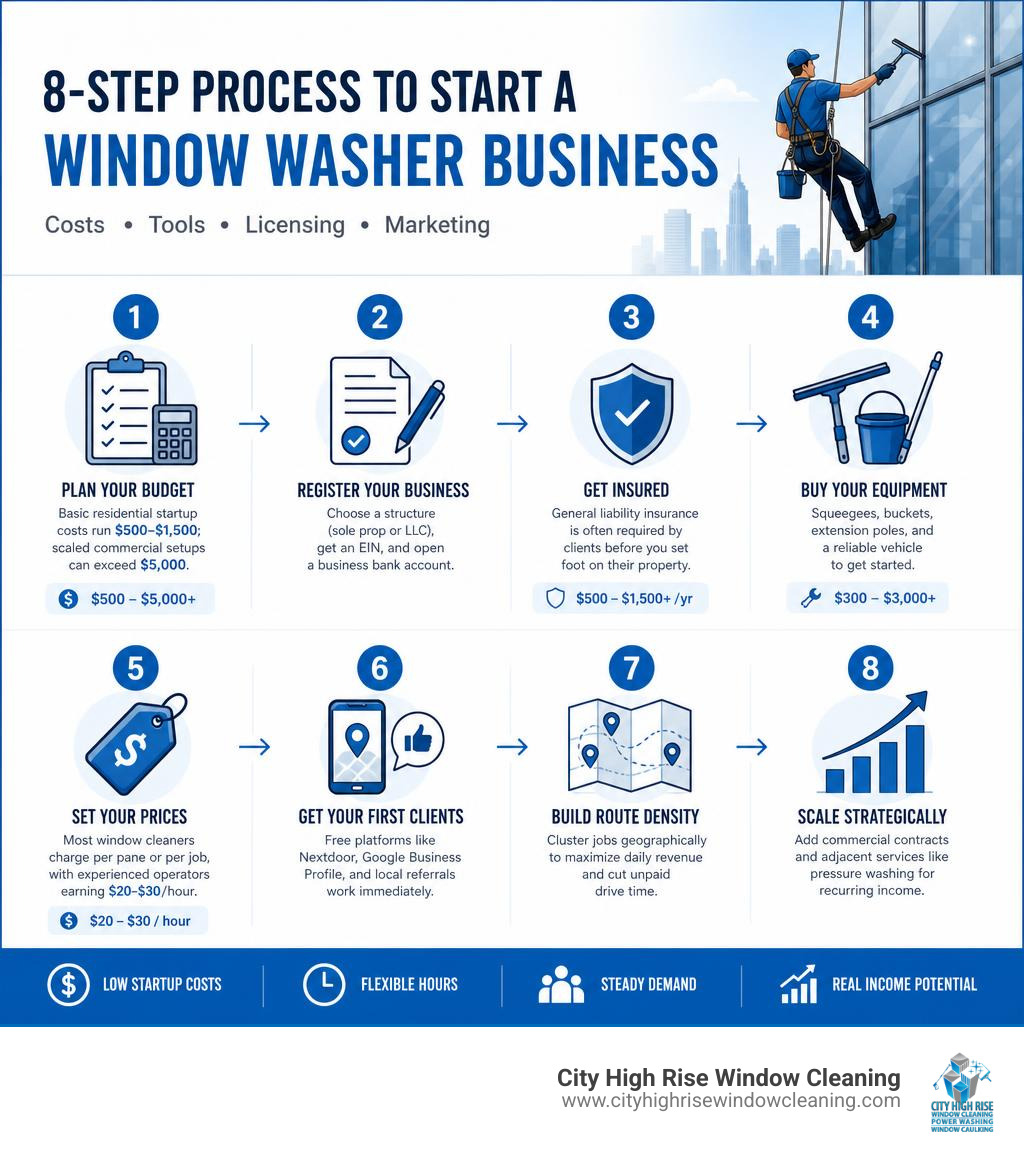
Quick-start snapshot for a window washer business:
- Plan your budget — Basic residential startup costs run $500–$1,500; scaled commercial setups can exceed $5,000
- Register your business — Choose a structure (sole prop or LLC), get an EIN, open a business bank account
- Get insured — General liability insurance is often required by clients before you set foot on their property
- Buy your equipment — Squeegees, buckets, extension poles, and a reliable vehicle to start
- Set your prices — Most window cleaners charge per pane or per job, with experienced operators earning $20–$30/hour
- Get your first clients — Free platforms like Nextdoor, Google Business Profile, and local referrals work immediately
- Build route density — Cluster jobs geographically to maximize daily revenue and cut unpaid drive time
- Scale strategically — Add commercial contracts and adjacent services like pressure washing for recurring income
The business rewards operators who treat it as a recurring-revenue asset — not a side hustle. A solo operator running tight routes can realistically clear $45,000–$110,000 in Year 1, with profit margins between 20% and 70% depending on overhead and job density.
I’m Brett Hochman, CEO of City High Rise Window Cleaning and a leader in the exterior building maintenance industry since 1977 — giving me nearly five decades of hands-on experience building and operating a window washer business at every scale, from ground-level residential work to complex high-rise facade maintenance across the NYC metro area. That depth of experience shapes every recommendation in this guide, so you can skip the costly mistakes and build a business that actually grows.
Key terms for window washer business:
How to Launch a Profitable Window Washer Business on a Budget
When I first look at the economics of starting a Window Washing Business, the most attractive feature is how lean you can make your launch. Unlike other trades that require massive initial capital outlays for heavy machinery or specialized diagnostic tools, window cleaning can be bootstrapped with minimal savings.
If you are running on a tight budget, you can start a lean operation with basic hand tools and a reliable vehicle. The primary goal during your launch phase is not to have the flashiest setup, but to establish cash flow and secure your first dozen recurring accounts. As your revenue grows, you can reinvest your profits to purchase more advanced equipment, such as water-fed poles and purified water filtration systems.
To give you a realistic idea of what to expect, here is a budget breakdown comparing a lean beginner setup to a scaled commercial operation:
| Expense Category | Beginner / Lean Setup (Residential) | Scaled / Commercial Setup (Multi-Story) |
|---|---|---|
| Hand Tools & Safety Gear | $500 – $1,500 | $1,500 – $3,000 |
| Water-Fed Pole & Pure Water System | N/A (Traditional Squeegee) | $2,500 – $5,000+ |
| Ladders & Transport Rack | $200 – $500 | $1,000 – $2,000 |
| Licensing, Permits, & Entity Setup | $150 – $500 | $500 – $1,500 |
| First-Year Insurance Premiums | $500 – $1,000 | $2,000 – $5,000+ |
| Marketing & Initial Branding | $0 – $500 (Organic & Local Flyers) | $1,000 – $3,000 (SEO & Paid Ads) |
| Total Estimated Startup Capital | $1,350 – $4,000 | $8,500 – $19,500+ |
Essential Equipment for a Beginner Window Washer Business
For those launching a beginner-level window washer business, your primary toolkit will consist of traditional hand tools. Do not make the mistake of buying cheap, plastic squeegees from a local home improvement store. Professional-grade tools last longer, save your wrists from fatigue, and prevent scratching on client glass.
Your starter kit must include:
- Professional Squeegees: Invest in high-quality brass or stainless steel channels (sizes 12-inch and 18-inch are the industry standards) with replaceable, professional-grade rubber blades.
- T-Bars and Microfiber Sleeves: These are used to apply your cleaning solution to the glass. Microfiber sleeves hold water exceptionally well and scrub away dirt without scratching.
- Heavy-Duty Buckets: A rectangular 5-gallon bucket is designed specifically to fit your T-bars and squeegees horizontally.
- Extension Poles: A sturdy aluminum extension pole (ranging from 4 to 12 feet) allows you to clean first- and second-story windows safely from the ground.
- Microfiber Towels and Scrim: Essential for detailing the edges of the window frame and wiping away any remaining water droplets.
- Glass Scrapers: Equipped with replaceable carbon steel blades to remove stubborn debris like paint, stucco, or tape residue (always use with caution to avoid scratching tempered glass).
Scaling Your Window Washer Business to Commercial and High-Rise Work
As you transition from residential properties to commercial storefronts and multi-story commercial buildings, your equipment needs will shift toward efficiency and safety.
The standard for modern multi-story exterior window cleaning is the Water-Fed Pole (WFP) system. WFP systems utilize carbon-fiber telescoping poles that can reach up to 60 or 70 feet high. These poles deliver purified water directly to a specialized brush that scrubs the glass. Because the water is completely demineralized via reverse osmosis (RO) and deionization (DI) filtration systems, the windows dry completely spot-free without the need for a squeegee. This system dramatically increases your speed and safety, keeping your feet firmly on the ground.
For high-rise work, the equipment becomes highly specialized, involving rope descent systems (RDS), suspended scaffolds, industrial-grade harnesses, and safety lanyards. Scaling to this level requires extensive safety training and certification. To understand the operational and sales systems required to land these larger commercial contracts, resources like Pulse Sales Trainings can provide valuable insight into B2B client acquisition.
Legal Requirements, Business Structure, and Insurance
Operating legally is non-negotiable if you want to protect your personal assets and win high-paying commercial contracts. The first step is selecting the right business structure.
Many solo operators start as Sole Proprietorships because they are simple and cost nothing to set up. However, a sole proprietorship offers zero liability protection. If a ladder slips and damages a client’s roof, or if a third party is injured, your personal savings, home, and assets are at risk.
For this reason, I highly recommend forming a Limited Liability Company (LLC). An LLC creates a legal boundary between your personal assets and your business liabilities.
Once your LLC is registered with your state:
- Apply for an Employer Identification Number (EIN) through the IRS website (it is free and takes minutes).
- Open a dedicated business bank account to keep your personal and business finances strictly separated. Mixing funds can pierce your corporate veil, rendering your LLC liability protection useless.
Licensing and Permits for Window Cleaners
While most municipalities in New York, Long Island, Westchester, and New Jersey do not require a highly specialized trade license for standard window washing, you will still need a general business license or occupational permit to operate legally.
Additionally, local environmental regulations are strict in our region. When using water-fed poles or pressure washing equipment, you must be aware of local water-use restrictions and wastewater runoff permits. In New York City and parts of New Jersey, discharging soapy water or chemical runoff directly into municipal storm drains is a violation of clean water acts. You must familiarize yourself with local guidelines regarding wastewater reclamation or eco-friendly, biodegradable soap usage to avoid hefty municipal fines.
Essential Insurance Coverage to Protect Your Assets
Insurance is the single most important shield for your window washer business. Property owners—especially high-end residential clients in Westchester or commercial managers in Manhattan—will not let you touch their buildings without proof of insurance.
You should carry the following coverages:
- General Liability Insurance: This is your primary defense. It covers bodily injury and property damage. If a ladder falls and breaks an expensive custom window or damages a client’s vehicle, this policy covers the cost. Aim for a minimum of $1,000,000 in coverage.
- Workers’ Compensation: If you hire even one employee, this is legally required in NY and NJ. It covers medical bills and lost wages if a technician is injured on the job.
- Tools and Equipment Insurance: Also known as inland marine insurance, this protects your squeegees, water-fed poles, and pressure washers from theft or damage while in transit or on a job site.
- Commercial Auto Insurance: If you use a van, truck, or even your personal vehicle primarily for business operations, personal auto policies will often deny claims in the event of an accident. You need a commercial policy to protect your vehicle and equipment.
Pricing Strategies and Building Route Density for Maximum Profit
Pricing your services correctly is the difference between running a thriving enterprise and working yourself into the ground. There are three primary pricing models utilized in the window cleaning industry:
- Per-Pane Pricing: This is the most transparent and accurate method for residential work. You count the individual panes of glass and charge a flat rate per pane (e.g., $5 to $10 per pane for exterior-only, and $10 to $18 for interior and exterior).
- Hourly Pricing: Useful for highly customized jobs or post-construction cleanups where the level of difficulty is unknown. However, hourly pricing can penalize you as you become faster and more efficient.
- Flat-Rate / Package Pricing: Offering tiered packages (e.g., Basic Exterior, Deluxe Interior/Exterior, and Premium including screen and track detailing) makes it easy for clients to understand what they are buying and allows you to upsell easily.
To determine your base rates, you must calculate your local overhead, travel times, and your target hourly revenue. For a detailed breakdown of local pricing benchmarks, refer to our guide on Window Cleaning Cost NYC.

The Power of Route Density and Recurring Revenue
The secret to maximizing profitability in a window washer business is not charging the highest price; it is building route density.
Drive time is a hidden tax on your business. If you charge $250 for a residential job but have to drive 45 minutes to get there, your effective hourly rate plummets. Conversely, if you can service five homes on the same street in a single day, you eliminate travel time, slash fuel costs, and dramatically increase your daily profit margins.
To build route density, focus on turning one-time clients into recurring contracts:
- Residential Cycles: Homeowners typically require professional cleaning 1 to 2 times per year (spring and fall). Offer a discount for clients who sign up for an annual or bi-annual maintenance agreement.
- Commercial Cycles: Retail storefronts, offices, and restaurants in busy metro areas need clean glass constantly to maintain their appearance. These clients should be placed on weekly, bi-weekly, or monthly recurring schedules. While the price per visit is lower than residential, the predictable, year-round recurring revenue provides the financial backbone for your business.
Low-Cost Marketing Strategies to Get Customers Immediately
When you are starting out, you do not need a massive advertising budget to land your first customers. You need to leverage local, organic, and direct marketing channels.
First, establish your digital footprint:
- Google Business Profile: Claim and optimize your free profile immediately. Fill out every section, list your service areas in NY or NJ, and upload high-quality photos of your work.
- Yelp: Create a business profile and optimize it for local searches.
- Nextdoor: This neighborhood-centric platform is an absolute goldmine for residential service providers.
To learn more about tailoring your services to residential clients, check out our guide on Residential Window Cleaning Services.

Hyperlocal Marketing and Referral Campaigns in NY and NJ
Hyperlocal marketing is incredibly effective because of the high density of neighborhoods in Long Island, Westchester, and Northern New Jersey.
The statistics speak for themselves: 88% of neighbors on Nextdoor support a local business at least once a week, and 76% have been influenced by a recommendation on the platform.
Here is how to execute a low-cost, high-impact local campaign:
- The “First Dozen” Campaign: Offer a heavily discounted service to your first 12 clients on Nextdoor or local Facebook groups in exchange for an honest, detailed review on your Google and Nextdoor profiles.
- Physical Flyers: Design simple, clean flyers and distribute them in target neighborhoods. Focus on properties that clearly have dirty windows or are currently undergoing renovations.
- B2B Canvassing: Walk into local retail storefronts, introduce yourself to the manager, and offer a free demonstration on their front door. Once they see the difference, offer a highly competitive monthly rate.
- Real Estate and Property Manager Partnerships: Reach out to local real estate agents who need homes looking pristine for open houses, or offer your services for post construction cleaning to general contractors finishing up local builds.
Frequently Asked Questions About Starting a Window Cleaning Business
Can I start a window cleaning business with no money?
Yes, you can launch with virtually zero personal savings by starting extremely lean. You can begin by using basic household cleaning tools, borrowing extension ladders if necessary, and offering heavily discounted services to neighbors to fund your professional gear. Focus on organic marketing—such as posting in local community groups, door-knocking commercial storefronts, and asking for referrals—to generate immediate cash flow that you can reinvest directly into professional squeegees, safety gear, and business registration.
How much do window cleaners realistically earn?
A solo owner-operator running an efficient, dense route can realistically generate $45,000 to $110,000 in annual revenue in their first couple of years, operating at 50% to 70% net margins. Experienced technicians typically charge rates equivalent to $20 to $30+ per hour. Once you scale past the solo ceiling by adding crews, vehicles, and commercial maintenance contracts, a multi-crew business in high-density regions like New York and New Jersey can easily generate $200,000 to $1,000,000+ in annual revenue, though net margins will shift to 35% to 50% due to payroll and expanded overhead.
What safety training is required for multi-story or high-rise work?
While basic residential work requires simple ladder safety awareness, multi-story and high-rise commercial work is heavily regulated by OSHA. Technicians must undergo rigorous training in fall protection, ladder safety, and the proper use of rope descent systems (RDS) or suspended scaffolding.
Obtaining certifications from organizations like the International Window Cleaning Association (IWCA) or securing a SPRAT (Society of Professional Rope Access Technicians) certification is critical. High-rise work also requires specialized services like window restoration to remove hard water stains and mineral buildup safely at extreme heights.
Conclusion
Building a successful window washer business requires dedication, the right equipment, strict legal compliance, and a focus on route density. By starting lean, pricing your services for profitability, and delivering exceptional customer service, you can build a highly lucrative, recurring-revenue asset.
At City High Rise Window Cleaning, we have spent over 30 years perfecting this trade. Serving New York City, Long Island, New Jersey, and Westchester, we provide premier high-rise window cleaning, power washing, and exterior building restoration services. Our business is built on an unwavering commitment to safety, professional service, and a 100% customer satisfaction guarantee. Whether you are looking to learn from the best or need elite commercial services for your property, we are here to help.


