

Boost Your Business: The Power of Commercial Pressure Cleaning
Boost Your Business: The Power of Commercial Pressure Cleaning
Losing Tenants to Dirty Exteriors? Commercial Pressure Cleaning Can Protect Value Fast
Commercial pressure cleaning is the professional removal of dirt, grime, mold, algae, grease, and biological growth from the exterior surfaces of commercial properties using high-powered water systems, specialized chemicals, and surface-appropriate techniques.
Here’s what you need to know at a glance:
| What It Is | High-pressure or soft-wash cleaning for commercial buildings, parking lots, facades, and more |
|---|---|
| Who Needs It | Property owners and managers of office buildings, retail centers, high-rises, and industrial sites |
| How Often | Quarterly to annually, depending on traffic, climate, and surface type |
| Average Cost | $0.15-$0.75/sq ft for building washes; $0.09-$0.35/sq ft for concrete |
| Key Benefit | Protects property value, retains tenants, reduces liability, extends surface lifespan |
The stakes are real. One office complex in the Galleria area lost three potential tenants in a single month – the cited reason was the “unprofessional appearance” of its algae-covered exterior. In high-demand markets like New York City, Long Island, and New Jersey, your building’s first impression isn’t just aesthetic. It’s financial.
In April 2026, with commercial real estate competition at a peak across the Tri-State area, a clean exterior is no longer optional – it’s a competitive advantage.
I’m Brett Hochman, CEO of City High Rise Window Cleaning, with over 48 years of hands-on experience in exterior building maintenance including commercial high-rise window cleaning and high-rise hot water power washing – I’ve seen how commercial pressure cleaning transforms neglected facades into revenue-generating assets. In this guide, I’ll walk you through everything NYC and Tri-State property owners need to know to protect their investment and maximize ROI.
For owners comparing methods, standards from the Pressure washing industry and runoff rules tied to the Clean Water Act show why commercial work requires more than a basic hose-and-wand approach.
Commercial pressure cleaning vocab explained:
- average price per square foot pressure washing
- concrete pressure washing near me
- painting and power washing near me
Commercial Pressure Cleaning vs. Residential: Why the Difference Matters for Your Business
When I talk to property managers in Manhattan or Westchester, I often hear the same question: “Can’t I just have my janitorial staff use a consumer-grade pressure washer?” The short answer is: you can, but you probably shouldn’t.
Residential pressure washing is designed for small-scale tasks like cleaning a backyard deck or a single-family driveway. These units usually top out at 2,000–2,800 PSI with a low flow rate (GPM). Commercial pressure cleaning, however, is a completely different beast.
Power and Scale
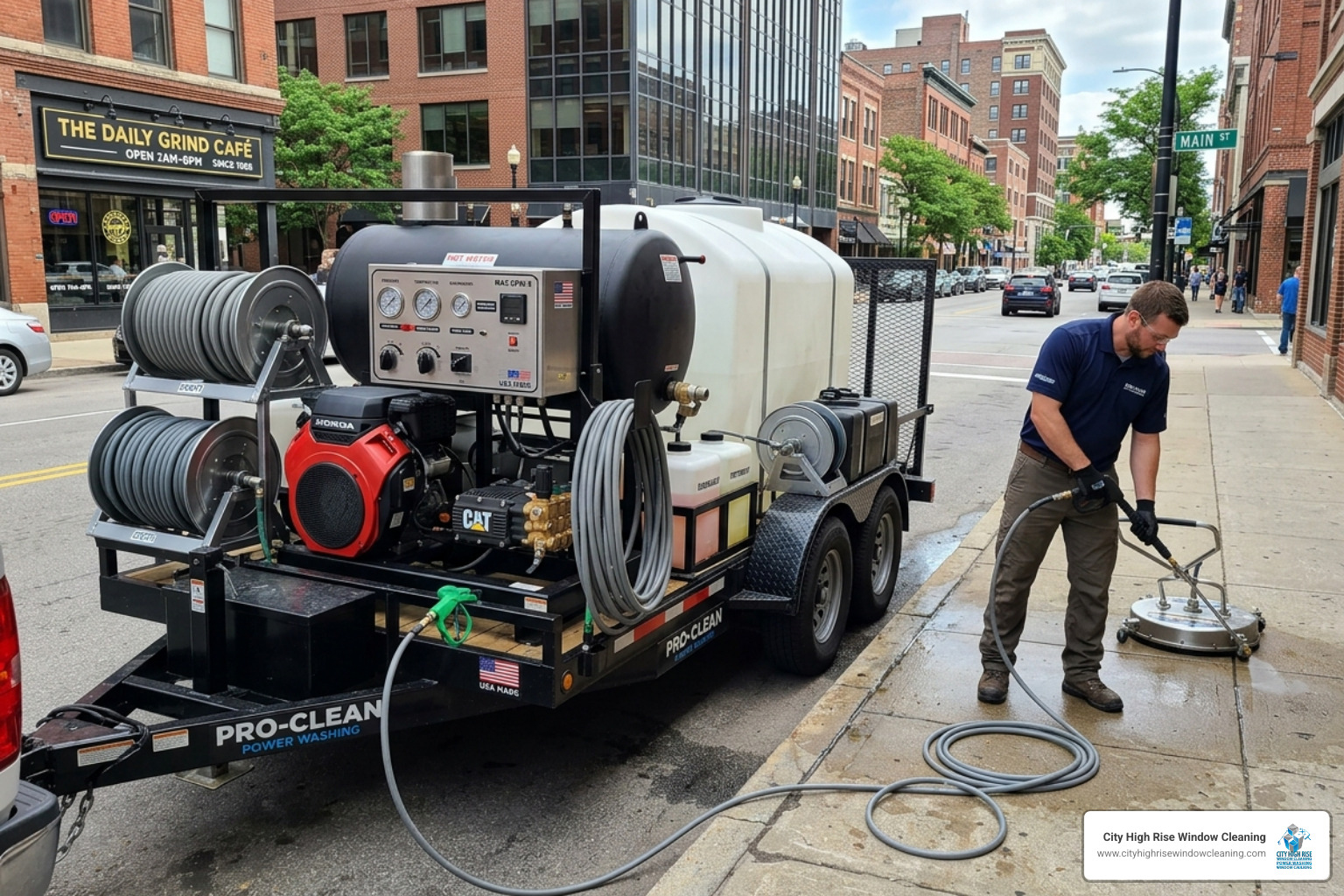
Commercial-grade equipment is built for efficiency and endurance. While a homeowner might spend all weekend cleaning a driveway, my teams use professional gas-powered units that range from 3,000 to 4,000 PSI with a flow rate of 5 to 12 GPM. In some industrial applications, we even see specialized equipment hitting 7,000 PSI.
The real secret isn’t just the pressure (PSI); it’s the volume of water (GPM). High GPM allows us to rinse away heavy debris and industrial pollutants much faster, preventing the “ghosting” or “striping” effects often seen with underpowered DIY attempts.
Hot Water vs. Cold Water
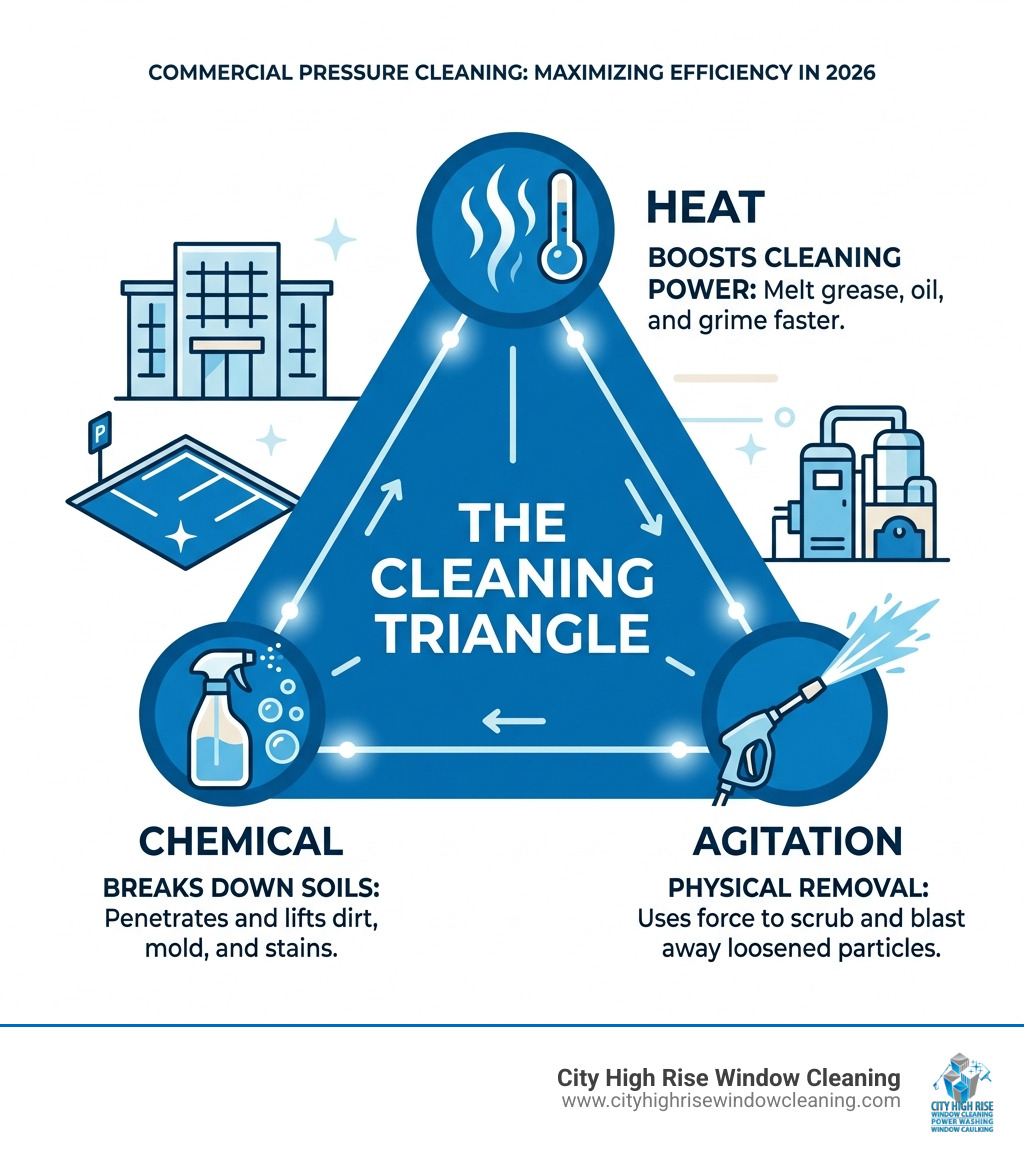
Most residential units only use cold water. For a commercial property—especially those with parking garages, dumpster pads, or restaurant storefronts—cold water simply won’t cut it. We utilize high-rise hot water power washing to emulsify grease, oil, and chewing gum. Think of it like washing greasy dishes; you need heat to break those molecular bonds.
Essential Equipment and Techniques for Superior Commercial Pressure Cleaning
To get the job done right in a environment like New York City, we don’t just rely on “point and shoot” wands. We use an arsenal of specialized tools designed for specific surfaces.
- Flat Surface Cleaners: These look like lawnmowers but house spinning spray bars underneath. They provide a uniform clean on parking lots and sidewalks, preventing the “zebra stripes” caused by manual wands.
- Soft Washing: This is a low-pressure technique (under 1,000 PSI) that relies on specialized, biodegradable chemicals to kill organic growth like mold and algae at the root. It’s essential for delicate surfaces like awning cleaning or dryvit/stucco facades.
- Water Reclamation: In many urban jurisdictions, letting wastewater run into storm drains is a major violation of the EPA Clean Water Act. Professional commercial setups often include vacuum systems to capture and filter runoff.
- Drone Technology: In 2026, we are increasingly using drone-assisted soft washing for mid-rise buildings. This reduces the need for heavy scaffolding or lifts, speeding up the process and lowering costs for the client.
The Role of Hot Water and Soft Washing in Commercial Pressure Cleaning
In our humid Northeast climate, we deal with a specific culprit: Gloeocapsa magma. This is the black algae that creates those ugly streaks on roofs and facades. If you hit it with high pressure alone, you might strip the surface, but the spores remain.
By using a soft wash approach, we apply a surfactant and a cleaning agent (like sodium hypochlorite) that neutralizes the spores. When combined with hot water for greasy areas, we achieve a level of sanitization that cold-water “blasting” can never match. This is particularly vital for maintaining the integrity of high-end finishes like those found in Alucobond restoration projects.
How to Measure the ROI of Professional Commercial Pressure Cleaning
I always tell my clients that commercial pressure cleaning isn’t an expense—it’s an investment with a measurable return.
- Tenant Retention: As mentioned earlier, a dirty building drives away high-value tenants. A clean, professional appearance justifies higher lease rates.
- Liability Reduction: Oil spills in parking garages or algae on sidewalks are slip-and-fall lawsuits waiting to happen. Regular cleaning removes these hazards.
- Surface Longevity: Contaminants like salt air in Long Island or industrial soot in NJ can physically degrade masonry and metal over time. Removing them prevents premature failure.
Maintenance vs. Replacement Costs (Estimated 2026 Tri-State Rates)
| Surface Type | Cleaning Cost (per sq ft) | Replacement Cost (per sq ft) | ROI Multiplier |
|---|---|---|---|
| Concrete Sidewalk | $0.15 | $15.00+ | 100x |
| Brick Facade | $0.45 | $40.00+ | 88x |
| Alucobond Panels | $0.60 | $65.00+ | 108x |
Investing in facade restoration today saves you from the astronomical costs of structural repairs five years down the road. Learn more about Facade Restoration.
Maximizing Property Value in the Tri-State Area with Expert Commercial Pressure Cleaning
Operating in the New York, New Jersey, and Connecticut area presents unique challenges. Between the salt spray of the Atlantic, the heavy humidity of our summers, and the punishing soot from city traffic, buildings here take a beating.
In NYC, the “urban canyon” effect traps pollutants against building faces. In Long Island and coastal New Jersey, salt crystallization can actually “pop” the face off of bricks (a process called spalling). I’ve found that a “one size fits all” approach doesn’t work here. You need a team that understands local geography.
For example, a building in Westchester might struggle more with moss and lichen due to heavy tree cover, while a storefront in Queens is likely fighting diesel soot and graffiti. We tailor our chemical mixes and pressure settings to these specific environmental factors. This expertise is essential for specialized tasks like Alucobond restoration. To stay updated on how we handle these local challenges, check out the latest entries in our Power Washing Blog.
Safety, Insurance, and Compliance for Large-Scale Commercial Pressure Cleaning Jobs
This is where the “pros” are separated from the “amateurs.” If a contractor causes property damage or, worse, an injury on your site without the proper coverage, you as the property owner could be held liable.
When you hire for commercial pressure cleaning, especially for high-rise work, you must demand:
- OSHA Compliance: Every technician should be trained in fall protection and ladder safety.
- SPRAT Certification: For high-rise buildings, our technicians are SPRAT (Society of Professional Rope Access Technicians) certified. This ensures they can safely navigate rope descent systems on skyscrapers.
- Liability Insurance: We carry a minimum of $1M in general liability insurance, though for many NYC projects, we maintain much higher limits.
- Site Safety Plans: Before we pull a single trigger, we perform a Job Hazard Analysis (JHA) to identify risks like electrical lines, pedestrian traffic, and fragile landscaping.
This level of rigor is why we are the preferred choice for commercial high-rise window cleaning and facade maintenance across the region.
Frequently Asked Questions about Commercial Pressure Cleaning
How much does commercial pressure washing cost per square foot in 2026 for Tri-State properties?
Pricing typically ranges from $0.15 to $0.75 per square foot for building washes and $0.09 to $0.35 for concrete. These rates depend on the total square footage, the height of the building (which may require lifts or rope access), the severity of the staining, and your specific location—for instance, Manhattan logistics often command a premium over Long Island residential complexes.
How often should a commercial property be pressure washed in the Tri-State area?
High-traffic retail centers and restaurants benefit from quarterly cleanings to manage gum and grease. Office complexes and industrial sites generally require bi-annual or annual maintenance. If your property is near a major highway or the coast, you may need more frequent “rinse-downs” to prevent salt and soot buildup.
Can commercial pressure washing damage my building’s exterior?
Yes, if done incorrectly. Using 4,000 PSI on old brick or delicate stucco will cause permanent damage. However, when performed by certified professionals using soft wash techniques and adjustable PSI, it is perfectly safe. We use the “Cleaning Triangle”—balancing heat and chemistry—to reduce the need for raw mechanical pressure.
What types of commercial properties benefit most from professional pressure cleaning?
While every property benefits, retail storefronts see the most immediate “curb appeal” boost. Parking garages and industrial facilities benefit from the removal of hazardous oils. Multi-unit residential complexes (HOAs) often use our services to stay compliant with local codes and maintain property values for owners.
Why choose City High Rise Window Cleaning for your commercial pressure cleaning needs?
With 30 years of experience (and my personal 48 years in the industry), we understand the Tri-State market like no one else. We offer a 100% satisfaction guarantee, use SPRAT-certified technicians for high-access work, and prioritize safety above all else. We don’t just “wash” buildings; we restore them.
Conclusion: Partnering with City High Rise Window Cleaning for Unmatched Commercial Pressure Cleaning ROI
In the competitive landscape of April 2026, your building’s exterior is either working for you or against you. Don’t let a layer of grime be the reason you lose a high-value tenant or face a slip-and-fall lawsuit.
At City High Rise Window Cleaning, we bring three decades of expertise to every job site in NYC, Long Island, New Jersey, and Westchester. Whether you need a standard sidewalk scrub or complex high-rise hot water power washing, my team is ready to deliver professional results with a 100% satisfaction guarantee.
Ready for a free quote? City High Rise Window Cleaning offers 24/7 live consultation.


