

Clear Views: Everything About Window Cleaning High-Rise Buildings
Clear Views: Everything About Window Cleaning High-Rise Buildings
Window Cleaning High-Rise Buildings: Save 30% and Prevent Permanent Glass Damage
Window cleaning high-rise buildings is a specialized, safety-critical service that keeps your property’s exterior protected, compliant, and looking its best — and it’s far more complex than standard window washing.
Here’s what you need to know at a glance:
- Methods used: Rope access, Building Maintenance Units (BMUs), suspended scaffolds, aerial work platforms, and water-fed poles
- Safety standards: OSHA 1910, IWCA, and IRATA/SPRAT certifications are industry requirements
- Cleaning frequency: Every 2–4 months for urban and coastal properties in markets like NYC and New Jersey
- Time to clean: A 50-floor building takes 30–40 days; the Empire State Building takes a crew of six roughly four months
- Cost range: Cleaners earn $20–$29/hour; project costs vary by building height, access method, and scope
- Why it matters: Dirt, pollution, and salt air don’t just look bad — they etch glass permanently if left untreated
Cities are building upward fast. By 2050, the world is projected to add 41,000 new skyscrapers. In dense metro areas like New York and New Jersey, a building’s exterior is its first impression. Dirty windows signal neglect. Clean ones signal a well-managed, well-maintained asset.
But getting windows clean at 30, 50, or 100 stories up isn’t just about appearance. It’s about structural integrity, glass longevity, and keeping workers safe in one of the most demanding jobs in the trades. One industry veteran with 40 years of experience put it plainly: “A high-rise window cleaner is a valuable asset, especially if he is skilled. It takes years to develop one.”
I’m Brett Hochman, CEO of City High Rise Window Cleaning, and I’ve spent over 48 years in the exterior building maintenance industry — specializing in window cleaning high-rise buildings across New York City, Long Island, Westchester, and New Jersey. This guide covers everything you need to make smart, informed decisions about your building’s exterior care.
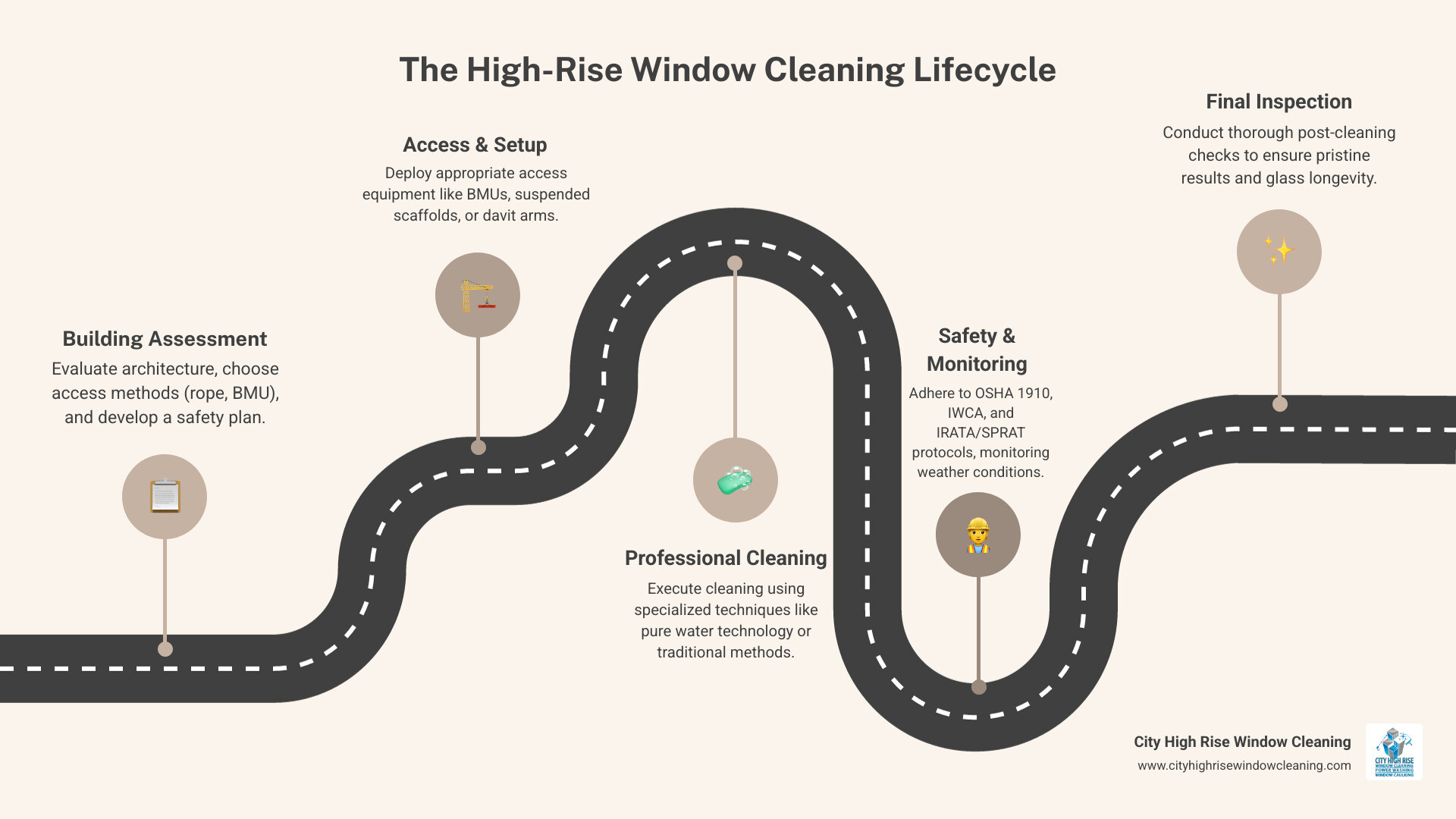
Essential Methods for Window Cleaning High-Rise Buildings
When I look at a skyscraper in Midtown or a luxury tower in Jersey City, I don’t just see glass; I see a logistical puzzle. The method we choose to solve that puzzle dictates the safety, speed, and cost of the entire project. In 2026, the industry has evolved to use a mix of “old school” grit and “new age” engineering.

Rope Access: The “Industrial Mountaineers”
Rope access is often the most versatile method for window cleaning high-rise buildings. Technicians use high-strength ropes, harnesses, and descent devices to move vertically. It’s often called “industrial mountaineering” because it requires the same level of focus and specialized gear as scaling a cliff.
The beauty of rope access is its efficiency. It can reduce labor hours by 50% to 70% because there is very little setup compared to heavy machinery. For buildings with narrow streets or irregular shapes where a platform can’t reach, rope access is our go-to. At City High Rise, our Commercial High-Rise Window Cleaning teams are experts in these controlled descents.
Building Maintenance Units (BMUs)
A BMU is a permanent, roof-mounted crane that carries a “cradle” or basket down the side of the building. These are the workhorses of modern skyscraper maintenance. While they are expensive to install, they increase cleaning efficiency by 30% to 40% on tall buildings with large, flat glass areas. However, they aren’t “set it and forget it” tools—they require rigorous maintenance and load testing every 13 months to remain safe.
Suspended Scaffolds and Swing Stages
You’ve likely seen these—the long platforms hanging from the roof by steel cables. These are ideal for multi-person crews or when we need to carry heavy equipment for post construction cleaning. We often use “davit arms” on the roof to secure these stages.
Aerial Work Platforms (AWPs)
For mid-rise buildings (usually up to 180 feet), we might use boom lifts or scissor lifts. These are great for buildings where we can’t get roof access but have plenty of ground space to park the machinery.
Efficiency Comparison Table
| Method | Best For | Labor Efficiency | Setup Time |
|---|---|---|---|
| Rope Access | Complex shapes, 6-40 stories | High (50-70% savings) | Very Low |
| BMU | Super-tall skyscrapers | Very High (30-40% gain) | Low (Permanent) |
| Swing Stage | Flat facades, heavy repairs | Moderate | High |
| Aerial Lift | Mid-rise (up to 180 ft) | High | Moderate |
Specialized Access for Complex NYC Architecture
New York City is famous for its architectural “wedding cake” setbacks and historical cornices. As a Manhattan High-Rise Window Cleaning Company, I’ve seen it all. We often have to use counterweight systems or specialized davit arms to clear a building’s ledge safely. In areas like Brooklyn, where older industrial buildings are being converted to luxury lofts, our Brooklyn High-Rise Window Cleaning Company teams frequently use these custom rigging solutions to navigate unique facades.
Pure Water Technology and Reach Systems
For windows up to about 70–80 feet (roughly 6 or 7 stories), we often use water-fed poles. These are made of lightweight carbon fiber and pump deionized, demineralized water directly to a brush.
Why “pure” water? Because regular tap water has minerals that leave spots. Pure water acts like a magnet for dirt and dries completely streak-free without the need for a squeegee. This is a game-changer for Window Restoration because it’s eco-friendly and keeps our feet on the ground whenever possible.
How Professionals Master Safety and Training at Extreme Heights
Safety isn’t just a checkbox for us; it’s the foundation of everything we do. You might think hanging off a 50-story building is the most dangerous job in the world, but statistically, it’s safer than driving a taxi. Globally, high-rise cleaners see 1.5 million “exposures” (times on the side of a building) every year, yet fatalities are typically limited to one or two. That’s because of strict protocols.
Certifications and Compliance
Every technician I hire must undergo rigorous training. We follow OSHA 1910 standards and look for certifications from the International Window Cleaning Association (IWCA) or rope access organizations like IRATA or SPRAT.
- IRATA Level 3: These pros have over 1,000 supervised hours and are experts in rescue planning.
- Fall-Arrest Systems: We always use a “double-rope” system. One rope is for work; the second is a safety backup that catches the technician instantly if the first rope fails.
Load Testing and Inspections
In New York and Philadelphia, safety standards are among the highest in the world. Roof anchors—the points we tie our ropes to—must be certified to hold at least 5,000 pounds (or 15kN). We perform daily safety checks and quarterly inspections on all gear. If a rope shows even a tiny nick, it’s retired immediately.
Weather Monitoring and Environmental Risks
The biggest enemy of window cleaning high-rise buildings isn’t height—it’s the wind.
- The 25 MPH Rule: We generally halt all high-rise work if sustained winds exceed 25 mph.
- Building Sway: On super-tall towers, the building itself can sway several feet in the wind. This makes it impossible to keep a squeegee on the glass and creates a “pendulum” risk for the cleaner.
- Thermal Stress: In the winter, we have to be careful. Using hot water on freezing glass can cause it to shatter. We use cool or lukewarm water to prevent thermal shock.
As a leading New Jersey High-Rise Window Cleaning Company, we monitor local weather stations and rooftop anemometers constantly to ensure our crews are never caught off guard by a sudden gust off the Hudson.
The Logistics of Cleaning Skyscraper Windows: Time, Cost, and Frequency
Cleaning a skyscraper isn’t a weekend job. It’s a marathon.
How Long Does It Actually Take?
- A 50-story building: Usually takes 30 to 40 days to clean the entire exterior.
- The Empire State Building: With its 102 floors and 6,514 windows, it takes a crew of six men about four months to finish. By the time they finish, it’s almost time to start again!
The Cost of Clean
High-rise window cleaners in the U.S. typically earn between $20 and $29 per hour, with experienced cleaners in high-demand markets like NYC earning an average of $58,000 per year. For property managers, the total project cost depends on the access method. Investing in a permanent BMU might have a high upfront cost, but it can improve operational efficiency by 30%, saving money over the long term.
As a Midtown Manhattan High-Rise Window Cleaning Company, we help managers balance these costs by providing detailed estimates that account for the specific architectural challenges of the Diamond District or Billionaires’ Row.
Determining Your Cleaning Schedule
How often should you call us? It depends on your environment:
- Urban Areas (NYC/Jersey City): Pollution, exhaust, and bird droppings mean you need a clean every 3–4 months.
- Coastal Areas (Long Island/Jersey Shore): Salt air is a glass killer. It can etch the surface permanently. We recommend every 2–3 months for these properties.
- Standard Commercial/Residential: Bi-annual or quarterly service is usually enough to maintain the “sparkle.”
Whether it’s a commercial tower or Residential High-Rise Window Cleaning, keeping a regular schedule is always cheaper than performing a massive “restoration” clean after years of neglect.
Advanced Technology and Challenges in Modern Window Cleaning High-Rise Buildings
The industry is changing. We aren’t just guys with squeegees anymore; we are technicians managing advanced systems.
The Rise of Robotics
Robotic window cleaners are no longer science fiction. Some tethered robotic systems can clean between 14,000 and 33,000 square feet per hour—achieving up to 90% labor savings. While they can’t handle deep recesses or complex “wedding cake” architecture yet, they are excellent for the massive glass curtains of modern towers. These robots reduce worker exposure to height by almost half, making the industry even safer.
Beyond the Glass: Total Facade Maintenance
When our technicians are on the ropes, they aren’t just cleaning. They are the “eyes in the sky” for property managers. We often perform:
- Window Caulking to prevent leaks.
- Facade Restoration to remove oxidation from metal panels.
- Alucobond Restoration for modern composite facades.
In places like Long Island City, where new glass towers are popping up every month, our Long Island City High-Rise Window Cleaning Company teams provide these integrated services to keep the entire building envelope healthy.
Overcoming Architectural Obstacles
Modern architects love curved glass and deep recesses. These look beautiful but are a nightmare to clean. Curved facades require “stabilization” systems to keep the cleaner from swinging away from the glass. We also have to be careful with material-specific handling. You can’t use the same chemical on an aluminum frame that you use on stone.
Our Uptown Manhattan High-Rise Window Cleaning Company frequently deals with these “prestige” buildings that require a soft touch and specialized knowledge. For more insights into maintaining complex facades, explore our article on The Future of Facade Maintenance in NYC.
Frequently Asked Questions about Window Cleaning High-Rise Buildings
How often should high-rise windows be cleaned?
Standard commercial buildings in urban areas like New York or New Jersey typically require cleaning 2 to 4 times per year, though coastal properties may need service every 2 months to prevent salt etching.
Is high-rise window cleaning dangerous?
While the heights are extreme, the industry is statistically safer than driving a taxi; with 1.5 million annual exposures, fatalities are limited to 1-2 per year due to strict OSHA and IRATA safety protocols.
How long does it take to clean a 50-story building?
A standard 50-floor skyscraper generally takes a professional crew between 30 and 40 days to clean in its entirety, depending on the access method used and the complexity of the facade.
What factors influence the cost of high-rise window cleaning?
Costs are primarily influenced by building height and complexity, access methods required (e.g., rope access vs. BMU), frequency of cleaning, and the specific services needed like High-Rise Hot Water Power Washing or Facade Restoration.
What is pure water technology and why is it used?
Pure water technology uses deionized water, free of minerals and impurities, which dries spot-free without the need for squeegees or chemicals. This method is highly effective for streak-free results and is environmentally friendly, especially for windows reachable with water-fed poles.
Conclusion
City High Rise Window Cleaning is your trusted partner for expert window cleaning high-rise buildings across NYC, NJ, and Long Island. With 30 years of experience and a 100% satisfaction guarantee, we prioritize a safety-first culture to deliver pristine results and help you achieve significant maintenance cost savings. Explore our comprehensive Professional High-Rise Window Cleaning Services today.
Ready for a free quote? City High Rise Window Cleaning offers 24/7 live consultation.


