

Don’t Look Down and Other Tips for Choosing High-Rise Painters
Don’t Look Down and Other Tips for Choosing High-Rise Painters
Professional Painters for Skyscrapers: Cut Maintenance Costs by 40% and Avoid Costly Liability
Professional painters for skyscrapers are specialized contractors who use advanced access techniques like rope systems, swing stages, and scaffolding to safely apply durable coatings to tall buildings. Hiring the right team ensures you avoid the massive liability of amateur mistakes while cutting long-term maintenance costs by up to 40% through efficient rope access and high-performance coatings.
What to Look For When Hiring:
- Safety Record – OSHA compliance, IRATA certification, and zero lost-time incidents
- Access Methods – Rope access, boom lifts, swing stages, or custom rigging
- Coating Expertise – Elastomeric coatings, UV-resistant finishes, corrosion control
- Project Management – Evening/weekend scheduling to minimize tenant disruption
- Surface Preparation – Power washing, sandblasting, substrate repair to SSPC standards
Painting a skyscraper isn’t like painting a house. Wind speeds increase by 1.5x every 30 feet of elevation. Temperature swings can cause coatings to fail mid-application. A single safety mistake can shut down a project for weeks-or worse. That’s why property managers in New York and New Jersey can’t afford to hire general contractors for high-altitude work.
The best high-rise painters combine decades of experience with modern rope access techniques that cut costs by 40% compared to traditional scaffolding. They use low-VOC coatings that won’t force tenants to evacuate. And they follow strict planning processes that account for weather windows, building movement, and public safety below.
I’m Brett Hochman, and I’ve been leading high-rise exterior maintenance projects across the Tri-State area since 1977. Over 48 years, I’ve seen what separates competent professional painters for skyscrapers from those who create liability nightmares-and I’ll show you exactly what to demand before signing any contract.
What are High-Rise Painting Services?
When I talk about high-rise painting, I’m not just talking about a fresh coat of color. These services are a comprehensive shield for some of the most complex structures on the planet. In cities like New York and Jersey City, high-rise painting covers everything from luxury residential towers and massive office skyscrapers to five-star hotels and historical landmarks.
These services are designed to protect the building envelope. We cover:
- Exterior Walls: Whether it’s concrete, stucco, brick, or metal panels.
- Balconies: Often requiring specialized waterproofing and slip-resistant coatings.
- Window Frames and Mullions: Protecting the metal from oxidation and corrosion.
- Fire Escapes and Railings: Ensuring these critical safety features remain structurally sound and rust-free.
- Industrial Structures: Including rooftop mechanical enclosures and water towers.
For a deeper dive into what we do, you can check out our exterior high-rise painting services. At City High Rise Window Cleaning, we’ve spent over 30 years perfecting the art of maintaining these towering assets. Our team also provides commercial high rise window cleaning and residential high rise window cleaning to ensure your building looks pristine from top to bottom.
The Unique Challenges of Painting Skyscrapers and Elevated Structures
If you’ve ever stood on a roof in Manhattan during a “breezy” day, you know that wind at 500 feet is a completely different animal than wind at street level. Wind shear is perhaps the greatest challenge for professional painters for skyscrapers. It can turn a simple spray application into a neighborhood-wide overspray disaster if not managed with surgical precision.
Then there’s humidity and temperature. In our region—stretching from the humid summers of Long Island to the freezing winters of Westchester—the “weather window” for painting is remarkably tight. We have to monitor the dew point and substrate temperature constantly. If the surface is too cold or too damp, the paint won’t bond, leading to premature peeling and a massive waste of your capital budget.
Architectural nuances also play a huge role. Modern buildings aren’t just flat boxes; they have overhangs, recessed windows, and decorative fins that create “dead zones” for traditional equipment. We also have to account for substrate movement. Tall buildings are designed to sway. If you apply a rigid paint to a building that moves, that paint is going to crack. That is why we adhere to Building Owners and Managers Association (BOMA) standards to ensure every project meets the highest industry benchmarks for commercial real estate.
Finally, logistics in high-density urban areas are a nightmare. You can’t just park a truck on a busy New York City street without months of permitting and coordination. We have to manage pedestrian protection, vibration from nearby subways, and the sheer height of the structure, all while ensuring the public stays safe below.
Specialized Techniques Used by Professional Painters for Skyscrapers
To conquer these challenges, we use equipment that looks more like something out of a mountain climbing expedition than a hardware store.
Industrial Rope Access (Abseiling)
This is the gold standard for modern high-rise work. Using IRATA-certified technicians, we can descend from the roof using specialized rope systems. It’s fast, it’s discreet, and it allows us to reach spots that a swing stage simply can’t touch.
Swing Stages and Scaffolding
For massive surface areas where we need multiple painters working side-by-side, we use suspended scaffolding (swing stages). These are motorized platforms that we rig to the roof. For new construction or total restorations, traditional pipe scaffolding might be used, though it’s often the most expensive and disruptive option.
Comparison: Rope Access vs. Traditional Scaffolding
| Feature | Rope Access (Abseiling) | Traditional Scaffolding |
|---|---|---|
| Setup Time | Very Fast (Hours) | Slow (Days/Weeks) |
| Cost | Lower (Less labor/equipment) | Higher (Significant rental/labor) |
| Disruption | Minimal (No sidewalk blockage) | High (Occupies street/sidewalk) |
| Access | Can reach tight corners | Limited to vertical planes |
| Security | Ropes removed daily | Fixed structure can be a climbing risk |
Why Professional Painters for Skyscrapers Prioritize Surface Preparation
I always tell my clients: the most expensive paint in the world will fail if it’s applied over dirt. Surface preparation is 70% of the job. We start with high-pressure power washing to remove salt, grime, and loose debris. In some cases, we use sandblasting or shot blasting to strip old, failing coatings down to the raw substrate.
We follow SSPC (The Society for Protective Coatings) standards to ensure the surface profile is perfect for adhesion. This might involve skim coating concrete to fill “bugholes” or using high-quality coatings from Sherwin-Williams that are specifically formulated for high-build applications. We also perform rust removal and substrate repair-because painting over rust is just hiding a problem that will eventually eat through your building. For buildings that need deep cleaning before coating, our high rise hot water power washing service ensures the substrate is completely free of contaminants.
How Professional Painters for Skyscrapers Minimize Tenant Disruption
Nobody wants a painter peering into their 40th-floor office window at 2:00 PM during a board meeting. To keep your tenants happy, we employ several strategies:
- Strategic Scheduling: We often work evening or weekend shifts to avoid peak business hours.
- Low-VOC and Low-Odor Materials: We use paints that don’t off-gas “chemical” smells into the HVAC system.
- Discreet Access: Rope access technicians can often mobilize and demobilize without ever entering the main lobby.
- Coordination with Other Services: We often bundle painting with high rise window caulking services to get all the “loud” work done at once.
Strategic Planning and Safety Protocols for High-Altitude Projects
Safety isn’t just a checklist for us; it’s a culture. When you’re working 1,000 feet in the air, there is zero room for error. Every project begins with a Site-Specific Safety Plan (SSSP). This document outlines every potential risk-from high winds to pedestrian traffic-and details exactly how we will mitigate them.
We strictly follow OSHA regulations and New Jersey Apartment Association (NJAA) safety guidelines for residential properties. This includes:
- Fall Protection: Every technician is double-tied with redundant safety lines.
- Pedestrian Canopies: We install sidewalk sheds or “bridge” scaffolding to protect the public from any accidental drops (even a dropped paintbrush can be lethal from that height).
- Permit Acquisition: We handle all the DOT and DOB permits required for NYC and New Jersey operations.
- Regular Safety Audits: I personally ensure our gear is inspected daily and that our team undergoes constant re-certification.
High-Performance Coatings: Ensuring Durability Against the Elements
The paint you use on your bedroom walls won’t last a week on the exterior of a skyscraper. We use high-performance industrial coatings designed to take a beating.
Elastomeric Coatings are my personal favorite for concrete and stucco. These coatings are “stretchy”-they can expand and contract up to 300% without cracking. This is vital for bridging hairline cracks and keeping water out of the building’s structure.
We also look for:
- UV Stability: To prevent the sun from fading the color and breaking down the chemical bonds of the paint.
- Corrosion Control: Essential for the steel elements of a building.
- Waterproofing: Using PPG industrial coatings to create a seamless moisture barrier.
- Anti-Graffiti Finishes: Especially important for the first two floors of urban buildings.
Beyond Aesthetics: Related Maintenance and Protection Services
A professional high-rise painting company should be your building’s best friend. While we’re up there, we see things that property managers can’t see from the ground. That’s why we offer a full suite of facade restoration and cleaning services.
In New York City, we help buildings stay compliant with FISP (Facade Inspection & Safety Program), formerly known as Local Law 11. We also assist with Local Law 126 for parking structures. Our related services include:
- Concrete Restoration: Fixing spalled concrete before it falls.
- Glass Replacement and Restoration: We can often restore scratched or etched glass for 90% less than the cost of replacement through our window restoration service.
- Sealant and Caulking: Replacing the dried-out “rubber” around your windows with high rise window caulking to stop leaks.
- Anchor Installation: Installing and certifying the safety anchors that allow our teams (and window cleaners) to work safely.
Check out our guide on how to maintain your building’s exterior for more tips on preserving your asset in the Tri-State area.
Frequently Asked Questions About Professional Painters for Skyscrapers
How much do professional painters for skyscrapers cost?
Costs vary based on the building’s height, access method, and surface condition. However, using rope access instead of traditional scaffolding can reduce labor and equipment costs by up to 40%.
What is the best paint for high-rise buildings in New York?
Elastomeric coatings are the industry standard for NYC skyscrapers. They provide a flexible, waterproof barrier that expands and contracts with the building’s movement, preventing cracks caused by extreme temperature swings.
How long does it take to paint a 50-story building?
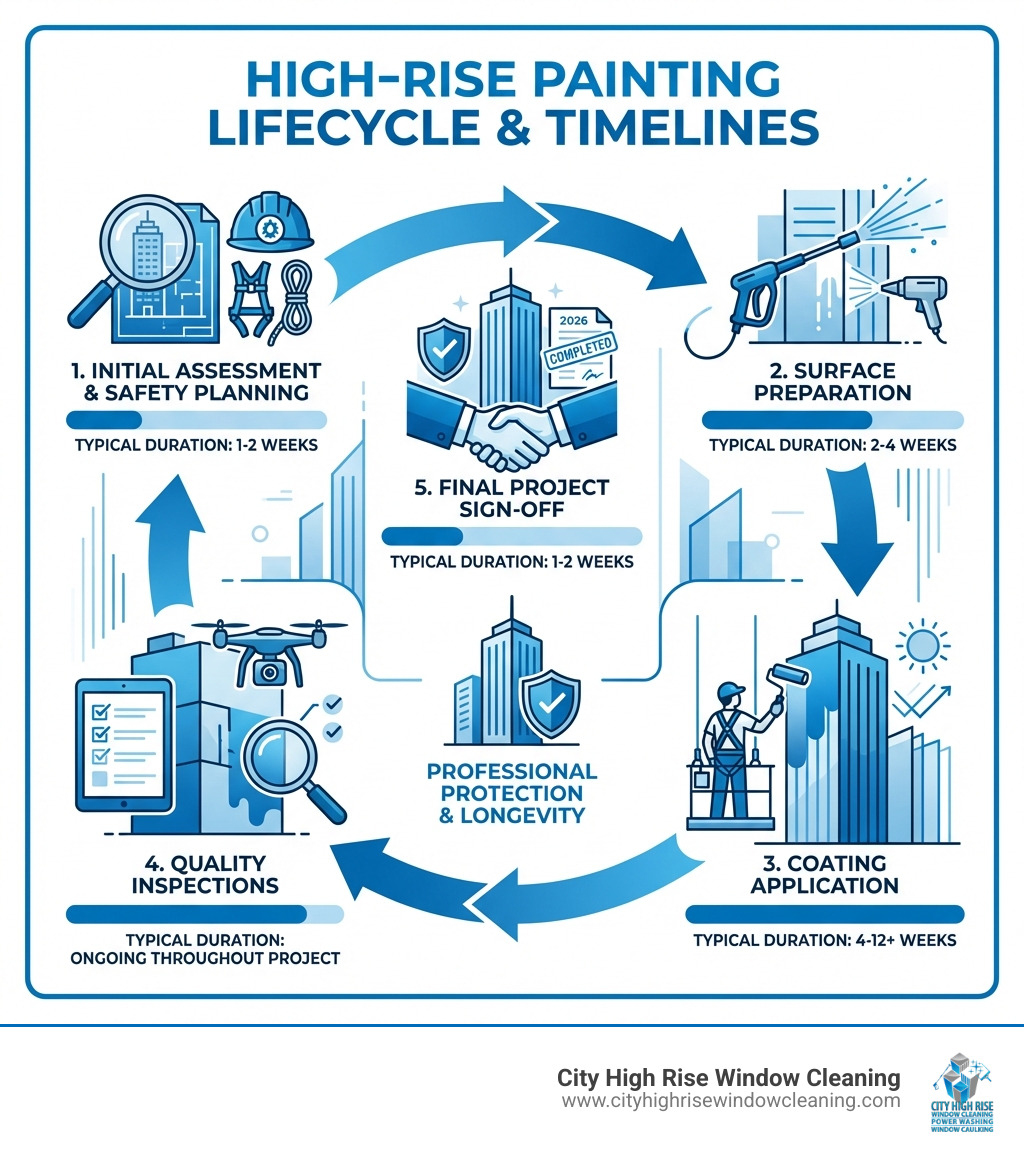
A typical project can take anywhere from 4 to 12 weeks depending on weather conditions and the level of surface preparation required. Using rope access significantly speeds up mobilization and demobilization times.
Is rope access safer than scaffolding for skyscraper painting?
Yes, statistically rope access has a superior safety record. It eliminates the structural risks associated with heavy scaffolding and allows for rapid evacuation or equipment removal during high-wind events in urban environments.
How often should a skyscraper be repainted?
Most high-rise exteriors require professional repainting every 5 to 10 years to maintain structural integrity and prevent water intrusion, especially in coastal areas like Long Island and New Jersey.
Conclusion
Investing in professional painters for skyscrapers isn’t just about making your building look pretty-it’s about protecting a multi-million dollar asset. A failed coating leads to water intrusion, which leads to rusted rebar, which leads to “spalling” concrete that can fall and cause catastrophic liability.
At City High Rise Window Cleaning, we bring over 30 years of experience to every project in NYC, Long Island, New Jersey, and Westchester. We don’t just “paint”; we preserve. With our 100% customer satisfaction guarantee and our impeccable safety record, we’ve become the trusted partner for property managers who want the job done right the first time.
You can learn more about our high-rise expertise and see how we’ve helped transform skylines across the Northeast. Don’t leave your building’s health to chance.
Ready for a free quote? City High Rise Window Cleaning offers 24/7 live consultation. Call 917-749-8342 to speak to a live representative.


