

Renovation Done? Now What? A Guide to Deep Cleaning Your New Space
Deep Cleaning House After Construction: Stop Breathing Toxic Dust and Start Enjoying Your Renovation
The Hidden Dangers: Why Post-Construction Cleaning is Non-Negotiable
Deep cleaning house after construction transforms a dusty construction site into a safe, livable space. The renovation is complete, but there’s one crucial step left: removing every trace of dust, debris, and residue that construction leaves behind.
Quick Answer: How to Prepare Your House After Construction
- Remove large debris – Vacuum and sweep all surfaces (walls, floors, ceilings)
- Deep clean all surfaces – Wipe down with sanitizing cleaners, including inside cabinets
- Address fine dust – Use HEPA-filtered vacuums and air scrubbers to capture microscopic particles
- Clean HVAC systems – Dust vents, ducts, and replace filters to prevent circulation of contaminants
- Sanitize key areas – Focus on kitchens and bathrooms with thorough disinfection
- Final polish – Clean windows, buff floors, and remove any remaining construction marks
The reality? Construction dust isn’t like regular household dust. It contains harmful substances like silica, lead, and asbestos fibers that can cause respiratory problems and allergies. Even after your contractor finishes, the industry standard is only “broom-swept”—meaning they’ll remove large debris and do a basic sweep, leaving the detailed cleaning entirely up to you.
As Brett Hochman, CEO of City High Rise Window Cleaning with over 48 years in exterior building maintenance, I’ve seen countless property owners struggle with post-renovation cleanup, especially in high-rise buildings across New York and New Jersey. Deep cleaning house after construction requires specialized knowledge, proper equipment, and a systematic approach to ensure your newly renovated space is truly ready for occupancy.
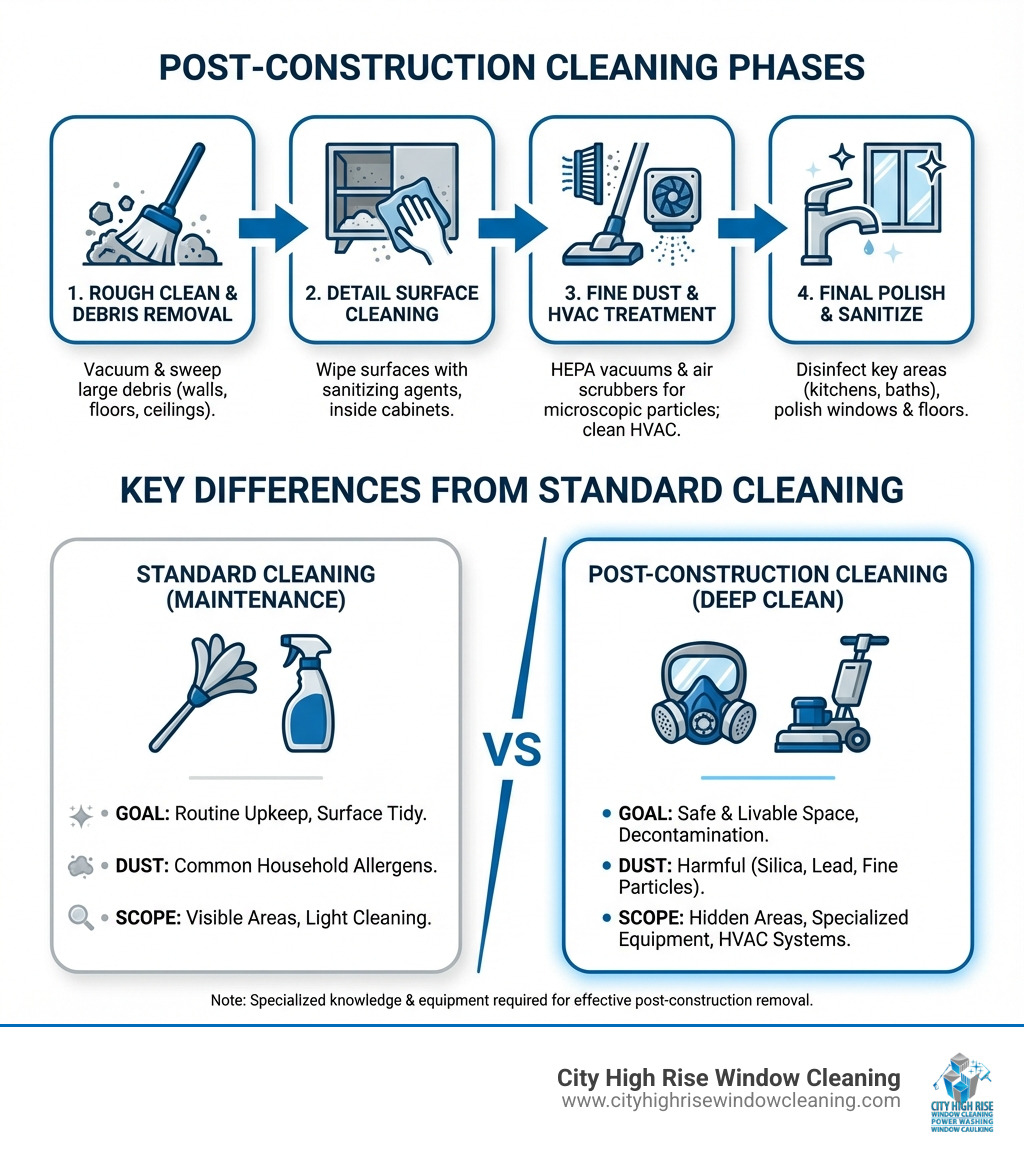
Quick look at deep cleaning house after construction:
Construction dust is far from ordinary household dust. It’s a complex mix of fine particles from various building materials, many of which are hazardous. This includes substances like crystalline silica from concrete and mortar, lead particles from older paint or materials, and even asbestos fibers if your renovation involved older structures. According to sources like the CDC, these tiny particles, when airborne and inhaled, can cause serious health issues. Prolonged exposure to silica dust can lead to silicosis, a severe and often fatal lung disease. You can learn more about the dangers of crystalline silica dust from the CDC.
These microscopic particles can trigger respiratory problems, exacerbate allergies, and even lead to more severe long-term health complications. Beyond the air you breathe, construction dust infiltrates every nook and cranny. It settles into HVAC systems, contaminating air ducts and filters, and then gets recirculated throughout the property.
And let’s not forget the more visible safety hazards. Stray nails, screws, shards of glass, sharp pieces of wood, and other debris can be left behind, posing a risk of cuts, punctures, or trips.
That’s why deep cleaning house after construction isn’t just about making things look nice; it’s about creating a truly safe and healthy environment for everyone who enters the space.
Gearing Up: Your Essential Post-Construction Cleaning Toolkit
Before you even think about tackling the dust and debris left by construction, you need to arm yourself with the right tools and supplies. From my perspective, trying to clean post-construction without the proper equipment is like trying to scale a skyscraper without ropes – inefficient, dangerous, and likely to leave you frustrated.
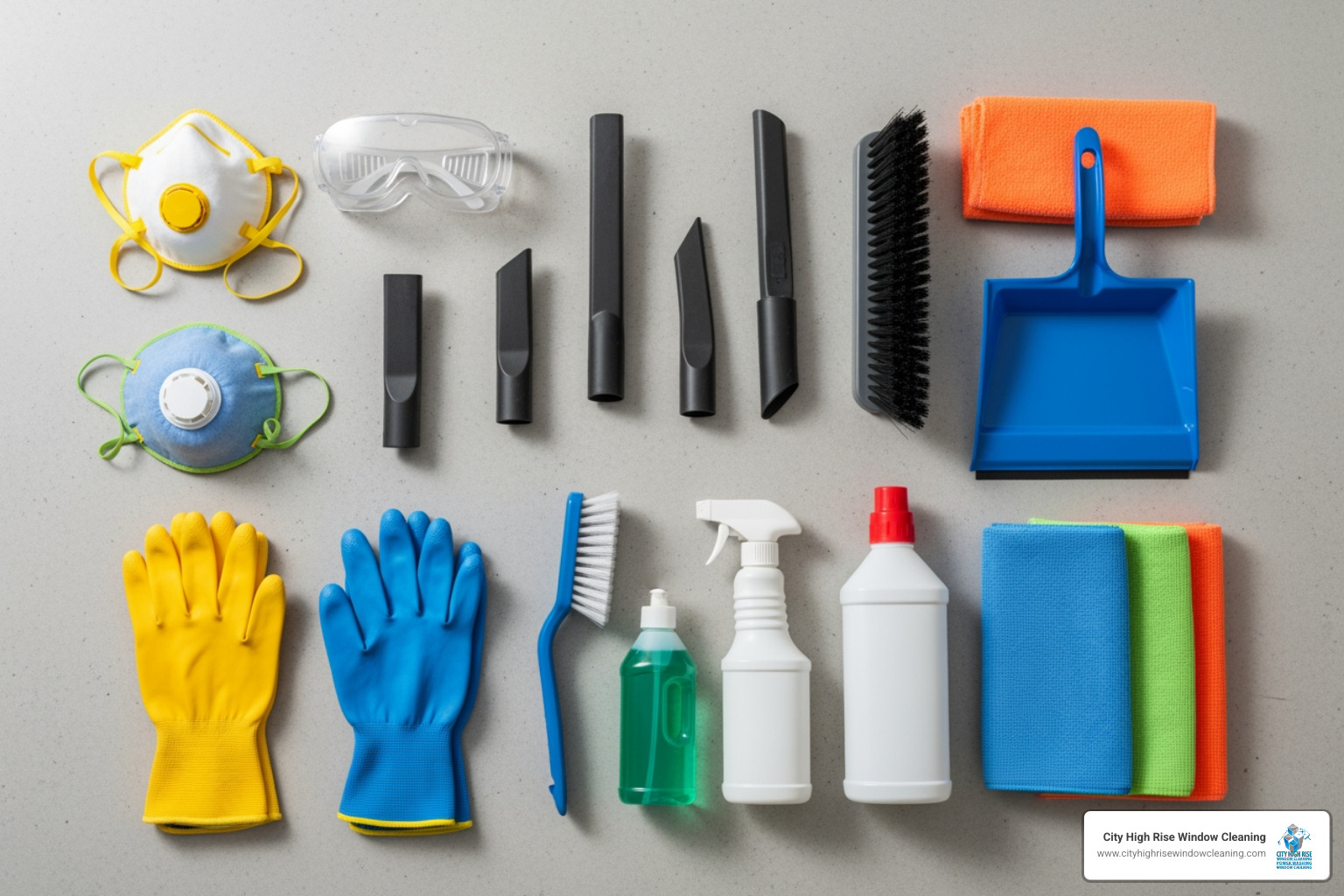
Here’s what I consider essential for effective and safe deep cleaning house after construction:
Personal Protective Equipment (PPE): This is paramount. Construction dust, as I mentioned, can be harmful. Always wear:
- N95 or P100 Respirator Masks: These are crucial for filtering out fine dust particles, protecting your lungs from silica, lead, and other irritants. A simple surgical mask won’t cut it here.
- Safety Glasses or Goggles: To protect your eyes from airborne dust and chemical splashes.
- Heavy-Duty Gloves: To protect your hands from sharp debris, harsh cleaners, and prolonged exposure to dust.
- Long-Sleeved Clothing and Pants: To minimize skin exposure to dust and potential irritants.
Specialized Cleaning Equipment:
- Heavy-Duty Shop Vacuum: Your regular household vacuum is likely not up to the task. A powerful shop vacuum can handle large debris, screws, and heavy dust without getting clogged or damaged.
- HEPA Filters: Ensure your vacuum and any air purification systems are equipped with High Efficiency Particulate Air (HEPA) filters. This is a game-changer. HEPA filters are designed to capture at least 99.97% of airborne particles 0.3 microns in size, including the fine dust, pollen, mold, and bacteria that linger after construction. Without them, you’re just recirculating fine dust.
- Air Scrubbers: For truly clearing the air, especially in a large renovation in a New York City brownstone or a commercial space in New Jersey, consider renting commercial-grade air scrubbers with HEPA filters. These machines continuously filter the air, capturing airborne dust particles and significantly improving indoor air quality.
- Microfiber Cloths: These are excellent for trapping dust rather than just pushing it around. Have plenty on hand for wiping down surfaces.
- Glass Scrapers/Razor Blades: For carefully removing paint splatters, caulk, and adhesive residue from glass and other hard surfaces. Exercise extreme caution when using these.
- Buckets: For mixing cleaning solutions and rinsing cloths.
- Heavy-Duty Squeegee: Especially for windows, a good squeegee can make a big difference in achieving streak-free results.
- Extendable Dusters and Poles: To reach high ceilings, light fixtures, and wall ledges without needing to constantly move a ladder.
- Stiff Bristle Brushes: Essential for scrubbing grout, stubborn stains, and textured surfaces.
- Soft Brushes/Attachments: For delicate surfaces, light fixtures, and electronics.
Cleaning Solutions:
- All-Purpose Cleaners: Choose cleaners that are effective yet safe for various surfaces.
- Glass Cleaner: For streak-free windows and mirrors.
- Disinfectants: Especially for bathrooms and kitchens, to sanitize surfaces that may have been exposed to construction grime.
- Degreasers: If there was any work involving machinery or heavy oils.
- Specialty Cleaners: Depending on your new finishes (e.g., stone cleaner for marble, wood cleaner for hardwood floors).
- Eco-Friendly/Non-Toxic Options: Whenever possible, I recommend using environmentally friendly and non-toxic cleaning products. They’re safer for you, your family, and the environment, especially important in densely populated areas like Long Island.
Essential Safety and Cleaning Supplies List:
- N95/P100 Respirator Masks
- Safety Glasses/Goggles
- Heavy-Duty Gloves
- Heavy-Duty Shop Vacuum with HEPA filter
- HEPA Air Scrubber (rented)
- Microfiber Cloths (many!)
- Glass Scrapers/Razor Blades
- Buckets
- Heavy-Duty Squeegee
- Extendable Dusters/Poles
- Stiff Bristle Brushes
- Soft Brushes/Vacuum Attachments
- All-Purpose Cleaner
- Glass Cleaner
- Disinfectant
- Degreaser (if needed)
Having these tools ready will not only make the job easier but also safer and more effective, ensuring that your deep cleaning house after construction efforts truly pay off.
The Ultimate Guide to Deep Cleaning Your House After Construction
Now that you’re geared up, let’s dive into the systematic approach I recommend for deep cleaning house after construction. This isn’t your average weekend tidy-up; it’s a meticulous process designed to eliminate every trace of construction residue. The average deep cleaning process can take up to eight hours or more for a typical 2,000 sq. ft. home.
My golden rule for any deep clean is to work from top to bottom. Start with high surfaces like ceilings and light fixtures, so any dust or debris that falls can be captured later when you clean lower surfaces and floors.
I advocate for a three-phase cleaning process to ensure nothing is missed. This structured approach is what we use for our professional clients in New York, Long Island, and Westchester.
The 3-Phase Cleaning Process Explained
Phase 1: Rough Clean (Debris Removal)
- Clear all construction waste, leftover materials, packaging, plastic sheeting
- Initial vacuum/sweep with heavy-duty shop vacuum
- Remove stickers and protective films from windows, appliances, fixtures
- Pre-clean windows to remove major grime and paint splatters
Phase 2: Light Clean (The Deep Dusting)
- Top-to-bottom dusting of ceilings, light fixtures, walls, ledges, shelves
- Wipe down all hard surfaces with damp microfiber cloths
- Clean HVAC vents and replace all filters
- Deep clean floors – vacuum carpets thoroughly, sweep and mop hard floors
Phase 3: Final Clean (Detailing and Polishing)
- Spot clean remaining smudges, fingerprints, paint drips
- Final window cleaning with glass cleaner and squeegee
- Clean and polish all appliances inside and out
- Sanitize bathrooms and kitchen surfaces
- Final vacuum/mop pass
Room-by-Room Deep Cleaning House After Construction Checklist
General Areas (Walls, Ceilings, Vents)
- Use extendable duster on ceilings and walls, working top to bottom
- Dust light fixtures and ceiling fans thoroughly
- Vacuum all air vents with brush attachment, replace HVAC filters
- Wipe down baseboards, trim, doors, and disinfect doorknobs
- Vacuum closet floors, dust shelves
Kitchen
- Empty and clean all cabinets and drawers inside and out
- Wipe down and disinfect countertops and backsplashes
- Clean all appliances inside and out, including under/behind if movable
- Clean and polish sink and faucet fixtures
- Sweep, vacuum, and mop floors, paying attention to grout lines
Bathrooms
- Clean and sanitize toilets, sinks, tubs, shower stalls
- Clean and polish mirrors and chrome fixtures
- Scrub tile and grout lines with stiff brush
- Wipe down walls, sweep, vacuum, and mop floors
Windows & Doors
- Clean all glass surfaces inside and out, removing stickers and paint overspray
- Dust and wipe down window sills, ledges, frames, and vacuum tracks
- For complex window situations in high-rise buildings, consider professional Window Restoration
Exterior Surfaces
- Clear walkways and driveways of construction debris
- Wash exterior walls and siding as needed
- For tough exterior cleaning jobs, professional Power Washing can restore surfaces
By following this comprehensive checklist, you’ll be well on your way to a truly clean and healthy space.
DIY vs. Pro: When to Hire a Cleaning Service in NYC
So, you’ve seen the extensive checklist and the tools required. Now the big question: should you tackle this yourself, or call in the professionals? From my standpoint, having seen the aftermath of countless construction projects across New York City, Long Island, New Jersey, and Westchester, the answer isn’t always straightforward. It often comes down to balancing time, resources, safety, and the desired outcome.
Here’s a look at the factors to consider:
| Feature | DIY Post-Construction Cleaning | Professional Post-Construction Cleaning |
|---|---|---|
| Cost | Lower upfront cost (materials only) | Higher upfront cost (labor, specialized equipment, materials) |
| Time | Very time-consuming (can take days or weeks for a large project) | Efficient (completed quickly by trained teams) |
| Equipment | Requires purchasing/renting specialized tools (HEPA vac, air scrubber) | Professionals bring commercial-grade, specialized equipment |
| Results | Variable (depends on effort, knowledge, and tools) | Guaranteed thoroughness and professional finish |
| Safety | Higher risk of exposure to hazardous dust, physical strain | Lower risk (trained teams with proper PPE and protocols) |
| Expertise | Limited knowledge of construction dust types and removal techniques | Specialized knowledge of construction materials and cleaning methods |
| Insurance | None (homeowner bears risk of damage/injury) | Insured and bonded (covers accidental damage or injury) |
Evaluating Project Size and Dust Levels:
For a very small renovation, like a single bathroom update, a determined DIYer with the right tools might manage. But for larger projects – a whole house remodel, a new build, or a significant commercial space – the sheer volume of dust and debris can be overwhelming. Construction dust is relentless; it sneaks into vents and settles into places you didn’t know existed.
Assessing Time Constraints:
The average deep cleaning process can take up to eight hours for a standard home, but after construction, it can easily take several days or even weeks for a thorough job, especially if you’re doing it alone. If you’re eager to move into your newly renovated space in NYC or open your new business in New Jersey, the time commitment for DIY might be too high.
The DIY Approach to Deep Cleaning House After Construction
Pros of DIY:
- Cost Savings: The most obvious benefit is saving money on labor. You’re only paying for materials and equipment rentals.
- Control: You have complete control over the process and can work at your own pace.
Cons of DIY:
- Time-Intensive: As I mentioned, this is a huge undertaking. It can easily consume all your free time for days, delaying your enjoyment of the space.
- Lack of Specialized Equipment: Investing in a HEPA vacuum, air scrubber, and other specialized tools can be expensive, negating some of the cost savings. Your regular household vacuum likely won’t cut it and could even be damaged by construction debris.
- Health Risks: Without proper PPE and techniques, you risk inhaling hazardous dust. Prolonged exposure to construction dust can cause potential health effects.
- Incomplete Results: It’s incredibly difficult for an untrained individual to achieve the same level of cleanliness as a professional, leaving behind fine dust that continues to settle for weeks.
When DIY is Feasible:
DIY cleaning might be feasible for very small, contained projects where dust generation was minimal, or if you have ample time, access to the right equipment, and a strong commitment to safety. For anything more substantial, I always advise caution.
5 Signs You Need a Professional Cleaner
Based on my experience, here are five clear signs that you should seriously consider hiring professional post-construction cleaners for your property in New York, Long Island, New Jersey, or Westchester:
- Overwhelming Fine Dust Everywhere: If, after an initial sweep, you still see a fine layer of dust coating every surface, clinging to walls, and floating in the air, you’re dealing with a professional-level dust problem. This pervasive “construction haze” requires specialized techniques to eliminate.
- Lack of Proper Equipment: You don’t own a HEPA-filtered shop vacuum, an air scrubber, or the right extendable tools to reach high ceilings. Trying to deep clean without these is like bringing a spoon to a snowball fight – ineffective and exhausting.
- Post-Renovation Fatigue: Renovations are exhausting. If you’re mentally and physically drained after the construction itself, adding a multi-day, rigorous cleaning project to your plate is a recipe for burnout and a less-than-thorough job. Don’t let the cleaning overshadow the joy of your new space.
- Large-Scale Projects: For extensive home remodels, new builds, or commercial renovations, the scale of cleaning required is simply too vast for one person or a small team to handle efficiently and effectively. This is especially true for larger properties or high-rise units where access and disposal can be complex. For exterior large-scale jobs, services like High Rise Hot Water Power Washing often become necessary.
- Need for Guaranteed, Move-In Ready Results: If you need your space to be truly spotless, healthy, and ready for immediate occupancy – whether for your family or a new tenant – a professional service provides that guarantee. They have the expertise to ensure every speck of dust is gone and all surfaces are sanitized, changing the space from ‘work zone’ to ‘wow-worthy’.
Hiring a professional for deep cleaning house after construction is an investment in your health, time, and the longevity of your renovation. It ensures that the final step of your project is handled with the same care and expertise as the construction itself.
Frequently Asked Questions about Post-Construction Cleaning
Here are some common questions I hear about deep cleaning house after construction, answered in a straightforward way:
How long does post-construction cleaning take?
The time it takes to deep clean a house after construction varies significantly. It depends on several factors: the size of the home, the extent of the renovation, and how much debris and dust were generated. A standard 2,000 square foot home might take a professional team anywhere from 8 to 16 hours or more for a truly thorough job. Often, it requires multiple visits to capture all the fine dust that settles over time.
Is post-construction cleaning more expensive than a regular deep clean?
Yes, typically it is. Post-construction cleaning is a specialized, labor-intensive service that goes far beyond a standard deep clean. It requires specialized equipment like HEPA vacuums, air scrubbers, and specific tools for removing paint, caulk, and adhesive. The cleaners also need specific training to safely handle and dispose of construction debris and fine particulate dust. All these factors contribute to a higher cost compared to a routine deep cleaning service.
What does “broom-swept condition” mean?
“Broom-swept” is the industry standard for what contractors typically leave behind after a construction or renovation project. It means they will remove large construction debris, tools, and materials, and perform a basic sweep of the floors. However, it explicitly does not include the detailed, deep cleaning required to remove fine dust from all surfaces, clean inside cabinets, wash windows, or sanitize areas. That meticulous final cleanup is usually the homeowner’s or property manager’s responsibility.
Is post-construction dust dangerous to breathe?
Yes. Construction dust can contain crystalline silica, lead from old paint, and other fine particles that irritate or damage your lungs. The World Health Organization notes that poor indoor air quality is a major health risk, and post-construction dust can significantly worsen that if it isn’t removed with HEPA filtration and proper cleaning.
Do I need a professional cleaner for a small renovation in NYC or New Jersey?
Not always. For a single bathroom or a small kitchen refresh, a careful DIY approach with the right PPE and a HEPA vacuum might be enough. But if you see dust in every room, have allergies or asthma, or you’re in a high-rise apartment in New York City, Long Island, Westchester, or New Jersey where access and ventilation are limited, it is often safer and faster to bring in professionals who specialize in post construction cleaning.
Reclaim Your Space: The Final Step to Your Dream Home
As I’ve shared, the journey from a construction site to a truly clean, healthy, and safe living or working space is a significant one. Deep cleaning house after construction is more than just a chore; it’s the critical final step that protects your health, preserves your investment, and allows you to fully enjoy your newly transformed property. It’s about removing the hidden dangers of construction dust and debris, ensuring that every surface, every corner, and every breath you take in your new space is pristine.
Whether you’re moving into a newly built home in Long Island, putting the finishing touches on a renovated office in New York City, or preparing a commercial space in New Jersey, a thorough post-construction clean is essential. For complex or high-rise projects, where safety, accessibility, and specialized equipment are paramount, a professional service like City High Rise Window Cleaning ensures a perfect, safe finish. We bring the expertise, the right tools, and the dedication to transform your construction aftermath into a marvel of cleanliness.
Ready to enjoy your newly renovated home without the mess? Learn more about our professional Post Construction Cleaning services.
Ready for a free quote? City High Rise Window Cleaning offers 24/7 live consultation. Call 917-749-8342 to speak to a live representative.


