
Mastering the Ropes: Advanced Techniques for Building Exterior Washing
Rope Access Cleaning: Unbeatable Savings, NYC 2025
What is Rope Access Cleaning and How Does It Work?
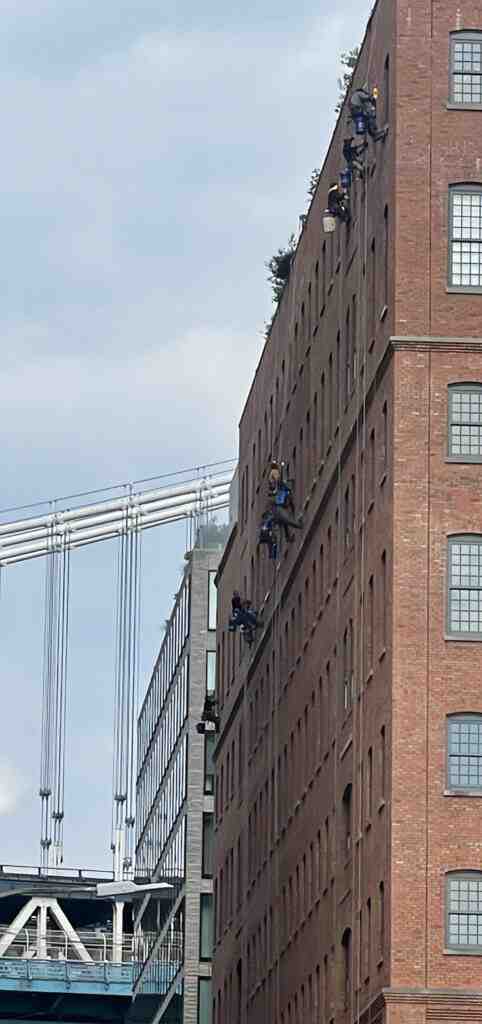
Rope access cleaning is a specialized method where trained technicians use industrial-strength ropes and safety equipment to descend building facades, accessing windows and surfaces that traditional methods struggle to reach. Originating in the offshore oil industry, it has become the gold standard for maintaining the skylines of New York, Long Island, Westchester, and New Jersey.
At its core is a brilliant dual-rope system. A technician is always secured to two independent anchor points on the roof. One rope supports their weight (the working line), while a second provides instant backup safety. This redundancy, combined with rigorous training, makes the method remarkably safe.
How It Works:
- Technicians anchor two independent rope systems to the building’s roof.
- They descend in a controlled manner using specialized devices.
- Minimal equipment is needed—just ropes, harnesses, and cleaning tools.
- Every part of a building can be accessed without scaffolding or lifts.
Key Benefits:
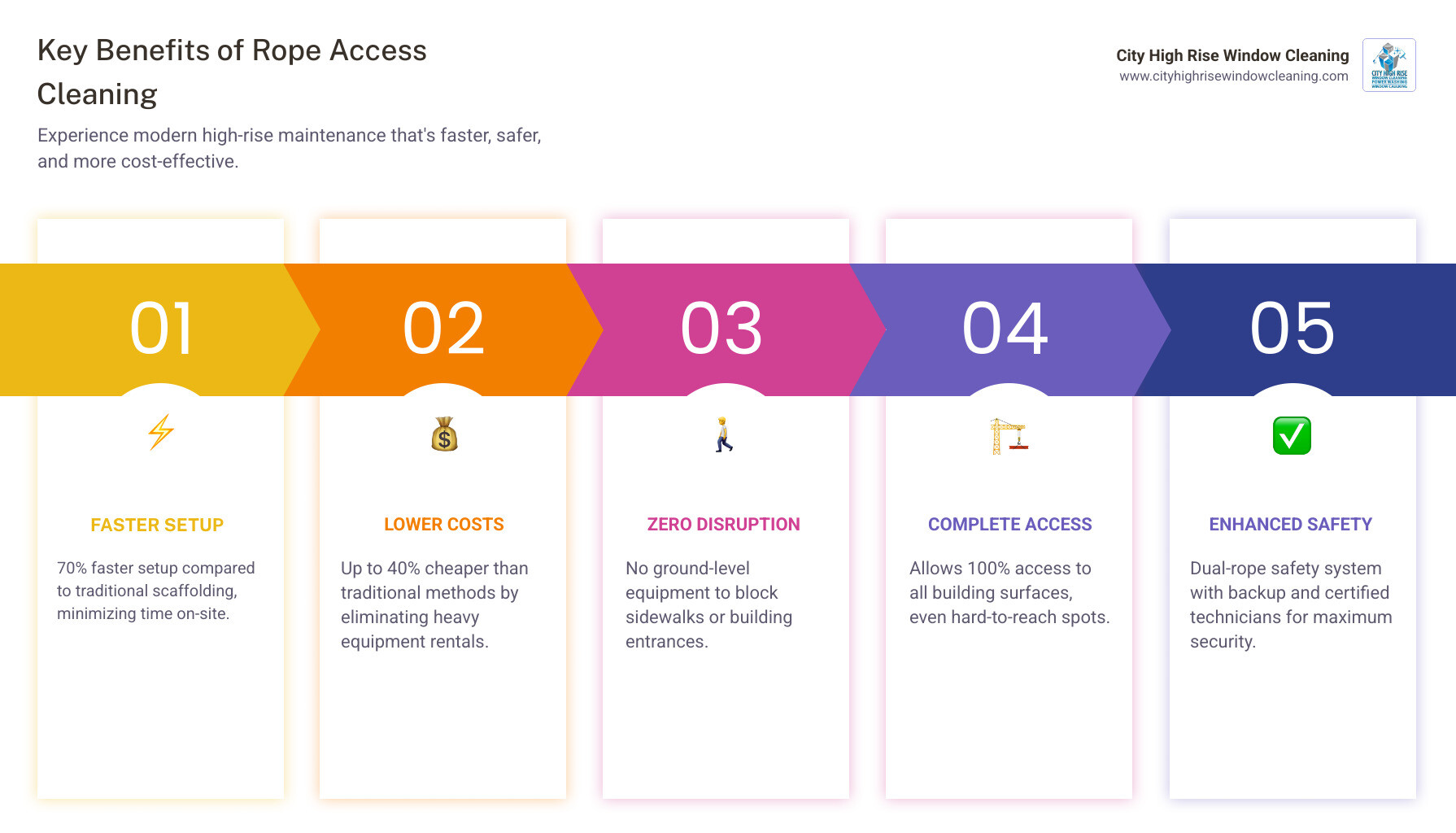
- Faster: Setup takes hours, not weeks.
- Cheaper: No scaffolding rental or heavy machinery costs.
- Safer: Two-rope system with certified technicians.
- Zero Disruption: No ground-level equipment blocking sidewalks or entrances.
- Complete Access: Reaches areas impossible for traditional methods.
The Core Equipment
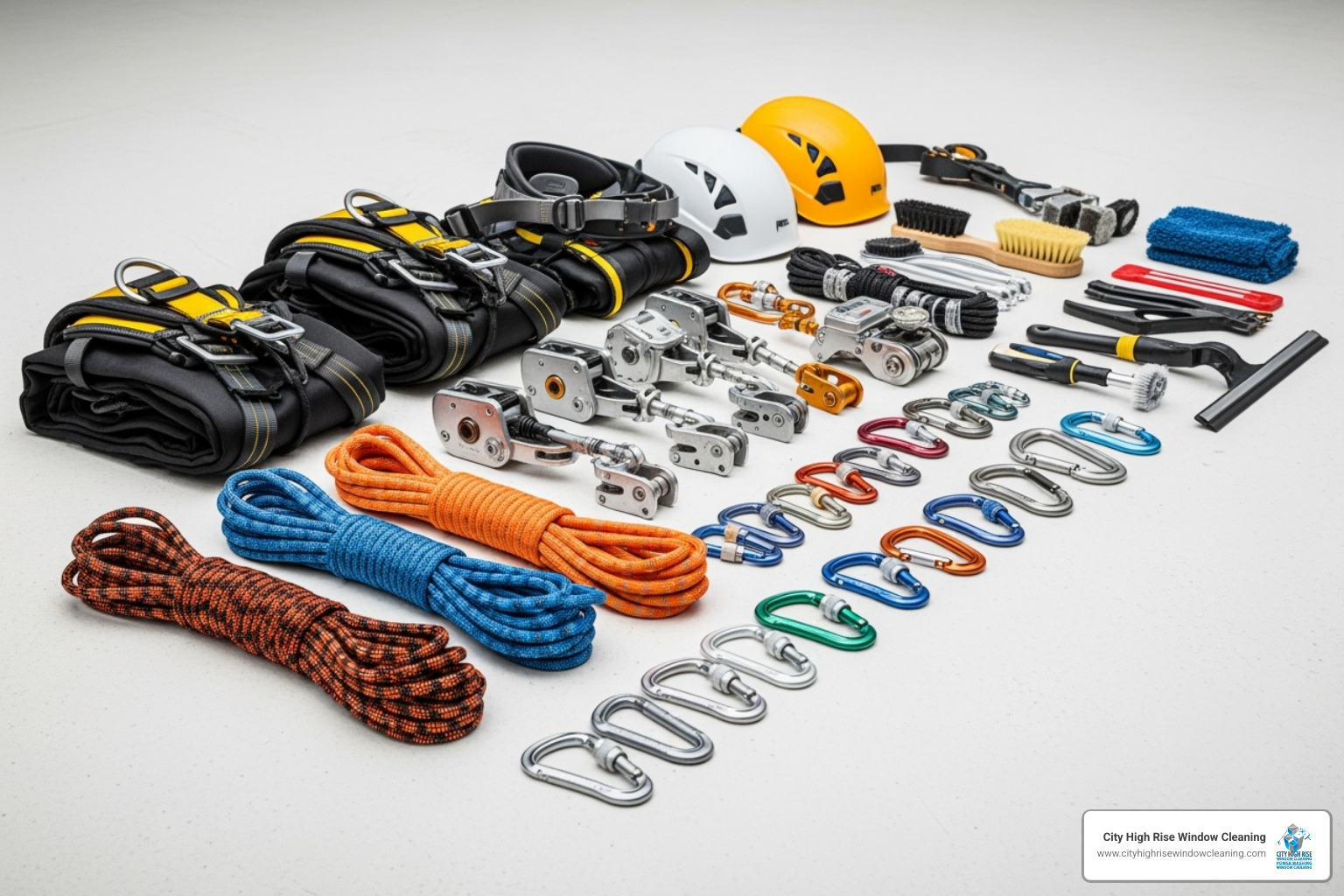
The safety of rope access cleaning hinges on specialized, carefully maintained equipment. Each piece is critical:
- Harnesses: Industrial-grade harnesses designed for comfort during long periods of suspension.
- Helmets: Essential head protection.
- Descenders & Ascenders: Mechanical devices that allow technicians to control their descent and climb ropes.
- Anchor Points: Secure, load-bearing connections on the building’s roof where ropes are attached.
- Ropes: Industrial-grade, low-stretch static ropes designed for strength and durability.
- Cleaning Tools: Squeegees, water-fed poles, or pressure washers, all securely tethered to the technician.
- Carabiners & Connectors: Locking metal links that connect the system’s components.
The Process on a Typical NYC Building
A typical project follows a strict, systematic process:
- Site & Risk Assessment: A project manager evaluates the building’s architecture, anchor points, and potential hazards to create a detailed safety plan.
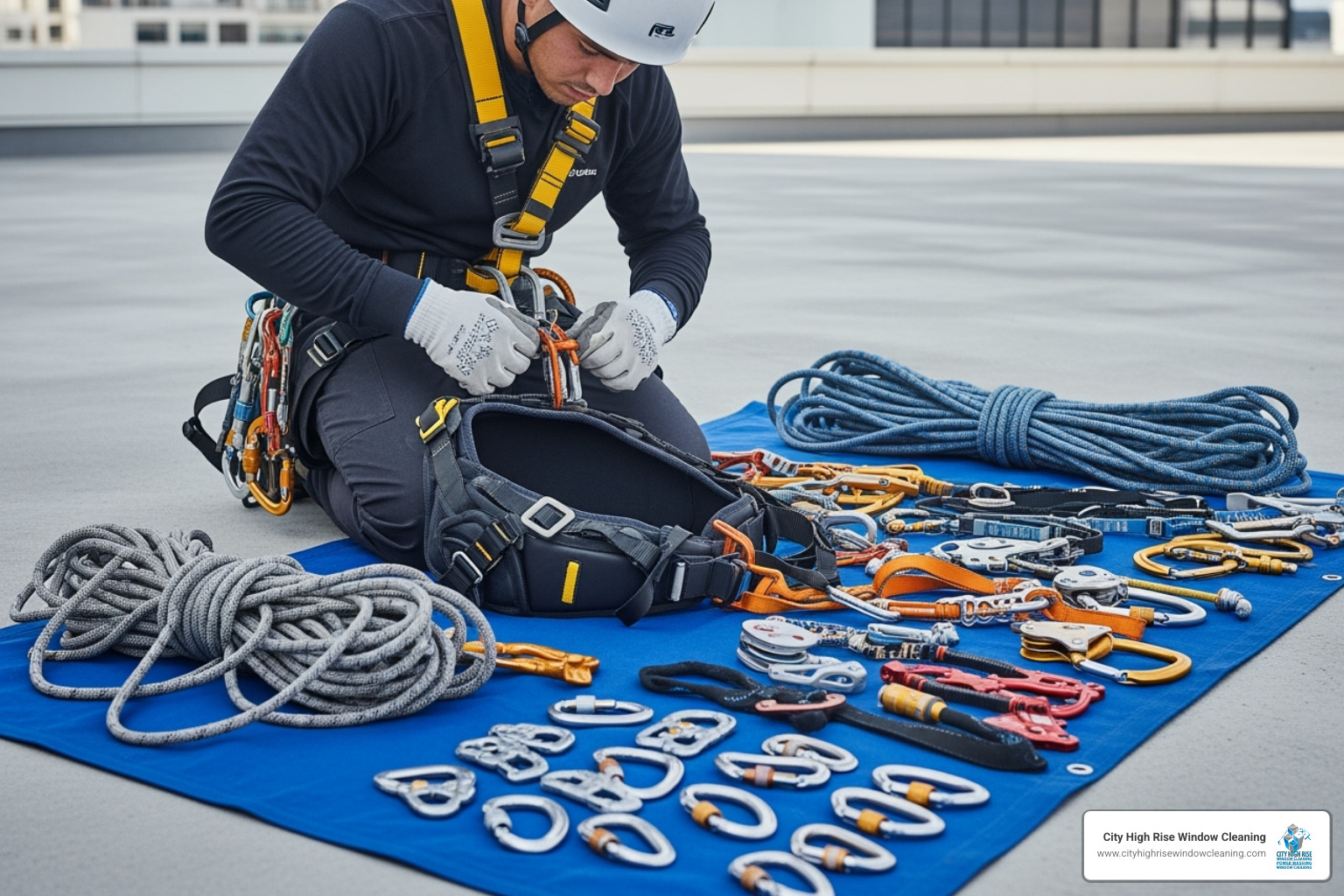
- Rigging: Technicians deploy two independent rope systems from tested anchor points on the roof.
- Controlled Descent & Work: After final checks, technicians descend, using their equipment to stop precisely where needed to perform cleaning or maintenance.
- Methodical Cleaning: Teams work in sections, using professional-grade tools and solutions appropriate for the building’s materials.
- Communication: Technicians on the ropes and ground support stay in constant contact via radios.
- De-rigging: Once work is complete, all equipment is carefully retrieved, leaving the site clean and clear.
This systematic approach ensures superior results with the highest standards of safety and efficiency.
More info about our high rise services
Why Rope Access is the Smart Choice for NYC High-Rise Maintenance
For property owners and managers in Manhattan, Long Island, Westchester, and New Jersey, maintaining a building’s exterior is essential. However, outdated methods like scaffolding and boom lifts are often slow, expensive, and disruptive. Rope access cleaning offers a modern solution that delivers better results faster and for less money.
Cost Savings: Traditional methods involve steep costs for equipment rental, lengthy installation, street permits, and bloated labor hours. With rope access, a small, efficient team rigs up in hours and completes the job in a fraction of the time. This eliminates massive equipment costs and reduces labor, directly benefiting your budget.
Faster Turnaround: A scaffolding project can shut down your building’s exterior for weeks. Rope access teams can often complete the same job in just a few days. This dramatic reduction in project time means your building returns to normal operations quickly, keeping tenants and the public happy.
Access to Hard-to-Reach Spots: New York’s stunning architecture, with its setbacks, overhangs, and intricate details, poses a major challenge for traditional equipment. Scaffolding can’t reach every corner, and boom lifts have maneuverability limits. Rope access technicians can position themselves anywhere on a facade, ensuring a 100% complete clean.
Minimal Disruption: In dense urban areas, ground-level equipment blocks entrances, disrupts retail tenants, and creates public liability. Rope access has virtually no ground-level footprint. Business continues as usual, and pedestrians are unaffected.
Proven Safety: With a dual-rope system and technicians certified to rigorous international standards, rope access cleaning has a safety record that often exceeds traditional methods. It is a highly controlled and predictable work environment.
Eco-Friendly: By relying on human skill instead of diesel-powered machinery, rope access has a minimal carbon footprint. It also allows for the use of pure water systems that reduce water consumption and eliminate chemical runoff.
Commercial High Rise Window Cleaning
Here’s how rope access stacks up against outdated methods:
| Feature | Rope Access Cleaning | Scaffolding/Boom Lifts |
|---|---|---|
| Cost | Significantly Lower | High |
| Setup Time | Hours | Days to Weeks |
| Disruption | Minimal | High |
| Accessibility | 100% | Limited by structure |
| Safety | Very High (Certified) | Moderate to High |
| Flexibility | Excellent | Limited |
The numbers and decades of experience are clear. For properties in the Tri-State area, rope access cleaning is the only choice that makes complete financial and operational sense.
Safety First: Equipment, Training, and NYC Regulations
When working at height in New York, Long Island, Westchester, and New Jersey, safety is the absolute foundation of our work. While it may look daring, professional rope access cleaning has an excellent safety record, often surpassing traditional methods. This is not by chance—it’s the result of redundant safety systems, rigorous training, and strict adherence to regulations.
Our operations are governed by stringent protocols that meet or exceed OSHA guidelines and specific NYC regulations like the Facade Inspection Safety Program (FISP). The cornerstone of this safety is the two-rope system: every technician is attached to a working line and an independent backup safety line at all times.
Hiring a certified and insured team is non-negotiable. It protects our workers, your property, and your liability, ensuring every person on your building is operating at the highest standard of competence.
Essential Training and Qualifications
A rope access technician must have physical aptitude, mental fortitude, and extensive training. The global benchmarks for certification are set by IRATA (Industrial Rope Access Trade Association) and SPRAT (Society of Professional Rope Access Technicians).
These organizations use a three-level certification system:
- Level One (Trainee): Learns fundamental maneuvers and rigging under direct supervision.
- Level Two (Operative): Qualified for more complex rigging and rescue operations.
- Level Three (Supervisor): An expert responsible for the entire team’s safety, capable of advanced rigging, site management, and complex rescues.
This progression ensures that only experienced and proven professionals are responsible for site safety. Skills are kept sharp through mandatory refresher training if techniques haven’t been used for over six months.
Rope Access Equipment and Maintenance
The reliability of rope access cleaning depends on its specialized equipment. We use industrial-grade, low-stretch Kernmantle ropes, which provide excellent strength and control. This type of static rope is essential for precise positioning, unlike dynamic climbing ropes which are designed to stretch.
All gear—from harnesses and helmets to carabiners and descenders—is classified as lifting equipment and falls under strict regulations like OSHA standards and LOLER (Lifting Operations and Lifting Equipment Regulations). This means every single piece of equipment undergoes exhaustive inspections for wear, damage, or corrosion before every use and at regular, documented intervals. Defective equipment is immediately retired. This diligence is not just a best practice; it’s a legal and ethical requirement that ensures the safety of every operation.
Where Rope Access Shines: Applications & Choosing the Right NYC Provider
The versatility of rope access cleaning extends far beyond windows. Our teams use these advanced techniques for a broad spectrum of exterior building maintenance and restoration tasks, including:
- Facade Restoration: Cleaning, repairs, and sealant application to ensure a building’s longevity.
- Building Inspections: Detailed visual inspections of facades and structures, crucial for compliance with NYC’s FISP (Facade Inspection Safety Program).
- General Maintenance: Minor repairs, painting, and pest control access in hard-to-reach areas.
- Post-Construction Cleaning: Thoroughly cleaning new or renovated building exteriors.
Residential High Rise Window Cleaning
Post Construction Cleaning
Buildings & Industries That Benefit Most
Rope access cleaning is the ideal solution for the modern urban landscapes of New York, Long Island, Westchester, and New Jersey. It is the preferred method for:
- Commercial Skyscrapers & Office Towers: Where speed and minimal disruption are critical.
- Residential Towers & Condos: Enhancing property value and resident experience.
- Historic Buildings: A gentle, precise approach for delicate facades.
- Hotels & Hospitals: For quiet work and maintaining a pristine appearance.
- Complex Architecture: Buildings with atriums, sloped glass, or limited ground access.
- Stadiums and Large Venues: For cleaning massive, otherwise inaccessible structures.
High Rise Hot Water Power Washing
How to Choose a Rope Access Company in NYC, Long Island, Westchester & New Jersey
Choosing the right partner is a critical decision. Here’s what to look for to ensure you’re hiring true professionals:
- IRATA/SPRAT Certification: This is non-negotiable. Verify that technicians hold current certifications.
- Safety Record: A reputable company will have an impeccable safety record and be transparent about their protocols.
- Comprehensive Insurance: Ensure they carry full liability insurance to protect your property.
- Experience: Look for a company with a proven track record on buildings similar to yours.
- References: Ask for references from other building managers. A confident company will gladly provide them.
- Knowledge of Local Regulations: The provider must be an expert in local codes, including NYC’s FISP (formerly Local Law 11).
- Transparent Quoting: You should receive a detailed quote that clearly outlines the scope of work, timeline, and costs.
A professional rope access cleaning company sells expertise, safety, and peace of mind.
Frequently Asked Questions about Rope Access Cleaning
Is rope access window cleaning safe?
Yes. When performed by certified professionals, rope access cleaning is remarkably safe. The mandatory two-rope system (a working line and an independent safety line) and rigorous training protocols make it statistically safer than many traditional methods.
How much does rope access cleaning cost in NYC?
While every project is different, rope access cleaning is generally more cost-effective than methods requiring scaffolding or heavy machinery. Savings come from reduced labor hours, no equipment rental fees, and faster project completion.
What certifications should a rope access technician have?
A professional technician must hold a current certification from either IRATA (Industrial Rope Access Trade Association) or SPRAT (Society of Professional Rope Access Technicians). These certifications are tiered (Level 1, 2, 3) to reflect experience and skill.
How often should NYC high-rise windows be cleaned?
To maintain your building’s appearance and prevent damage from pollutants, most high-rises in the NYC area benefit from professional cleaning at least twice a year. Buildings in high-traffic or coastal areas may require quarterly cleaning.
What else can rope access be used for?
Beyond window washing, rope access is ideal for a wide range of exterior services, including facade inspections, sealant replacement, high-rise painting, banner installation, bird proofing, and high-pressure power washing. It provides a safe and efficient way to access any part of a building’s exterior.
{
  \"@context\": \"https://schema.org\",
  \"@type\": \"FAQPage\",
  \"mainEntity\": [{
    \"@type\": \"Question\",
    \"name\": \"Is rope access window cleaning safe?\",
    \"acceptedAnswer\": {
      \"@type\": \"Answer\",
      \"text\": \"Yes. Certified rope access teams use a two-rope system and strict protocols, making it safer than most traditional methods.\"
    }
  },{
    \"@type\": \"Question\",
    \"name\": \"How much does rope access cleaning cost in NYC?\",
    \"acceptedAnswer\": {
      \"@type\": \"Answer\",
      \"text\": \"Usually less than outdated methods—fewer crew, less equipment, faster setup, less disruption.\"
    }
  },{
    \"@type\": \"Question\",
    \"name\": \"What certifications should a rope access technician have?\",
    \"acceptedAnswer\": {
      \"@type\": \"Answer\",
      \"text\": \"IRATA or SPRAT certification (Levels 1–3), plus ongoing training and re-assessment.\"
    }
  },{
    \"@type\": \"Question\",
    \"name\": \"How often should NYC high-rise windows be cleaned?\",
    \"acceptedAnswer\": {
      \"@type": \"Answer\",
      \"text\": \"Most buildings need professional cleaning at least twice a year to prevent damage and keep up appearances.\"
    }
  },{
    \"@type\": \"Question\",
    \"name\": \"What else can rope access be used for?\",
    \"acceptedAnswer\": {
      \"@type\": \"Answer\",
      \"text\": \"Facade restoration, caulking, painting, awning cleaning, inspections, and more.\"
    }
  }]
}
Summary: Why Rope Access Cleaning is NYC’s Best Bet for High-Rise Maintenance
For high-rise exterior maintenance in New York, Long Island, Westchester, and New Jersey, rope access cleaning is the clear choice. It combines skill, precision, and an unwavering commitment to safety to deliver results that are unattainable with outdated approaches.
This method offers superior safety through its redundant two-rope system and rigorous technician certification. It delivers significant cost savings by eliminating expensive, disruptive scaffolding and reducing project timelines from weeks to days. With minimal disruption, your building’s operations can continue without inconveniencing tenants or the public.
From window cleaning to facade restoration, rope access provides the versatility to handle a wide array of maintenance tasks. It protects your investment, improves your building’s appearance, and contributes to its long-term structural health. When choosing a provider, trust only certified professionals to ensure your project is handled with the expertise it deserves.
Exterior High Rise Painting Services
Awning Cleaning
Related: “How Often Should NYC High-Rise Windows Be Cleaned?”
Ready for a free quote? City High Rise Window Cleaning offers 24/7 live consultation. Call 917-749-8342 to speak to a live representative.


